Opinion
Monday Line: Sold votes and a dead-duck democracy
Published
4 years agoon
By
Mega Icon
From a lack of horses, we always saddle dogs, or cows, or even the ugly, scaly-backed alligator (agílíntí ab’ara hòìhòì). We do it every four years in the name of democratic elections. We choose bile as leaders then lament soon after that we are orphaned by the government.
The Arabs tell us that to understand a people, we should acquaint ourselves with their proverbs. As we lament the woes of being Nigerian and try to figure out who to vote for next year between crippling identical candidates, some snakes are providing guides across the north. They come in the form of Hausa proverbs. A friend who speaks the language forwarded them to me last week. One is “Koman lalachewan akuya, ya fi kare daraja (no matter how useless the goat is, it has more value than a dog).” Another is “mushin rago yafi alade da an yanka (a dead ram is better than a slaughtered pig).”
The Bible says that with Jesus at the Golgotha were two gentlemen: one to his right; the other to his left. Between the two, I have heard the question being asked: who was the better thief? You may have to find an answer to that question now if you intend to vote next year to elect a president for Nigeria. Up north, the above Hausa proverbs of goat and dog; of ram and pig have come handy. I am a Muslim, so I have no problem knowing that goat meat is a delicacy in Muslim homes while dog meat is haram. Again, I know that a ram not properly slaughtered may be unclean for consumption but then, it is better than a pig properly slaughtered. That is the graffiti on the political skies of the north. Some candidates attract metaphors of pig and dog; some are goat and ram. Proverbs provide hidden contexts and kicks for actions, positive and negative. In politics, they are the horses on which guns are mounted. Everyone should listen to what the proverbs are saying and to what they will say going forward to the elections.
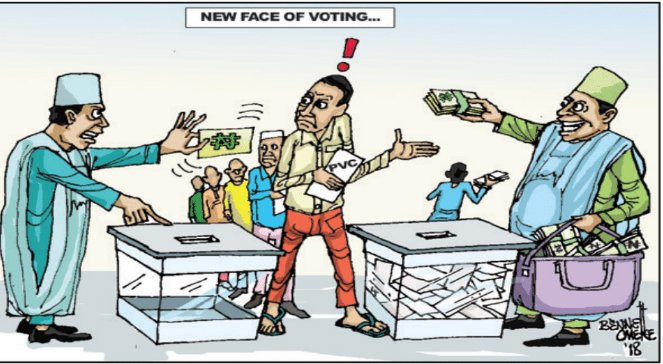
Another cycle is here. While dark imageries of region and religion rule electoral choices in the far north, dirty naira notes thumbprint for the electorate in the south. The Ekiti election has come and gone. For me, the most interesting spectacle there was the man in a viral video who said, with all innocence, that he took N5,000 bribe from a candidate before voting. He insisted he did it for posterity (nítorí ojó iwájú ni) and that the N5,000 was even small. “They were supposed to give us N10,000.” He would use the money to farm, he told his interviewer. He said so with a straight face before a rolling camera. He was not alone but he was the only one ‘stupid’ enough to speak the truth. And payment for votes in that election was not about any particular party. They all did it according to the strength of their muscles. Vote buying poisons our democracy and it is reprehensible. For the voters, what I have for them is not straight condemnation; it is pity. With a very heavy heart, I understand their problem and the harlotry in their decision. Prostitutes sell what they have to have what they lack. Whatever happened in Ekiti on Saturday will happen in Osun State next month (July 16). When people heard that a vote went for as much as ten thousand naira in Ekiti, I could hear expectant palms itching in other states. This house has fallen; it collapsed a while ago. People will collect money and choose their leader; if there are reasons to lament government negligence six months later, let that time come, the reasons will take care of themselves. It is a cycle, vicious and sad.
The Ashanti of the Republic of Ghana say “a good farmer will not cook the seed yam.” The Yoruba of Nigeria counsel their farmer not to eat his yam seeds because next season is just one night away (àmódún kò jìnnà k’éni má hú èbù sun je). But that remonstration is for the farmer who will be alive to see the next harvest. Everyone in Nigeria is sure only of the present. How do we convince very down people without hope not to sell anything within their powers to sell, including their votes? People are hungry and abandoned; they are very unsafe at the same time; none of the poor millions with PVCs is sure of being alive to ‘enjoy’ whatever the new government may bring. Some will be killed by hunger; some others by herdsmen without cows; many more by princely bandits who are beyond the short arms of our law. Those who manage to be alive will become displaced, abandoned citizens. The people are convinced by their circumstances to eat the food of tomorrow in the womb of today. They will sell their votes while they wait for Nigeria to bring whatever affliction it has. If we want democracy to work, we should first take hunger and fear off the menu of the Nigerian voter. Only the living sing the praise of the Lord.
The factors of money, region and religion did their thing in 2015 and 2019 and the result is today’s government of dead ducks and sinking floaters. Governments are like ducks; they exist to protect their flocks from kites and hawks. A duck that is mortally absent and exposes its children to predators is called a lame duck. Can we check what users of the English language mean when they describe a government as lame duck? Could that be what our president has become so soon? Not even the media remembered to ask why President Muhammadu Buhari was not part of the grand finale of his party’s campaign in Ekiti. He was not there; in his stead was Senator Bola Tinubu, the man positioned by APC and its governors to replace Buhari in 345 days’ time. And were we not told that presidential democracy has no space for two presidents at a time? Nigerian politicians are foisting that on us. But that really is not my bother here. My thoughts are on how our conditions are affecting our choices and how our choices are affecting our conditions. My thoughts are also on how helpless Nigerians struggle to live through these very bad times. It is like being boxed in a troubled plane with a pilot that is not there.
On 28 December, 2008, Joe Klein, a columnist with the Time Magazine, published a review of the fading tenure of President George W. Bush whose Republican Party had just lost the presidency to Barack Obama of the opposition Democratic Party. The piece is a full definition of what a duck is supposed to be and what it is when it is lame. I quote Klein verbatim here: “At the end of a presidency of stupefying ineptitude, he (Bush) has become the lamest of all possible ducks… This is a presidency that has wobbled between two poles — overweening arrogance and paralytic incompetence. The latter has held sway these past few months as the economy has crumbled. It is too early to rate the performance of Bush’s economic team, but we have more than enough evidence to say, definitively, that at a moment when there was a vast national need for reassurance, the president himself was a cipher. Yes, he’s a lame duck.” Klein described his president’s “disappearing act” in the very middle of an economic crisis as “a fitting coda to a failed presidency.” His focus and his judgement sound very Nigerian. But I cannot use those words for my president and his government. I do not have the courage to do so. But day and night, I look with anger and sorrow at what we have. I see Nigerians dying for hope. I imagine a mother duck too hobbled and absent that its ducklings become targets for predators. A certain Ken Greenwald would describe this duck as not just lame but worse – a dead duck – “a thing done up, played out, not worth a straw…”
Nigeria is like pepper; you pound it, you grind it, its smarting character remains its defining feature. It devalues people and their prized possessions. It is easy for the elite to condemn voters who sell their votes. English writer and Queen of Romance, Barbara Cartland, said “when we judge other people, it is always by our own standards and that often prevents us from understanding them or giving them the compassion they deserve…that we may denounce a thief, but how can we understand his action if we have never felt the compulsion to steal? And if we have never seen anyone we love hungry, ill and deprived.” How many Nigerians will survive or are surviving these very hard times without cutting corners? Businesses are fainting and dying as diesel goes for N850 per litre – and this at a time when electricity competes with the absence of government in people’s lives. Elected politicians promised to light up lives; they also pledged to power the country as had never been done before. Now, where are they? NEPA may have changed its name a million times, the name-change adds no value to it. Cost of cooking gas is setting fire to homes. Kerosene has long moved away from its friendship with the poor. Every item of survival is beyond the reach of everyone without access to the public till. Yet, there is no route for an escape. Injured hope is wheeled into the temple of the coming polls. The people are doing a count-down for the Buhari regime – 345 days to go. They think the coming election will remark the script of existence for the poor. But they see that 2023 road being narrowed when they hear politicians promise to continue the legacy of this president. You know what that means for the unsafe, the hungry and the jobless? Even if the coming change will bring some progress, the election that will birth it is February next year; this plane has till May 29, 2023 to land. You and I have eleven months, ten days more of grueling turbulence without any reassuring action in the cockpit.
We have had seven years of a hideous game of blames and of “overweening arrogance and paralytic incompetence.” We will have one more year of both, and even more years of the same, if the successor is as wobbled as what we have. And it looks like it. The child of a duck is a floater; snakes always give birth to snakes. I heard Tinubu, the man who wants to lead Nigeria’s two hundred million for the next eight years after Buhari, say something suggestive of business as usual. In his acceptance speech after his nomination, and in a letter to the president this past weekend, he spoke about erecting his structure on Buhari’s foundation and that the country is in trouble today because the PDP, in its 16 years, “depleted our resources and left us with hunger.” Playing the blame game. They all do it. If the PDP wins in February, there is no guarantee that it also won’t mint blame as dividend of people’s investment in its election. It is the system we run – the fault always lies in others. You know what the toad did when it missed its way to the stream? It hopped into the valley of mirage to fetch illusions for its thirsty community. Robert Kiyosaki, author of Rich Dad, Poor Dad said “when people are lame, they love to blame.”
Those are very true words. We will continue to be ruled by excuses and the country ruined by blames. It is the logical harvest from a field of diseased seeds. This democracy is dying – and will die – unless we move fast to give the people back their lives. We cannot win the 21st century race of progress with a team of cross-party cripples. Sadly, that is what our democracy offers and we can all feel it.
Celebrated columnist, Dr. Lasisi Olagunju writes from Ibadan, Oyo State Nigeria
Photo Credit: Punch Newspapers
You may like
Opinion
The Silent Thief in Nigeria’s Petrol Stations | By Solomon Oroge
Published
2 weeks agoon
June 17, 2026• How systemic fraud is draining billions, weakening businesses and threatening the future of the downstream petroleum sector
The Nigerian petroleum retail industry remains one of the most important drivers of economic activity in the country. Every day, millions of litres of petrol, diesel and other petroleum products are sold through thousands of filling stations spread across cities, towns and rural communities.
To many Nigerians, a filling station is simply a place where vehicles are refuelled. To investors and operators, however, it is a complex business environment involving inventory management, transportation logistics, cash handling, procurement processes, technology systems and human resources. When properly managed, petrol retailing can be highly profitable. When poorly controlled, it can become a breeding ground for one of the most dangerous threats to business sustainability – systemic fraud.
Unlike isolated incidents of theft or misconduct, systemic fraud is far more sophisticated and destructive. It is not the work of a single dishonest employee acting alone. Rather, it is a pattern of fraudulent activities that gradually becomes embedded within an organisation’s operational processes and culture. Over time, such practices become normalised, tolerated and, in some cases, deliberately protected by those who benefit from them.
This is what makes systemic fraud particularly dangerous. It often operates quietly beneath the surface while management remains focused on sales growth, market expansion and operational targets. By the time the full extent of the problem becomes apparent, substantial damage may already have been done.
Across Nigeria’s downstream petroleum sector, systemic fraud continues to drain significant resources from businesses every year. Revenue leakages occur through fuel diversion, stock manipulation, sales suppression, procurement abuses, payroll fraud, inventory theft and cash skimming. In many organisations, these activities take place daily, gradually eroding profitability and shareholder value.
One of the most common schemes is fuel diversion during transportation. Products that leave depots in approved quantities may arrive at their destinations with unexplained shortages. Sometimes these losses are disguised as operational variances or transportation-related discrepancies. In reality, they may be the result of organised siphoning carried out during transit.
Another common practice involves pump calibration manipulation. In such situations, customers unknowingly receive less fuel than the quantity displayed on the dispensing pump. While the discrepancy may appear insignificant on a single transaction, the cumulative financial impact can be enormous when repeated hundreds of times daily across multiple stations.
Tank dip manipulation represents another major challenge. Deliberate alteration of stock measurements allows losses to be concealed, making it difficult for management to accurately determine actual inventory positions. Similarly, sales suppression occurs when transactions are intentionally omitted from official records, creating opportunities for revenue diversion and cash theft.
Procurement fraud, inflated maintenance costs, ghost workers on payrolls, fictitious vendors and collusion between employees and suppliers have also become recurring concerns within many petroleum retail operations.
The unfortunate reality is that systemic fraud thrives where governance is weak, accountability is limited and internal controls are either poorly designed or inadequately enforced. High daily cash transactions, large fuel inventories, multiple operating locations and limited real-time supervision further increase exposure to fraud risks.
The warning signs are often visible long before losses become catastrophic.
Persistent cash shortages, unexplained stock variances, delayed banking, repeated customer complaints, inflated procurement costs and declining profitability despite rising sales should immediately attract management attention. Likewise, employees who resist transfers, refuse annual leave, display unusual secrecy or maintain lifestyles far above their legitimate income levels may warrant closer scrutiny.
Many organisations make the mistake of assessing fraud only from the perspective of direct financial losses.
However, the true cost extends much further.
Systemic fraud distorts management information and weakens decision-making. It undermines operational efficiency, damages corporate reputation, attracts regulatory sanctions and erodes customer confidence. Investors become wary, employees lose morale and businesses struggle to achieve sustainable growth.
Perhaps most damaging is the fact that fraud weakens trust—the single most important asset any organisation possesses. Once trust is compromised, rebuilding it becomes both difficult and expensive.
Addressing this challenge requires a shift from fraud detection to fraud prevention.
The most successful organisations understand that preventing fraud is significantly less costly than investigating fraud after it has occurred. Prevention begins with strong corporate governance, ethical leadership and a clear commitment to accountability at every level of the organisation.
Technology has also become an indispensable ally in the fight against fraud.
Automated tank monitoring systems, CCTV surveillance, GPS tanker tracking, integrated enterprise resource planning systems and data analytics tools provide organisations with greater visibility over operational activities and help identify unusual patterns before they escalate into major losses.
Yet technology alone cannot solve the problem.
Organisations must also invest in people, processes and culture. Employees should receive regular ethics training.
Whistleblower mechanisms must be strengthened and protected.
Responsibilities should be properly segregated and surprise verification exercises should become part of routine operational oversight.
In this regard, Internal Audit has a strategic role to play.
Modern Internal Audit functions must evolve beyond traditional compliance checks and become proactive partners in fraud risk management. Through fraud risk assessments, data analytics, control testing, fraud mapping and unannounced verification exercises, Internal Audit can provide independent assurance that critical controls are operating effectively and that emerging fraud risks are identified before they become crises.
To strengthen organisational resilience against systemic fraud, the Sedabuk Fraud Risk Management Model (SFRMM) was developed as a practical framework for fraud prevention, detection, investigation and sustainable risk management within petroleum retail operations.
The model is built around seven strategic pillars: Surveillance, Fraud Risk Assessment, Robust Internal Controls, Monitoring and Data Analytics, Management Accountability, Detection and Investigation, and Ethical Culture and Employee Engagement. Together, these pillars create a continuous cycle of identifying risks, implementing controls, monitoring activities, detecting anomalies, conducting investigations and driving continuous improvement.
The message for operators in Nigeria’s downstream petroleum sector is simple but urgent: the greatest threat to profitability may not be competition, inflation or market volatility. It may well be the silent leakage of resources occurring within their own operations.
As the industry continues to evolve under ongoing reforms and changing regulatory expectations, organisations must recognise that sustainable profitability is achieved not merely by increasing sales but by protecting every litre of fuel, every naira of revenue, every operational process and every stakeholder’s trust.
Companies that embrace ethical leadership, strong governance, proactive Internal Audit, technology-enabled monitoring and a zero-tolerance culture towards fraud will not only reduce losses but also strengthen stakeholder confidence, improve operational efficiency and position themselves for long-term success.
Dr. Solomon Oroge, PhD, is an accomplished professional in Internal Audit, Risk Management, Corporate Governance, Compliance and Fraud Risk Management with extensive experience in Nigeria’s downstream petroleum industry.
He is the developer of the Sedabuk Fraud Risk Management Model (SFRMM), a proprietary framework designed to help petroleum retail organisations proactively identify, prevent, detect and manage systemic fraud risks.
Oroge can be reached via the following contact details: saoprofessional@gmail.com or +234 806 512 6192.
Opinion
State Police, Local Government Autonomy: Answers to Nigeria’s Lingering Questions | By Titilope Gbadamosi
Published
2 weeks agoon
June 12, 2026Almost every democratically elected administration in Nigeria has had to grapple with pockets of insecurity in one form or another. Nigerians have watched uprisings metamorphose into banditry and terrorism, as though every administration had its own uniquely tailored brand of insecurity, defined by the modus operandi of these vicious elements.
The faces change, the methods change, but the burden on whoever occupies the highest office in the land has remained heavy and constant.
Just two administrations ago, during President Goodluck Jonathan’s tenure, we witnessed the horror of the abduction of the Chibok girls and explosives going off in public spaces in Abuja, the nation’s capital. Every well meaning Nigerian was worried, and nowhere felt truly safe. The President’s seat was not the most desirable at the time, and it was clearly a difficult job.
President Muhammadu Buhari’s administration had its own share, mostly in the form of clashes between farmers and herders, driven by grazing routes lost to farming, droughts pushing herders toward greener pastures, and old accommodations between communities slowly breaking down.
I recall quite vividly, while serving as Special Assistant to the former Governor of Oyo State, the late Senator Abiola Ajimobi, joining the head of our team in several peace talks with farmers, traditional rulers, and the Hausa and Fulani community in the state. One lesson from those rooms has stayed with me ever since. The people who understood the grievances, the terrain, and the actors were all local, yet the command of security sat far away in Abuja. That gap is the question every administration has struggled to answer.
Today, President Bola Ahmed Tinubu is in charge, and Nigerians who are students of history watched to see what shape insecurity would take and, more importantly, what this President would do differently. In recent development, the country received an answer that previous decades only debated.
On June 11, following the President’s formal request to the National Assembly to restructure our security architecture, the House of Representatives passed the constitutional amendment to establish state police, with 289 members voting in support and barely a voice against, while the Senate works to complete passage before year end. Today June 12th,2026, in his Democracy Day address, the President spoke plainly: the insecurity we face is partly the product of collapsed grassroots governance, and his administration remains committed to financial autonomy for our 774 local government councils. There it is, a two pronged solution: state police and true local government autonomy.
The first prong closes the gap I saw in those Oyo State peace talks. The amendment to Section 214 of the Constitution creates a dual policing structure under which each state may establish its own force. Security decisions will now be taken by those who know the terrain, the actors, and the grievances at first hand.
To his credit, the President did not merely champion the idea; he asked the National Assembly to institute controls to prevent abuses, the mark of a leader interested in a reform that endures rather than one that backfires. All of this rides on the largest security investment in our history, a 5.41 trillion naira commitment in the 2026 budget and over 50,000 new police officers approved for recruitment.
The second prong puts resources where the new responsibility will live. Since the Supreme Court ruled in July 2024 that federation allocations belonging to local governments must reach them directly, monthly allocations to the 774 councils have grown from roughly 387 billion naira in March 2025 to nearly 530 billion naira by September 2025. The money has never been the problem; control of it was. By pressing autonomy to its conclusion, this administration is returning both funds and accountability to the communities where insecurity actually begins, so that the grassroots governance whose collapse the President identified can finally be rebuilt.
So who wins in all of these? Nigerians win, because security decisions and development funds will finally live where the people live. Governors win the powers they have long demanded, and with them the responsibility they can no longer pass to Abuja. And the country wins a President willing to attempt what others only discussed. The President reminded us on Democracy Day that Nigerians bend and bleed but do not break. With these two reforms, we may finally stop having to prove it so often.
Dr. Titilope Gbadamosi is the Special Assistant on Youth Initiatives (Monitoring and Delivery) to President Bola Ahmed Tinubu.
Opinion
Nigeria’s Insecurity: Why the System Rewards Reaction, Not Prevention
Published
3 weeks agoon
June 6, 2026The most foolish person in a burning house is not the one who cannot find the exit. It is the one who knew the house would burn, watched it happen, and only ran when the ceiling collapsed. That is Nigeria’s governance posture toward insecurity—a pattern so consistent that it has become normalized.
“Ikú tó pa ojúgbà ẹni, òwe ló fi pa. (The death that kills your neighbour is a proverb directed at you).
The bandits did not simply arrive. They sent warnings ahead of them through a trail of violence that crossed state lines and appeared in every massacre headline we filed away as someone else’s problem.
When Insecurity Was Still “Someone Else’s Problem”
When the North was burning and the Middle Belt bleeding, the South West treated it as distant noise. Kwara became the first warning sign—the bridge between North and South—slowly slipping under the shadow of insurgency. The question every serious observer should have asked was simple: what happens when it crosses the border?
South West governors issued statements—careful, brief, and reactive. None moved with the urgency the threat demanded. Before long, violence arrived at our doorstep: herder brutality in Oke-Ogun, attacks in Oyo and Ekiti, kidnappings along the Ibadan–Ijebu-Ode expressway, and forest camps emerging in Ondo.
The warning signs had matured into reality, yet we were still searching for an exit strategy that should have been built years earlier.
The Problem: We Only Count the Dead
In safety performance management, there is a critical distinction between lagging indicators—outcomes after failure (deaths, destruction, losses)—and leading indicators, which measure prevention before failure occurs.
Aviation, oil and gas, and other high-risk industries understand this clearly: a system that obsesses over lagging indicators will always arrive after the accident.
Nigeria’s security governance is built almost entirely on lagging indicators. We count attacks after they happen. We rebuild after a collapse. We mourn after preventable deaths.
We rarely ask:
How many attacks were prevented this quarter?
How many threats were neutralized before execution?
How many cells were dismantled at the planning stage?
We do not know the answers—because we are not measuring them. The system was never designed to prevent. It was designed to respond: loudly, visibly, expensively, and always too late.
Another Base. The Same Question Nobody Asks
The presidency is reportedly considering a military base in Oriire Local Government Area of Oyo state. It is a familiar pattern: a major security incident, public outrage, and an institutional response designed to signal seriousness.
But the critical question remains unanswered: what has been the leading-indicator performance of existing bases?
How have long-standing military formations in places like Jos, Benue, and Zamfara—some active for over two decades—actually shifted the security outcome?
A military base without actionable intelligence is a stationary slaughter ground for soldiers. It does not prevent attacks; it often becomes a reactive outpost in a repeating cycle: attack, deployment, statement, investigation, and then silence—while underlying threat networks remain intact.
The Incentive Structure Behind the Chaos
The deeper issue is not the capability of security forces. It is the incentive structure of the system.
When leadership is judged only by incidents that have already occurred, governance shifts from prevention to performance management of failure. The objective becomes managing optics, not reducing probability.
Nigeria’s security budget has grown significantly over the past decade, yet insecurity has worsened. Kidnappings have become more brazen. Why? Because funding is justified by the persistence of the crisis, not its resolution.
If the problem is solved, what justifies the next budget cycle?
For years, decentralization has been proposed as the structural reform that could change the system—but it remains trapped in political rhetoric. Why? Because decentralization disperses power, and power in Nigeria’s political economy is not dispersed. It is concentrated.
Sixteen Days. Full Stop.
Forty-six children and teachers were kidnapped in Oriire. It reportedly took sixteen days for the presidency to authorize a specialized rescue framework.
Sixteen days before the Commander-in-Chief treated the abduction of forty-six human beings as a crisis requiring formal executive activation.
But responsibility in moments like this is not singular.
The Oyo State Governor, by constitutional convention regarded as the Chief Security Officer of the state and a recipient of security votes, also occupies a central coordinating role in the security architecture of the state. Within a crisis of this scale, expectations of rapid intergovernmental coordination, visible command urgency, and sustained pressure on federal response mechanisms are not optional, hey are inherent to the office.
Yet, the response cycle, from abduction to high-level coordinated action and physical engagement with affected communities, unfolded at a pace that raised legitimate public concern about the speed and intensity of institutional reaction.
By the time visible field visits and coordinated engagements occurred, the delay had already become part of the public record of the crisis itself—shaping perception as much as the incident shaped fear on the ground.
In a functional security system, crisis response is measured in hours, not days. Not for symbolism, but because time directly affects outcomes: every passing hour in an active kidnapping reduces the probability of safe recovery and increases the leverage of perpetrators.
Sixteen days, therefore, is not merely a lapse in timing. It reflects a deeper structural problem—where urgency is often declared after pressure builds, rather than operationalized when intelligence first breaks.
And in that gap between incident and action, citizens are left to absorb the consequences of delayed coordination across all tiers of authority.
The Verdict
Nigeria does not primarily need more military bases. It needs a new security measurement architecture—one that prioritizes intelligence conversion rates, early-warning response times, and pre-emptive disruption metrics over post-incident operations.
Every threat must be treated as time-sensitive, where minutes and hours determine outcomes—not weeks and statements.
Most importantly, citizens must shift the accountability question:
Not only “why did the attack happen?”
But “why was it not prevented?”
Nigeria’s security challenge is ultimately a leadership and systems failure—an institutional preference for reaction over prevention, because prevention is politically invisible.
You cannot hold a press conference about the attack that never happened.
Until this reality is named and confronted with precision, the cycle will continue.
Advertisement
Entertainment
Nigeria must be a place where children can dream without fear — Sean Dampte
Adekunle Gold, Simi welcome twins
Ayefele drops new album, Reflections
Reggae Legend, Jimmy Cliff, Dies At 81
Photos: Davido blows $3.7m on lavish Miami white wedding for Chioma
FAAN probes K1 for spilling alcohol on airport officer during boarding
MegaIcon Magazine Facebook Page
MEGAICON TV
Advertisement
Trending
-
News7 days agoKola Oyewo’s family to Adeleke, Ooni, Atiku: Your condolences are our pillar of strength
-
Politics1 week agoOyo APC rejects Makinde’s planned December LG poll, vows boycott
-
News1 week agoGovs Back State Police, Power Reform, Nutrition Drive, World Bank Partnership
-
News1 week agoIGP appoints Iniedu Force spokesman, replaces Placid