Opinion
Magu, maggots and Maga dogs | By Festus Adedayo
Published
6 years agoon
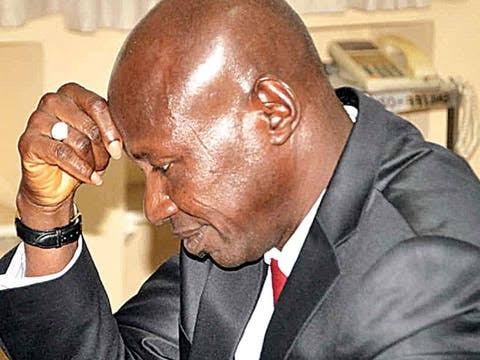
Again, the system felled Ibrahim Magu, Acting Chairman of the Economic and Financial Crimes Commission (EFCC) last week. It had always done that. Olusegun Obasanjo, the maiden president at inception of Nigeria’s fourth republic, first erected the crucifixion upon which a crime-fighting czar was hung. While employing the old Yoruba verbal denunciation of thieves by way of pouting lips, clapping both hands repeatedly, literally poking hands into the face of the accused and shouting Ole! Ole! E ki’gbe ole, ole!, Obasanjo did all that against former Inspector General of Police, Tafa Balogun in January, 2005.
He did more: Obasanjo asked Balogun to immediately tender his letter of resignation, on account of huge theft of public money traced to him. The dossier lay threateningly on the table before Obasanjo that morning inside the Aso Rock Villa. As narrated by Nuhu Ribadu, first EFCC’s Chairman’s biographer, Prof Wale Adebanwi in his A Paradise for Maggots, Balogun went on all fours as a tribal symbolic solicitation to Obasanjo to, in my words, kill me at home and not kill me abroad, whose Yoruba translation was, pa mi si’le, ma pa mi si’ta. A total sum of N2.7 billion in five different banks and jaw-dropping number of choice properties had been traced to the police chief whose mantra for combating crime was Operation Fire for Fire.
Three people were at that meeting: Obasanjo, his Chief of Staff, Abdullahi Mohammed and Balogun himself. Mohammed had earlier summoned Balogun, on behalf of the President. The three of them, being and having affinity with the Yoruba nation (Mohammed hailed from Ilorin, Kwara State), could connect with Balogun’s symbol-baiting prostration. Here was the bodily hefty, giant-in-position Nigeria’s Inspector General of Police in total surrender to his accuser. Tafa Balogun was not only prostrate, in that prostrating position, he was pliant, literally castrated of his manhood and was in subdued acceptance of his guilt.
Balogun was to be dragged by the EFCC to court a few weeks later. He had been handcuffed and even dragged on the floor by young police officers who probably had not stopped sucking their mothers’ teats when he joined the police force. Then Chief Superintendent of Police, Ibrahim Magu, one of the EFCC operatives under Ribadu, led that operation that saw a huge crime czar like Balogun falling with a deafening thud like a common felon.
Thoroughly defoliated of his manhood in the public by Magu and his boys, Balogun had reportedly pleaded with them that, “I can change your lives, please. Let me settle you and let’s settle this. I can make you rich for life.”
Within the period he held the brunt of power, Ribadu oscillated in the air like a pestilence to a commune of Nigerian fraudsters and corrupt Politically-Exposed Persons (PEPs) who were mutating in the air like a ravaging virus.
Aside allegations against him that he was Obasanjo’s poo-poo bowl carrier, Ribadu succeeded in instilling fears into the hearts of Nigerian malefactors clothed in the euphemism of political office holders. His rout of criminals was so celebrated that late literary giant, Chinua Achebe, in lauding the clinical way he fought crime and criminals, compared him to Eliot Ness.
Ness was an American crime-bursting legend of the 1930s renowned for bringing down the Al Capone gang in Chicago, Illinois. His law enforcement team, a 1,000-strong group called Bureau of Prohibition, was nicknamed The Untouchables. When the system was to chop Ribadu off, it made mincemeat of him and flushed the Adamawa-born crime-buster down the cistern like a common felon.
In quick successions, Farida Waziri and Ibrahim Lamorde came, appointed into office by Presidents Umaru Musa Yar’Adua and Goodluck Ebele Jonathan. They also made noise and got some criminals to scamper off their felonies. However, not long after, they became the proverbial Maga dogs, biting the systemic hands that recruited and fed them, thereby getting drenched in the sewage waters that seemed to have been reserved for Nigerian crime-busting chiefs. So, why did the four EFCC czars come into office with so much hope, so much adulations, expectations, vapory glories, but ended up being drenched in a haze of ignominy?
Is there a latent systemic error that will always ensure that the after-office graveyards of these crime lords must be garlanded with stench and shame?
As against what its minders are making us to believe, it is a huge minus to the Muhammadu Buhari government that Magu is being tried now. It is either the government has no mind of its own and was amenable to being swept right, left and center by the currents of some individuals’ whims and caprices, or that it is seriously implicated in the politics of crime-fighting, the ocean of which is alleged to have drowned Magu. This is because, in the cache of allegations said to have been leveled against the ex-EFCC boss, there is a rehash of same allegations which the DSS, about five years ago, saw as reasons why Magu’s nomination should not be upheld by the Nigerian senate.
Throughout the years spent by Magu as EFCC chair, those who understood the workings of the mind of the Buhari government claimed that he was an insider-outsider therein. This meant that though Magu was of the government, he was not for them. If he was for them, his confirmation as EFCC chair shouldn’t have lingered as embarrassingly as it did, like the cry of a wife who clandestinely murdered her hubby. There is the claim that he was of the Bola Tinubu/Yemi Osinbajo rump of the current power calculus. This then must explain why it was easy for those who cooked the slur on the Vice President’s name, using alleged proceedings of Magu’s interrogation, to reinforce the believability of their claim.
The truth is, there are far weightier allegations against Buhari government functionaries hanging in the public domain than those leveled against Magu. For instance, owning property in Dubai, UAE is alleged to be one of Magu’s errs. However, it is common knowledge that the UAE remains a haven where corruptly acquired wealth is laundered for the Nigerian political elite and owning eye-popping property in this Arab country is the rule, rather than the exception. No wonder cyber-heist kingpins like Hushpuppi and Woodberry found a comforting nest there. A minister in Buhari’s government was recently accused of owning humongous mansions in Abuja. His riposte was that he acquired them as a teacher.
The Attorney General of the Federation, the one who must be popping champagne for having seen the back of Magu, also has a mountain load of his own allegations trailing him like recalcitrant flies envelope oozing stench. There is no doubt that illicit financial outflows from Nigeria daily trickle out of PEPs’ conduits and pipes.
The Chief of Army Staff, Lt. Gen. Tukur Buratai was, not long ago, enmeshed in an asset declaration scandal pronged on allegation of ownership of property in Dubai. In his reply, he claimed that the property belonged to his unstated family and that the family made these investments in this Middle East city in 2013, long before his appointment. No further questions were asked. No further investigations needed to be carried out. As far as Nigeria and government were concerned, Buratai’s answers were QED.
Matthew Page, in a Carnegie Endowment for International Peace page, had made a damning condemnation of this capricious craving of Nigeria’s political elite. “For Nigeria’s corrupt political elites, Dubai is the perfect place to stash their ill-gotten gains and enjoy luxury real estate worth millions. But unless authorities stop turning a blind eye, the long-term costs to Nigeria’s economy and Dubai’s reputation could be high,” he had written.
If the truth be told, Magu was an accident waiting to happen on the Nigerian crime-fighting system. So also were his predecessors.
This is because, an office which is that consequential is subjected to inconsequential indices of operations which cannot but render its occupants dead on arrival. What procedure, process or rules guide the appointment of EFCC czars? In other words, how do they emerge? Are they chosen on account of moral gallantry, their ethnicity, man-knows-man procedure or mere seniority? How many times did past occupiers of that office, before and after coming on board, demonstrate ability to look at enticing lures in the face and tell them to go jump inside the River Niger? Elliot Ness, who Achebe compared Ribadu to, in 1931, had a member of the Al Capone gang bait with two $1,000 notes (about $17,000) if he turned a blind eye to the group’s illegal merchandizing. He refused and even though he died penurious at age 54, Ness’ heroic reputation is legendary in America.
Is there a crime-fighting institution or architecture in Nigeria? The answer is no. Our measurement of their suitability is the candidate’s ethnic affiliation, the person who introduces them and their loyalty to the occupier of authority seat. To expect a thorough-bred czar to come out of such a nebulous system is hypocrisy of the highest order.
The story is told of how Obasanjo picked Dora Akunyili without any bother about her ethnicity but a buzz that she had demonstrated an unusual moral courage alien to this clime while working with the Petroleum Trust Fund (PTF) as pharmacist. When she eventually came on board at NAFDAC, she merely rehashed what was her internal constitution. In serious climes, anyone who is to be appointed into an office as critical as the EFCC, who would naturally confront billions of Naira in kickbacks and illicit perks of office must have been psychologically grilled before society can arrive at their suitability. In Nigeria, politicians, who know the criminal functionality of having their Man Fridays occupy such positions, fight tooth and nail to have them in office.
Again, are we being fair to appoint a policeman with no pedigree of snubbing ill-gotten wealth, whose salary is a paltry few thousands of Naira, to superintend over a potential illicit wealth empire like the EFCC? The Carnegie Endowment said PEPs – “individuals who are or have been entrusted with a prominent public function” like Magu and the likes, “are at higher risk of involvement in unlawful activity due to their positions of influence and access to assets.” In fact, it states that, as at 2016, the Center for Advanced Defense Studies (now known as C4ADS) “acquired the data of a private database of Dubai real estate information (dubbed the ‘Sandcastles’ data) and that, at a conservative estimate, “at least 800 properties were found to have links to Nigerian PEPs or their family members, associates, and suspected proxies.”
So why are we crying wolf now when we exposed a police officer whose take-home is less than a million naira to assets in multiple of billion naira worth?
In a Nigeria that is brimming with street mindsets of fraudulently acquired wealth, of filthy wealthy men and women who crawl in a cesspit like maggots, are we sincere to think we would always have men/women who will kick against what has become normal among us? Are we seriously looking for a clean EFCC chairman in this dirty clime? Those are the honest questions we must ask ourselves. If we now seek a person who is unlike the filth associated with us, should we just pick them peremptorily like they pick a fallen mango off the tree?
This is why, if we think that, with Muhammed Umar as replacement for Magu, or even any substantive name brought up eventually, the maladies in the EFCC would stop, we are fooling ourselves and are on a Pyrrhic victory binge. This is because, no institution of consequence is so forged in saner clime.
By the way, I read that Magu is bitterly complaining that his tormentors-in-chief had treated him with rank ignominy, like a common criminal, inside the Force Criminal Investigation and Intelligence (FCIID) dungeon where he is said to be currently held. Oh, right? How did he, as CSP who led the assault operation against Tafa Balogun, treat the then Inspector General of Police? Wickedness is like the story in the Myth of Sisyphus, a 1942 essay by the Algerian-French philosopher, Albert Camus. While Sisyphus pushes the boulder down the mountain, he goes back again and does the same thing, till the end of time. Good is the only thing that can break the jinx.
You may like
Opinion
The Silent Thief in Nigeria’s Petrol Stations | By Solomon Oroge
Published
5 days agoon
June 17, 2026• How systemic fraud is draining billions, weakening businesses and threatening the future of the downstream petroleum sector
The Nigerian petroleum retail industry remains one of the most important drivers of economic activity in the country. Every day, millions of litres of petrol, diesel and other petroleum products are sold through thousands of filling stations spread across cities, towns and rural communities.
To many Nigerians, a filling station is simply a place where vehicles are refuelled. To investors and operators, however, it is a complex business environment involving inventory management, transportation logistics, cash handling, procurement processes, technology systems and human resources. When properly managed, petrol retailing can be highly profitable. When poorly controlled, it can become a breeding ground for one of the most dangerous threats to business sustainability – systemic fraud.
Unlike isolated incidents of theft or misconduct, systemic fraud is far more sophisticated and destructive. It is not the work of a single dishonest employee acting alone. Rather, it is a pattern of fraudulent activities that gradually becomes embedded within an organisation’s operational processes and culture. Over time, such practices become normalised, tolerated and, in some cases, deliberately protected by those who benefit from them.
This is what makes systemic fraud particularly dangerous. It often operates quietly beneath the surface while management remains focused on sales growth, market expansion and operational targets. By the time the full extent of the problem becomes apparent, substantial damage may already have been done.
Across Nigeria’s downstream petroleum sector, systemic fraud continues to drain significant resources from businesses every year. Revenue leakages occur through fuel diversion, stock manipulation, sales suppression, procurement abuses, payroll fraud, inventory theft and cash skimming. In many organisations, these activities take place daily, gradually eroding profitability and shareholder value.
One of the most common schemes is fuel diversion during transportation. Products that leave depots in approved quantities may arrive at their destinations with unexplained shortages. Sometimes these losses are disguised as operational variances or transportation-related discrepancies. In reality, they may be the result of organised siphoning carried out during transit.
Another common practice involves pump calibration manipulation. In such situations, customers unknowingly receive less fuel than the quantity displayed on the dispensing pump. While the discrepancy may appear insignificant on a single transaction, the cumulative financial impact can be enormous when repeated hundreds of times daily across multiple stations.
Tank dip manipulation represents another major challenge. Deliberate alteration of stock measurements allows losses to be concealed, making it difficult for management to accurately determine actual inventory positions. Similarly, sales suppression occurs when transactions are intentionally omitted from official records, creating opportunities for revenue diversion and cash theft.
Procurement fraud, inflated maintenance costs, ghost workers on payrolls, fictitious vendors and collusion between employees and suppliers have also become recurring concerns within many petroleum retail operations.
The unfortunate reality is that systemic fraud thrives where governance is weak, accountability is limited and internal controls are either poorly designed or inadequately enforced. High daily cash transactions, large fuel inventories, multiple operating locations and limited real-time supervision further increase exposure to fraud risks.
The warning signs are often visible long before losses become catastrophic.
Persistent cash shortages, unexplained stock variances, delayed banking, repeated customer complaints, inflated procurement costs and declining profitability despite rising sales should immediately attract management attention. Likewise, employees who resist transfers, refuse annual leave, display unusual secrecy or maintain lifestyles far above their legitimate income levels may warrant closer scrutiny.
Many organisations make the mistake of assessing fraud only from the perspective of direct financial losses.
However, the true cost extends much further.
Systemic fraud distorts management information and weakens decision-making. It undermines operational efficiency, damages corporate reputation, attracts regulatory sanctions and erodes customer confidence. Investors become wary, employees lose morale and businesses struggle to achieve sustainable growth.
Perhaps most damaging is the fact that fraud weakens trust—the single most important asset any organisation possesses. Once trust is compromised, rebuilding it becomes both difficult and expensive.
Addressing this challenge requires a shift from fraud detection to fraud prevention.
The most successful organisations understand that preventing fraud is significantly less costly than investigating fraud after it has occurred. Prevention begins with strong corporate governance, ethical leadership and a clear commitment to accountability at every level of the organisation.
Technology has also become an indispensable ally in the fight against fraud.
Automated tank monitoring systems, CCTV surveillance, GPS tanker tracking, integrated enterprise resource planning systems and data analytics tools provide organisations with greater visibility over operational activities and help identify unusual patterns before they escalate into major losses.
Yet technology alone cannot solve the problem.
Organisations must also invest in people, processes and culture. Employees should receive regular ethics training.
Whistleblower mechanisms must be strengthened and protected.
Responsibilities should be properly segregated and surprise verification exercises should become part of routine operational oversight.
In this regard, Internal Audit has a strategic role to play.
Modern Internal Audit functions must evolve beyond traditional compliance checks and become proactive partners in fraud risk management. Through fraud risk assessments, data analytics, control testing, fraud mapping and unannounced verification exercises, Internal Audit can provide independent assurance that critical controls are operating effectively and that emerging fraud risks are identified before they become crises.
To strengthen organisational resilience against systemic fraud, the Sedabuk Fraud Risk Management Model (SFRMM) was developed as a practical framework for fraud prevention, detection, investigation and sustainable risk management within petroleum retail operations.
The model is built around seven strategic pillars: Surveillance, Fraud Risk Assessment, Robust Internal Controls, Monitoring and Data Analytics, Management Accountability, Detection and Investigation, and Ethical Culture and Employee Engagement. Together, these pillars create a continuous cycle of identifying risks, implementing controls, monitoring activities, detecting anomalies, conducting investigations and driving continuous improvement.
The message for operators in Nigeria’s downstream petroleum sector is simple but urgent: the greatest threat to profitability may not be competition, inflation or market volatility. It may well be the silent leakage of resources occurring within their own operations.
As the industry continues to evolve under ongoing reforms and changing regulatory expectations, organisations must recognise that sustainable profitability is achieved not merely by increasing sales but by protecting every litre of fuel, every naira of revenue, every operational process and every stakeholder’s trust.
Companies that embrace ethical leadership, strong governance, proactive Internal Audit, technology-enabled monitoring and a zero-tolerance culture towards fraud will not only reduce losses but also strengthen stakeholder confidence, improve operational efficiency and position themselves for long-term success.
Dr. Solomon Oroge, PhD, is an accomplished professional in Internal Audit, Risk Management, Corporate Governance, Compliance and Fraud Risk Management with extensive experience in Nigeria’s downstream petroleum industry.
He is the developer of the Sedabuk Fraud Risk Management Model (SFRMM), a proprietary framework designed to help petroleum retail organisations proactively identify, prevent, detect and manage systemic fraud risks.
Oroge can be reached via the following contact details: saoprofessional@gmail.com or +234 806 512 6192.
Opinion
State Police, Local Government Autonomy: Answers to Nigeria’s Lingering Questions | By Titilope Gbadamosi
Published
1 week agoon
June 12, 2026Almost every democratically elected administration in Nigeria has had to grapple with pockets of insecurity in one form or another. Nigerians have watched uprisings metamorphose into banditry and terrorism, as though every administration had its own uniquely tailored brand of insecurity, defined by the modus operandi of these vicious elements.
The faces change, the methods change, but the burden on whoever occupies the highest office in the land has remained heavy and constant.
Just two administrations ago, during President Goodluck Jonathan’s tenure, we witnessed the horror of the abduction of the Chibok girls and explosives going off in public spaces in Abuja, the nation’s capital. Every well meaning Nigerian was worried, and nowhere felt truly safe. The President’s seat was not the most desirable at the time, and it was clearly a difficult job.
President Muhammadu Buhari’s administration had its own share, mostly in the form of clashes between farmers and herders, driven by grazing routes lost to farming, droughts pushing herders toward greener pastures, and old accommodations between communities slowly breaking down.
I recall quite vividly, while serving as Special Assistant to the former Governor of Oyo State, the late Senator Abiola Ajimobi, joining the head of our team in several peace talks with farmers, traditional rulers, and the Hausa and Fulani community in the state. One lesson from those rooms has stayed with me ever since. The people who understood the grievances, the terrain, and the actors were all local, yet the command of security sat far away in Abuja. That gap is the question every administration has struggled to answer.
Today, President Bola Ahmed Tinubu is in charge, and Nigerians who are students of history watched to see what shape insecurity would take and, more importantly, what this President would do differently. In recent development, the country received an answer that previous decades only debated.
On June 11, following the President’s formal request to the National Assembly to restructure our security architecture, the House of Representatives passed the constitutional amendment to establish state police, with 289 members voting in support and barely a voice against, while the Senate works to complete passage before year end. Today June 12th,2026, in his Democracy Day address, the President spoke plainly: the insecurity we face is partly the product of collapsed grassroots governance, and his administration remains committed to financial autonomy for our 774 local government councils. There it is, a two pronged solution: state police and true local government autonomy.
The first prong closes the gap I saw in those Oyo State peace talks. The amendment to Section 214 of the Constitution creates a dual policing structure under which each state may establish its own force. Security decisions will now be taken by those who know the terrain, the actors, and the grievances at first hand.
To his credit, the President did not merely champion the idea; he asked the National Assembly to institute controls to prevent abuses, the mark of a leader interested in a reform that endures rather than one that backfires. All of this rides on the largest security investment in our history, a 5.41 trillion naira commitment in the 2026 budget and over 50,000 new police officers approved for recruitment.
The second prong puts resources where the new responsibility will live. Since the Supreme Court ruled in July 2024 that federation allocations belonging to local governments must reach them directly, monthly allocations to the 774 councils have grown from roughly 387 billion naira in March 2025 to nearly 530 billion naira by September 2025. The money has never been the problem; control of it was. By pressing autonomy to its conclusion, this administration is returning both funds and accountability to the communities where insecurity actually begins, so that the grassroots governance whose collapse the President identified can finally be rebuilt.
So who wins in all of these? Nigerians win, because security decisions and development funds will finally live where the people live. Governors win the powers they have long demanded, and with them the responsibility they can no longer pass to Abuja. And the country wins a President willing to attempt what others only discussed. The President reminded us on Democracy Day that Nigerians bend and bleed but do not break. With these two reforms, we may finally stop having to prove it so often.
Dr. Titilope Gbadamosi is the Special Assistant on Youth Initiatives (Monitoring and Delivery) to President Bola Ahmed Tinubu.
Opinion
Nigeria’s Insecurity: Why the System Rewards Reaction, Not Prevention
Published
2 weeks agoon
June 6, 2026The most foolish person in a burning house is not the one who cannot find the exit. It is the one who knew the house would burn, watched it happen, and only ran when the ceiling collapsed. That is Nigeria’s governance posture toward insecurity—a pattern so consistent that it has become normalized.
“Ikú tó pa ojúgbà ẹni, òwe ló fi pa. (The death that kills your neighbour is a proverb directed at you).
The bandits did not simply arrive. They sent warnings ahead of them through a trail of violence that crossed state lines and appeared in every massacre headline we filed away as someone else’s problem.
When Insecurity Was Still “Someone Else’s Problem”
When the North was burning and the Middle Belt bleeding, the South West treated it as distant noise. Kwara became the first warning sign—the bridge between North and South—slowly slipping under the shadow of insurgency. The question every serious observer should have asked was simple: what happens when it crosses the border?
South West governors issued statements—careful, brief, and reactive. None moved with the urgency the threat demanded. Before long, violence arrived at our doorstep: herder brutality in Oke-Ogun, attacks in Oyo and Ekiti, kidnappings along the Ibadan–Ijebu-Ode expressway, and forest camps emerging in Ondo.
The warning signs had matured into reality, yet we were still searching for an exit strategy that should have been built years earlier.
The Problem: We Only Count the Dead
In safety performance management, there is a critical distinction between lagging indicators—outcomes after failure (deaths, destruction, losses)—and leading indicators, which measure prevention before failure occurs.
Aviation, oil and gas, and other high-risk industries understand this clearly: a system that obsesses over lagging indicators will always arrive after the accident.
Nigeria’s security governance is built almost entirely on lagging indicators. We count attacks after they happen. We rebuild after a collapse. We mourn after preventable deaths.
We rarely ask:
How many attacks were prevented this quarter?
How many threats were neutralized before execution?
How many cells were dismantled at the planning stage?
We do not know the answers—because we are not measuring them. The system was never designed to prevent. It was designed to respond: loudly, visibly, expensively, and always too late.
Another Base. The Same Question Nobody Asks
The presidency is reportedly considering a military base in Oriire Local Government Area of Oyo state. It is a familiar pattern: a major security incident, public outrage, and an institutional response designed to signal seriousness.
But the critical question remains unanswered: what has been the leading-indicator performance of existing bases?
How have long-standing military formations in places like Jos, Benue, and Zamfara—some active for over two decades—actually shifted the security outcome?
A military base without actionable intelligence is a stationary slaughter ground for soldiers. It does not prevent attacks; it often becomes a reactive outpost in a repeating cycle: attack, deployment, statement, investigation, and then silence—while underlying threat networks remain intact.
The Incentive Structure Behind the Chaos
The deeper issue is not the capability of security forces. It is the incentive structure of the system.
When leadership is judged only by incidents that have already occurred, governance shifts from prevention to performance management of failure. The objective becomes managing optics, not reducing probability.
Nigeria’s security budget has grown significantly over the past decade, yet insecurity has worsened. Kidnappings have become more brazen. Why? Because funding is justified by the persistence of the crisis, not its resolution.
If the problem is solved, what justifies the next budget cycle?
For years, decentralization has been proposed as the structural reform that could change the system—but it remains trapped in political rhetoric. Why? Because decentralization disperses power, and power in Nigeria’s political economy is not dispersed. It is concentrated.
Sixteen Days. Full Stop.
Forty-six children and teachers were kidnapped in Oriire. It reportedly took sixteen days for the presidency to authorize a specialized rescue framework.
Sixteen days before the Commander-in-Chief treated the abduction of forty-six human beings as a crisis requiring formal executive activation.
But responsibility in moments like this is not singular.
The Oyo State Governor, by constitutional convention regarded as the Chief Security Officer of the state and a recipient of security votes, also occupies a central coordinating role in the security architecture of the state. Within a crisis of this scale, expectations of rapid intergovernmental coordination, visible command urgency, and sustained pressure on federal response mechanisms are not optional, hey are inherent to the office.
Yet, the response cycle, from abduction to high-level coordinated action and physical engagement with affected communities, unfolded at a pace that raised legitimate public concern about the speed and intensity of institutional reaction.
By the time visible field visits and coordinated engagements occurred, the delay had already become part of the public record of the crisis itself—shaping perception as much as the incident shaped fear on the ground.
In a functional security system, crisis response is measured in hours, not days. Not for symbolism, but because time directly affects outcomes: every passing hour in an active kidnapping reduces the probability of safe recovery and increases the leverage of perpetrators.
Sixteen days, therefore, is not merely a lapse in timing. It reflects a deeper structural problem—where urgency is often declared after pressure builds, rather than operationalized when intelligence first breaks.
And in that gap between incident and action, citizens are left to absorb the consequences of delayed coordination across all tiers of authority.
The Verdict
Nigeria does not primarily need more military bases. It needs a new security measurement architecture—one that prioritizes intelligence conversion rates, early-warning response times, and pre-emptive disruption metrics over post-incident operations.
Every threat must be treated as time-sensitive, where minutes and hours determine outcomes—not weeks and statements.
Most importantly, citizens must shift the accountability question:
Not only “why did the attack happen?”
But “why was it not prevented?”
Nigeria’s security challenge is ultimately a leadership and systems failure—an institutional preference for reaction over prevention, because prevention is politically invisible.
You cannot hold a press conference about the attack that never happened.
Until this reality is named and confronted with precision, the cycle will continue.
Advertisement
Entertainment
Nigeria must be a place where children can dream without fear — Sean Dampte
Adekunle Gold, Simi welcome twins
Ayefele drops new album, Reflections
Reggae Legend, Jimmy Cliff, Dies At 81
Photos: Davido blows $3.7m on lavish Miami white wedding for Chioma
FAAN probes K1 for spilling alcohol on airport officer during boarding
MegaIcon Magazine Facebook Page
MEGAICON TV
Advertisement
Trending
-
Politics1 week ago2027: Oseni Mobilises Oyo Artisans, Traders, Targets One Million Votes for Tinubu
-
News2 days agoKola Oyewo’s family to Adeleke, Ooni, Atiku: Your condolences are our pillar of strength
-
Opinion1 week agoState Police, Local Government Autonomy: Answers to Nigeria’s Lingering Questions | By Titilope Gbadamosi
-
Opinion5 days agoThe Silent Thief in Nigeria’s Petrol Stations | By Solomon Oroge