More criticisms have come the way of former president Olusegun Obasanjo over his letter where he chastised President Muhammadu Buhari and his administration, claiming the president was preparing to rig the 2019 poll.
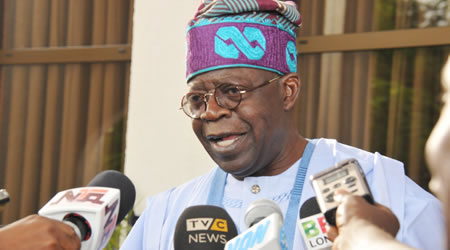
In his response to the letter on Tuesday, former Lagos governor and Co-Chair of the All Progressives Congress Presidential Campaigns, Asiwaju Bola Tinubu, said Obasanjo was projecting unto the APC the misconduct he would perpetrate if still in power.
“Yet, the ways of Obasanjo are not those of the APC. And this difference has meant the better for Nigeria,” Tinubu said in the strongly-worded letter.
Asiwaju described the former president as an election rigger without peer.
“There is no election which occurred under Obasanjo’s watch or in which he participated that did not involve cheating on his part. Even the late President Umaru Musa Yar ‘Adua admitted he was the beneficiary of a flawed election engineered by none other than today’s vociferous complainant,” he said.
Tinubu’s riposte personally signed by him, titled “CHIEF OBASANJO – AT WAR AGAINST HIS OWN DEEDS”, reads: “Former President Obasanjo is many things to many people; but he is all things unto himself. His recent contribution to our political discourse wherein he alleges plots to steer the coming elections shows he benefits from an exceedingly faulty memory, is purely shameless or has a most wicked sense of humor. Perhaps all three are facets of his makeup and were equally on display in his latest prosaic display.
“The crux of his long tirade was the allegation that INEC is poised to cook the election results. Chief Obasanjo should not get his dander up and waste good ink for nothing. This election will be a free and open exercise of the people’s right to choose their leaders. Obasanjo makes fiery allegations against this right but offers no corroborating evidence; he presents only reams of words. This is because Obasanjo is projecting onto the APC the misconduct he would wrought if still in power. Yet, the ways of Obasanjo are not those of the APC. And this difference has meant the better for Nigeria.
“Moreover, Chief Obasanjo should be the last to complain about election rigging. His administration was an unalloyed miscarriage of justice and of the best aspirations of the Nigerian people. We all know he was not elected in 1999. He was handed Nigeria on a silver platter; perhaps because Nigeria was so easily given that he went about treating the nation as if it was a less than precious thing; he thought it was a cheap give-away not a privilege to govern this nation.
“This man should have positioned himself to be the father of the nation. All the goodwill that could be granted a political figure was bestowed on him. The global economy was such that it fueled our growth. Everyone wanted Nigeria to succeed after emerging from years of noxious military rule. Despite the flawed exercise that rendered him president, we all bit our tongues in hope that he would say and do the right things that would move Nigeria forward.
“Instead of being a unifying figure as Commander-in-chief, he lowered himself to being a divisive, vindictive conniver. There was no table which he neared that he did not upset and overturn. There was no one who came into his company for any period of time with whom he did not fall out if he expresses a thought contrary to one of his.
“He tried to convert our young democracy into a one party state. His PDP boasted that they would rule for 60 uninterrupted years. Never did they boast that they would govern us well during even one year of the sixty. He could have placed the economy on the path to durable growth and shared prosperity through diversification, industrialization and creation of a social safety net for the poor. Instead, he handed the economy over to a tight group of cronies, turning what should be a modern economy into a version of the mammoth trading companies that dominated the 17th and 18th century. The Transcorp conglomerate was intended to be a throwback to monopolistic enterprises such as the East Indian Company wherein a select handful would control the national economy’s strategic heights.
“We hoped that Obasanjo would personify statesmanship, thus showing the way to a more benign political culture. Instead, he bickered and feuded with his vice president and mostly anyone who dared remind him that he was human and thus infallible.
“Given the vast margin between the good he could have achieved and the nebulous feats that comprise his true record, Chief Obasanjo is the person most responsible for the flaws in the Nigerian political economy since 1999. His ego is as expansive as the firmament but his good deeds would fit into a modest sachet with ample room to spare.
“The worst of Obasanjo’s record, I have yet to describe. When it comes to elections, he has been a rigger without peer. There is no election which occurred under Obasanjo’s watch or in which he participated that did not involve cheating on his part. Even the late President Umaru Musa Yar ‘Adua admitted he was the beneficiary of a flawed election engineered by none other than today’s vociferous complainant. For Obasanjo to lament over electoral malpractice is tantamount to the ocean complaining that a few raindrops are causing it to get wet.
“In his writing, Obasanjo alleges the Osun election indicates rigging will take place in the coming contests. Let’s go straight to the truth, Obasanjo has no grievance with the process. His personal history suggests fair process is the least of his concerns. What knocks Obasanjo off kilter is that he could not dictate the result in Osun. He told those in the PDP that he held sway in Osun and throughout the Southwest. They believed him. He led them to defeat notwithstanding the almost impossible voter turnout in PDP strongholds in that state. Obasanjo can only win an election when has the final say over the final vote tally. Otherwise, he is a troubled man.
“In an attempt to relieve his trouble, Chief Obasanjo makes reference to a joke about INEC. He says, “The INEC was asked if the Commission was ready for the election and if it expects the election to be free, fair and credible. The INEC man is reported as saying in response, ‘we are ready with everything including the results.’” The joke has a touch of humor; we are glad that Obasanjo is not completely devoid of this most human of traits. However, he makes a telling omission by failing to give you the vintage of this bit of sarcasm.
“The jest was not born last week. It’s vintage is circa 2003- a time when a certain President Obasanjo rode roughshod over INEC. He would summon the nervous INEC chairman to the Villa, proceeding to hector the man until he gave way to Obasanjo’s demands. At Obasanjo’s urging, INEC improperly published fake election results on the gubernatorial race in Lagos. Not until a public outcry did INEC back away from rigging Lagos. A similar attempt was made in Lagos in 2007. In essence, for Obasanjo to laugh at this joke means he has belatedly developed the ability to laugh at himself.
“If Obasanjo was so committed to free elections, how could he countenance Atiku’s recent boast of single-handedly rigging elections in the Southwest. Atiku claimed that he took all states for the PDP but left Lagos alone due to some misguided affinity for me. By this statement, Atiku publicly admitted to rigged elections in the SW. Beyond resort to wholesale rigging, Atiku could never deign to be more popular and potent in the Southwest than the panoply of good and decent leaders that guided the defunct AC. Moreover, I can assure you that we did not need Atiku’s false beneficence to win the elections in Lagos. The people voted for us and their votes countered the ill-designs Obasanjo and Atiku set in motion. Thus, if Obasanjo cannot chastise Atiku for publicly boasting that he rigged elections, then Obasanjo’s display of righteous indignation is but a magician’s trick.
“His fine words and sentiments come a dozen years too late. These noble things would have greater effect had he placed them into practice when he was at the helm of affairs. At that time, he was powerful so he did as he might. Now that he lacks power, he has taken to preach that which he never did.
“In his commentary, he mentions that INEC has a record of past rigging. I wonder if he understands the admission he makes. No other president has exercised such tight control over INEC for as many years as Obasanjo. No president has had the domineering relationship with INEC that Obasanjo enjoyed. If there are reports of past INEC rigging, those reports are of Obasanjo’s making. It is the irony of ironies for Obasanjo to complain of the fruit on the table when his was the hand that planted the tree.
“Chief Obasanjo tries to further confuse matters by pointing to the case of the CJN’s assets declaration as evidence of future vote-rigging via tampering with the judiciary. Again, Obasanjo goes into a personality shift. For years, Obasanjo has boasted of himself as our corruption fighter nonpareil. The very aim of this current letter is to attack imagined INEC malfeasance. Yet, with regard to the CJN, he blithely ignores the large cache of dollars in the CJN’s account and the millions of dollars that passed through the accounts. Obasanjo seems unbothered by the unexplained presence of such sums. Perhaps Obasanjo’s nonchalance regarding the money is that he expected the funds there because he knows both the origin and reasons for the trove.
“Chief Obasanjo sinks so low as to suggest that the VP, during the exercise of his official duties, was taking the PVC numbers of market women and traders. This statement reveals the bilious nature of the man. Obasanjo even quotes the notorious Bode George in claiming that the VP was “gutting our collective treasury” by giving loans of N10,000 to market women under the administration’s empowerment programs.
“What? Giving money to poor people to enhance their lives and escape the maw of poverty is, by PDP metrics, gutting the collective treasury. If helping the poor is gutting the treasury, Atiku’s privatizing large chunks of the economy into his own pocket must have been seen by the PDP as a vital public service. Jonathan and his Petroleum Minister’s siphoning government coffers of several billion dollars to enrich the already-rich must have been viewed by the PDP as the epitome of a social safety net. Obasanjo’s and the PDP’s disdain for the common person could not be clearer.
“Obasanjo should be ashamed to even raise this issue. When he was president, the economy was on an easy sledding due to positive global trends. Obasanjo did not raise a finger to do anything for the poor. He and Atiku were champions of trickle-down economics. If anything good trickled down to the poor it was by accident. Obasanjo left the poor unattended because he cared nothing for them. Poverty increased under his cold indifference. Not one meaningful social program was established during his watch. The banking and pension deregulation he brought were geared to profit the wealthy CEO’s and managers of these financial entities. The malpractices attendant to these deregulation fiascos extinguished the savings of millions of Nigerians. In reliance on these artifices of Obasanjo and his ilk, many Nigerians were thrust down the lower rungs of the poverty they so desperately sought to avoid. Obasanjo’s allies gobbled the savings of the poor and still feast on them to this day.
“Chief Obasanjo is one of the last people to preach to anyone about using public funds to care for the poor. He had the gall to fret that funds should not be given to the urban poor because they are not poor enough. But his grouse does not show any defect in the administration’s program. His complaint shows the defect in Obasanjo’s humanity or lack of it. To complain that some people are not poor enough for his liking is to reveal that seeing human suffering does not motivate him to cure it. He would rather that people suffer it the more. Your unease and distress becomes his entertainment or at least evidence he is superior to the common man. Watching a laborer struggle against penury is no more than a spectator sport for Obasanjo.
“The most fantastic of all his claims is that this administration has returned Nigeria to the days of Abacha. If this were true, the press would be constantly closed. Obasanjo would be constricted in writing such letters. Elections would not be upon us. Atiku would not be able to freely campaign and the diversity of opinion in the public space would be suppressed.
“For Obasanjo to utter such an outrage is that he hopes lighting strikes twice. He was ushered into office after Abacha’s demise. He thinks if he can invoke Abacha’s name, the same thing will happen again. By hook, crook or utter fantasy, Obasanjo seeks to return to Aso Villa, not as an irritating, importuning guest but as a long-term resident. He wants to be back in control. If he cannot be president, then the president better carve from his office a special room for Obasanjo.
“Obasanjo thinks he is more than the greatest Nigerian. He thinks himself greater than Nigeria itself. Unless he is allowed to lead the procession, he will groan, grouse and grit. However, neither President Buhari nor the progressive APC have much use for his reactionary policies and his megalomaniac ways. Thus, we shall be forced to endure more of his letters. But enduring such missives is vastly superior and small price to pay for not having to endure a repeat of his unenlightened misgovernance”.