
News
Worries as govs turn senate into ‘retirement home’


Some governors have indicated interest in the 2019 senatorial election after their tenure. Currently, there are 15 ex-governors in the Senate, and political pundits are of the opinion that some of the governors only go to the upper legislative chamber to “rest,” describing it as a situation which has gross implications for the future of the country, JESUSEGUN ALAGBE writes
While he is rounding off his eight-year two-term tenure as the governor of Imo State, Rochas Okorocha has declared his ambition to run for the Imo West Senatorial District in the 2019 general elections.
The governor made known his intention last month, even though he had earlier stated that he would not run for any elective position in 2019, but would only be interested in who would succeed him after leaving office.
On why he changed his mind so quickly, Okorocha — widely regarded as one of the controversial governors in the country — had said it would be a “disservice” to the nation if he failed to contest for the senatorial position, considering the “wealth of experience” he had garnered as a governor for eight years.
“I have decided to run for the Imo West Senatorial District because if I don’t, bad people will take the position. If my name appears on the ballot paper as contesting for the Senate, it will boost the All Progressives Congress’ chances in the state. And many from my zone have said they will not contest if I am interested,” the 55-year-old governor said.
Okorocha, who is deeply rooting for his son-in-law and chief of staff, Uche Nwosu, to succeed him as the governor of Imo State, also told his deputy, Mr. Eze Madumere, to contest in next year’s senatorial election.
Madumere had, however, said he was only interested in running for the governorship of the state, vowing to pursue his ambition to a logical conclusion.
Okorocha isn’t the only governor nursing the ambition of contesting in the 2019 general elections as a senator; his counterpart in Oyo State, Abiola Ajimobi, who is also rounding off his eight-year tenure next year, had stated that he would contest for the Oyo South Senatorial District in 2019 after completing his tenure as governor.
Ajimobi had earlier represented his senatorial district between 2003 and 2007 on the platform of the Alliance for Democracy, and just like Okorocha, the Oyo State governor had also previously stated that he would not contest in any political position after his governorship tenure.
But last month, he said he had changed his mind because he was being encouraged to return to the Red Chamber by his party stakeholders.
When his eight-year two-term tenure ends in November 2018, there are insinuations that the Osun State Governor, Mr. Rauf Aregbesola, might also contest for the Lagos West Senatorial District in the 2019 general elections.
Although they have the fundamental rights to contest for any elective position in the country, political pundits and social commentators, however, frowned at a situation whereby governors, upon the completion of their tenure, turn the Senate into a “retirement home.”
“This phenomenon is not good for our democracy. Some of the governors already spent eight years in their states, so what’s the point of going to the National Assembly again?” asked the Executive Director of Gender Equality, Peace and Development Centre, Prof. (Mrs.) Patricia Donli.
Donli, who is also a board member of ActionAid International and a former board chairperson, West Africa Network for Peace-building, said it was not surprising that the country was not developing because some of the governors only think of resting at the Senate after their tenure.
She said, “That’s why our democracy is not growing. Most of these governors, just like most of our political leaders, always think of themselves, not of the people.
“Some of them didn’t do well as governors, so how can we expect such people to deliver for the nation at the National Assembly? If you couldn’t develop your state as a governor, how would you develop the nation?
“Some of the governors just go to the National Assembly to rest. Some of them have never sponsored any progressive bill. When the camera is on them, you’ll see them sleeping while deliberations are going on. They have turned it to a place of retirement.
“I pray these people would just retire quietly in their luxurious mansions, which they have used public funds to build if they have any conscience at all.”
The don suggested that it was time the youths took charge of the political situation of the country and got rid of “recycled” leaders.
“We need fresh blood in the National Assembly, those who are versatile and knowledgeable; such should contest for the National Assembly elections,” she said.
There are 15 former governors in the Senate, including the Senate President and a former Kwara State governor, Dr. Bukola Saraki; former Kano State governor, Rabiu Kwankwaso; former Akwa Ibom State governor, Godswill Akpabio; former Plateau State governor, Jonah Jang; former Zamfara State governor, Ahmed Yerima; and a former Kebbi State governor, Adamu Aliero.
There are also a number of former deputy governors in the Red Chamber, including Mrs Biodun Olujimi (Ekiti) and Enyinaya Abaribe (Abia).
Some of them have gone on to spend more than the period they spent as governors and deputy governors in their states.
Abaribe, for instance, has been representing the Abia South Senatorial District of Abia State since April 2007.
A professor at the Department of Political Science, University of Lagos, Akinboye Oladele, said lack of political sensitisation and education was mostly responsible for the recycling of leaders in the country.
He also agreed with Donli, saying if more youths were politically conscious and engaged, they would be able to get rid of recycled leaders found in every political sphere of the country.
However, he said it might not be easy, considering the monetisation of politics in the country.
He said, “Ideally, anyone has the fundamental rights to contest for any elective position, but the people have the right of choice. The people determine who should represent them. What I have seen is that most of these governors would usually have amassed great wealth at their offices so that they could have enough money to throw around to fulfil their next ambitions.
“And this is so because politics in this part of the world is plagued by money, hence, even if the people do not want them to represent them at the Senate, due to the instrumentality of money and financial resource, they manoeuvre their way there. And this has not augured well for our country.
“People, especially the youths, should become more politically aware to know what’s required from someone who will represent them at the National Assembly. If we want to get rid or reduce the phenomenon of recycling leaders or those turning the National Assembly into a retirement home, we need enough political sensitisation and education. Unfortunately, this is not happening.”
Nevertheless, Oladele was of the opinion that politicians who had performed well as governors might be able to carry their wealth of experience to the National Assembly and, therefore, be able to contribute meaningfully to national development.
A Port Harcourt-based political scientist, Dr. Charles Ayibadiwori, said governors would keep turning the National Assembly into a place of rest “as long as they see it as a place to make unquestionable amount of money as allowances.”
Recently, the senator representing Kaduna Central District, Mr. Shehu Sani, disclosed that he and his colleagues collect N13.5m monthly as running cost allowance, aside from others such as hardship allowance, constituency allowance, furniture allowance and wardrobe allowance, all running into millions of naira.
Ayibadiwori said, “So, tell me how a governor wouldn’t want to go and enjoy his life after his tenure? They talk less there, but they collect big money. Like I have always said; it is high time we made the National Assembly less appealing to the politicians.
“There are young, innovative people in this country who can do the job effectively and would be comfortable with just a salary that would take care of their expenses. Some of these guys have businesses that they have built.
“They have something else they are doing with their lives. They are not the regular politicians who wouldn’t have any source of income when they leave elective or selective positions.
“The problem I have is such people too don’t come out and show interest in politics. They need to come out and wrest power from the recycled leaders.”
A Senior Advocate of Nigeria, Mr. Yusuf Ali, said if governors who want to go to the Senate would only do so to add value to the lives of the people, their action wouldn’t be criticised, especially as they could use their experience while at the helm of affairs of their states to contribute to nation-building.
He said, “You cannot deny them their rights to vie for the office. I want to look at this issue in two ways: first, when you have people like that in the National Assembly, they make the legislative arm of the government to be more independent.
“This is because they cannot be pushed around by the executive. Having governed states before, they would have garnered lots of experience.
“However, they can only use their experience for the public good if they are selfless; if they see it as a service to the people, and not as an opportunity to add more wealth to their purse.”
On ending the phenomenon of recycling leaders in the country, Ali said, “If our politics were not monetised, it would help a lot in avoiding recycled leaders or governors turning the National Assembly into a retirement home.”
In her opinion, Lagos-based public affairs analyst, Ms Pearl Ozulanba, said the phenomenon whereby governors see the National Assembly as their next “abode” was due to the political structure in the country.
She noted that the structure had allowed some politicians to arrogate so much power to themselves to the extent that some of them, including governors, take decisions on their successors without caring about who and what the people want.
She said, “If you look at the problems we have in this country, these are problems that have been there for 10, 20 years, and they keep multiplying basically due to the problem of recycled leaders. The same person who has run a state poorly would still want to contest for the National Assembly. How can our nation then grow?
“Truth is, a lot of people in the National Assembly are just representing themselves, not the people they claim to be representing. Those vying to be in the National Assembly should see it as a means of serving the people, and not as a means of enriching themselves.”
https://iso.keq.mybluehost.me/tinubu-is-to-bring-peace-between-arab-and-israeli-in-apc-shehu-sani/


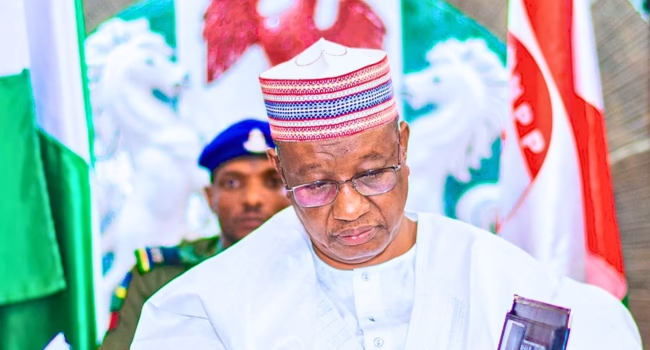
The Kano State House of Assembly has initiated impeachment proceedings against Deputy Governor Aminu Abdussalam Gwarzo over allegations of gross misconduct, abuse of office, and breach of public trust.
The notice was presented yesterday during plenary by the Majority Leader, Lawan Hussaini Dala, who said the action follows Section 188 of the 1999 Constitution of the Federal Republic of Nigeria.
Dala said the allegations stem from Abdussalam’s tenure as Commissioner for Local Government (2023–2024) and his current role as deputy governor. He accused the deputy governor of diverting funds meant for the 44 local government councils.
According to the majority leader, Abdussalam allegedly received N1.5 million monthly from each council between June 2023 and January 2024, totaling N462 million. Between February and July 2024, he allegedly collected N3.255 million monthly from each council under the guise of special assignments, amounting to N726 million.
Dala also accused the deputy governor of abuse of office, claiming he facilitated payments of N10 million from each council to NovoMed Pharmaceuticals Limited, totaling N440 million, in violation of state procurement laws.
“The misuse of official capacity to confer undue advantage constitutes abuse of power and undermines public trust,” Dala told lawmakers, adding that the allegations amount to gross misconduct under the Constitution.
The impeachment notice was reportedly endorsed by 38 lawmakers, meeting the constitutional threshold to proceed. The Speaker has acknowledged receipt, and the House is expected to serve the allegations on the deputy governor.
If approved, a panel may be constituted by the state Chief Judge to investigate the claims.
As of filing, Abdussalam had yet to respond publicly to the allegations.
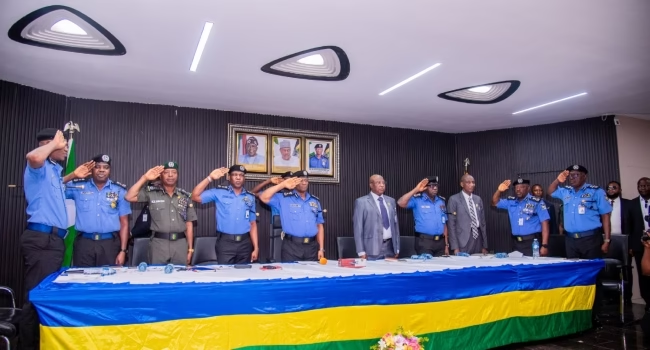
The Inspector-General of Police, Tunji Disu, on Wednesday inaugurated a seven-member committee on the establishment of state police, giving it four weeks to submit its report.
The inauguration was held during his maiden conference with senior police officers at the Peacekeeping Conference Centre, Force Headquarters, Abuja.
Charging members of the panel to discharge their duties with professionalism and objectivity, Disu described the assignment as “both significant and timely,” noting that it would shape the framework through which state policing may operate in Nigeria.
“In carrying out this assignment, your deliberations must be guided by professionalism, objectivity, and a clear appreciation of the unique complexities of policing a diverse nation such as our own,” the IGP said.
He stated that if properly designed and effectively implemented, state policing holds significant potential benefits for the country.
“By bringing law enforcement closer to communities, state police institutions can deepen local knowledge of security dynamics and enable quicker and more targeted responses to emerging threats,” he added.
The committee is expected to review existing policing models within and outside Nigeria, assess community security needs and emerging risks, and propose an operational framework for the establishment and coordination of state police structures.
It will also address issues relating to recruitment, training, standards and resource allocation, as well as develop accountability and oversight mechanisms to ensure professionalism and public trust.
The panel is chaired by Olu Ogunsakin, with Bode Ojajuni as secretary. Other members are Emmanuel Ojukwu, Okebechi Agora, Suleyman Gulma, Ikechukwu Okafor and Tolulope Ipinmisho.
Disu said the committee had about four weeks to conclude its assignment and submit a comprehensive report.
The move marks one of the first major steps taken by the new police chief since his appointment and confirmation a few days ago.
The development comes amid rising security concerns across the country, with several stakeholders advocating state policing as part of measures to tackle insecurity.
President Bola Tinubu had earlier asked the National Assembly to commence the process of amending relevant laws to pave the way for the creation of state police.
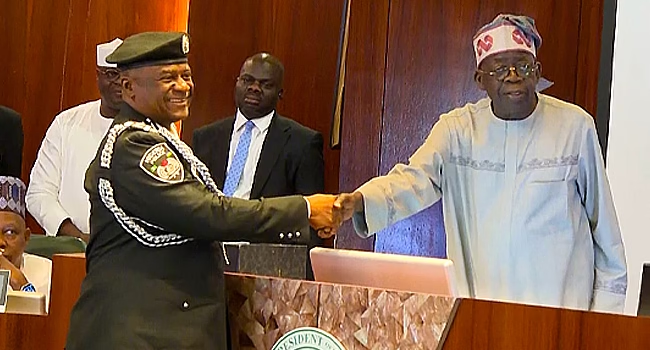
President Bola Tinubu on Wednesday swore in Olatunji Disu as the Inspector-General of Police (IGP).
Disu took the oath of office at the Council Chamber of the Presidential Villa, Abuja, shortly before the commencement of the Federal Executive Council (FEC) meeting.
The President also administered the oath of office to six commissioners of the Revenue Mobilisation Allocation and Fiscal Commission (RMAFC) and two commissioners of the Federal Civil Service Commission (FCSC).
The ceremonies were witnessed by ministers, senior government officials and family members of the appointees.
The council meeting began shortly after the swearing-in.
In attendance were Vice President Kashim Shettima; the Secretary to the Government of the Federation, Senator George Akume; the Chief of Staff to the President, Femi Gbajabiamila; the National Security Adviser (NSA), Nuhu Ribadu; and the Head of the Civil Service of the Federation, Mrs EsthMrs.Walson-Jack.
Disu was appointed acting IGP on February 25, 2026, by President Tinubu, following the resignation of former IGP Kayode Egbetokun.
His appointment was subsequently endorsed by the Nigeria Police Council (NPC).
The former Assistant Inspector-General of Police assumed office last Wednesday.
He previously served as Assistant Inspector-General in charge of the Force Criminal Investigation Department (FCID) Annex, Alagbon, Lagos, after his promotion to the rank last year.
A former head of the Lagos Rapid Response Squad (RRS), Disu has pledged to deliver accountable, modern and professional policing.





-
 Politics3 days ago
Ibarapa East Assembly Hopeful, Ramon Congratulates Ajiboye, Says Emergence Good for Oyo APC
-
 Politics1 week ago
Makinde: My Successor Must Be Loyal to Oyo, Not Me
-
 Politics3 days ago
2027: Former Oyo Deputy Governor Adeyemo Emerges APC Chairman (See Full List)
-
 Politics1 week ago
Fintiri Dumps PDP for APC, Moves with Cabinet, 14 Adamawa Lawmakers