The Seyi Makinde-led Oyo state government has declared that it has turned the heat on kidnappers and criminals in Ibarapa and Oke-Ogun axis of the state, assuring that the state will succeed in routing them.
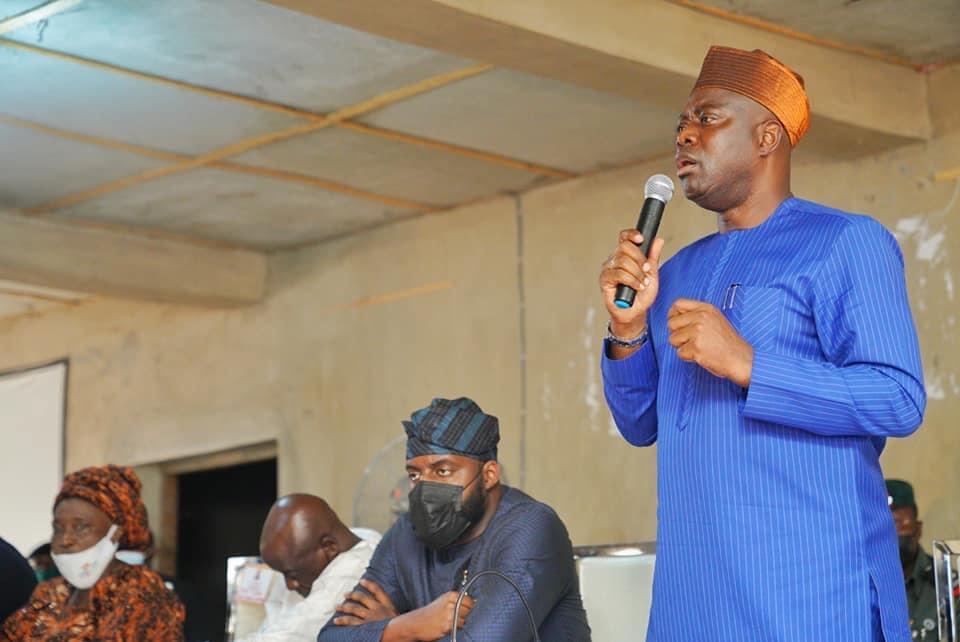
Governor Makinde, who was speaking at different spots in Ibarapaland where he engaged the people in town hall meetings, promised that his administration will get the criminals to account for their heinous acts in the state.
He also declared that the state could not afford to lose any more lives to insecurity, stating, however, that any action that must be taken must be guided by the realisation that a wrong solution must not be proffered in order to avoid unintended consequences.
According to the Chief Press Secretary to the governor, Mr. Taiwo Adisa, in a statement issued on Monday, the governor stated these in Ibarapaland during meetings at Idere, Igangan and visits to the homes of the late Dr. Fatai Aborode and others who lost their lives to the crisis in the area.
Governor Makinde, who equally commiserated with Mrs. Idowu Babarinde, who lost a child to indiscriminate shooting by kidnappers in their attempt to kidnap a filling station owner in Idere, said he was pained by the losses recorded in the area, adding that he felt the pain of the people of Ibarapaland.
“I decided to spend the night in Ibarapaland so as to let you know that if my people in this place cannot sleep with two eyes closed, I cannot also sleep with my two eyes closed in Ibadan,” the governor said, adding that the visit afforded him the opportunity of feeling the pains of the people first-hand.
He said: “We are turning the heat on the criminal elements and we will surely get them.”
He stated that the government will compensate victims of the insecurity situation in Ibarapaland, adding that measures that the government is taking to curtail the situation include the setting up of an all-inclusive peace and security committee at the local government levels and the stepping up intelligence gathering in the area.
“One of the things we want to do is, we must have a peace and security committee at the local government level, which will be all-encompassing. “Those people that are supposed to be there and can contribute meaningfully must be accommodated.
“So, I have listened to you. I came here purposely to sleep over to demonstrate that your problem is also my problem. If you cannot sleep with your two eyes closed, I also have no business sleeping with my two eyes closed in Ibadan.”
He further stated that the government will convene a meeting with traditional rulers in Ibarapaland in the next few days with a view to coming up with recommendations on the situation, warning that emergency situations as such should have been brought to the attention of the government long before it escalated.
Governor Makinde, who clarified that though he was misunderstood for the position he took during the crisis, he is not afraid to speak out but that he would not allow anyone to start ethnic war under his watch.
He added that the failure of communication, intelligence gathering and other factors led to the escalation of the crisis in the area and that though his government would take responsibility for some of the challenges, security challenges cannot be solved in one day.
The governor warned political office holders, community leaders and stakeholders in the area to treat emergency situations as sensitive and bring such to the attention of government on time, stating that claims that letters were written to him were faulty.
He told political leaders of the area not to shy away from seeking audience with him wherever there is a gap that must be bridged.
He added that apart from the immediate deployment of 200 additional Amotekun Corps to Ibarapaland, he has also instructed that the agency and other security apparatuses step up on intelligence gathering, stating that the government will also fast-track its identity management policy so that it could know who lives where in the state.
The governor equally warned residents of the state not to stigmatise any particular ethnic group but to search out the real enemies who he said are the kidnappers, bandits, rapists, hoodlums and armed robbers.
At the home of the Aborodes, where the governor commiserated with the father of the late Aborode, Governor Makinde said: “I want to tell you that I feel your pain, because when I saw the news of the death of Dr. Fatai Aborode, I was seriously pained.
“In 2017, when we were striving to restructure the PDP, we started meetings and put some people in some local governments. Dr. Aborode was made the point man in Ibarapa North. I was at Ibadan in charge of Ibadan North-East and we did hold meetings at Premier Hotel. The situation is that if a tsetse fly perches on one’s private part, it requires wisdom to make it fly away or to kill it.
“Everybody is alleging that the Police are not giving us enough support while Amotekun and Operation Burst are really being supportive. But what the Constitution of the Federal Republic of Nigeria states is that whatever bothers on internal security should be handled by the Police.
“That is why some of us have said the federal control of Police is limiting their performance. That was why we requested for State Police and we know it is a constitutional issue.
“So, when we got into government, we observed there was no State Police and we did not want to drop the idea. Those who were of the opinion that State Police may be used for political reasons also have their own point but if there is an alignment, people will see that the noticeable gap in policing should be bridged.
“When the discussion was going on, the IGP also agreed that there is a gap and that was why they recruited for community policing but we think that is not enough to bridge the existing gap. That was why we requested state policing and when we did not get that, we resorted to Amotekun as a stop-gap arrangement while the issue of the constitution review is going on.
“So, I would like to say that most of our compatriots have been cut down in their prime; we regret it and the solution is we must not lose more lives unnecessarily. That is very fundamental. So, anything we want to do, one thing that must guide us is the fact that we must not lose more lives.”
Governor Makinde stated that the crisis escalated due to failures on different fronts, saying: “There are failures on a number of fronts and one of the fronts we are witnessing failure was when some are saying they wrote letters to my office. I said I will love to see the acknowledgment copies to know where those letters are, who acknowledged them, and the prayers you made too.
“When I saw the acknowledgment letters, I saw that one of them was dated 27th of January, the earliest one was 20th of January and that is when the cases had escalated.
“Anything about security, I approve instantly because most of the things we want to do in Oyo State, ranging from economy, good education for our children and other things are hinged on a safe and secure environment. I believe there is a failure in that communication.
“Any emergency situation must be treated as an emergency. There is nothing that should stop you (chairmen) from telling us there is an emergency situation, which requires you to sit down with the governor. So, I have seen the failure we have to address and we have to ensure that, moving forward, wherever there is a gap, we must bridge instantly.”
On the trust deficit between Fulani herdsmen resident in the state and the local residents, the governor stated that the state will fast-track the identity management scheme that will help to identify who lives where in the state, warning, however, everyone must strive to keep the peace.
“Some of the problems have been existing for years. It is not all Fulani people that are criminals, I must tell you. Some of those caught after a robbery operation at Okeho were Igbira from Kogi State.
“So, we must strive and do the work that can keep our environment safe. There are few things the government has promised to do and the central part of it, which we think will help our situation is identity management. We want to know who is where.
“This week, after the whole issue started escalating, I asked the committee we set up to look into that but they had already formed an inter-ministerial committee. Immediately I noticed, I dissolved it and gave the S.A on ICT single-point responsibility and a time-frame to get it done. This is an unusual time.
“What happened in Rwanda will not be our portion. If anyone wants to ignite war in Nigeria,bit won’t be from here and won’t be under my own watch. We will find a solution to the challenges facing us because we know there are challenges.”
He also warned against attempts by some individuals to politicise the insecurity situation, noting that after his administration ends, the state would remain to face the consequences of their actions.
While speaking at Idere, the governor said though he could be accused of anything on the crisis in Ibarapaland, he could not be accused of not loving his people, saying that before he became governor, the people demonstrated love for him.
He said: “I feel your pain and I am not taking your love for granted. Those who want to politicise the situation were the ones saying I should have visited here but, the truth is, I needed feedback. And it was deliberate that the document we brought out in 2019, security is one of the pillars that we say this administration would rest upon.
“It was deliberate for me to stay here overnight. One thing I want to take away is that we are all together to solve this problem. I don’t want further needless loss of lives, whether Fulani or Yoruba or anybody and we all need to come together.
” There are criminals from all over and we also have the issue of fake news. Sometimes, we don’t know which news is true and the fake one. They have given the security agencies a run around.
“Deliberately, some elements will send fake news out and security agencies will still expend the limited resources to chase after something that is not real. But we should not be looking back. We are where we are right now and we must think-out solutions that will move us forward with minimal disruptions and loss of lives.
“Within the next one week, we will summon the meeting Kabiyesi asked us to call for. One of the initiatives of the government is, we need to know who is where and that is why I asked them to fast track the policy of identity management in Oyo State. Be it okada riders, be it Fulani herdsmen, we want to know you and know what you are doing.
“So, I solicit your support and we will deploy resources to get it done.
“By God’s grace, very soon, all of us will begin to sleep with our two eyes closed. But we all have to do it together. If you see something, say something to us. Always remind those who are going about, insisting they must politicise the issue of security in the state too.”
During the different stops, traditional rulers, political leaders, youth leaders and other stakeholders took turns to brief the governor of the challenges they have been dealing with in the hands of herdsmen from 2008 and kidnappers, especially in recent times.