Connect with us

News

UK finance minister, Kwasi Kwarteng, sacked

Published

on

(FILES) In this file photo taken on October 3, 2022 Britain’s Chancellor of the Exchequer Kwasi Kwarteng delivers his keynote address on the second day of the annual Conservative Party Conference in Birmingham, central England. – Kwarteng has been sacked, the BBC and Sky News reported on October 14, 2022 quoting unnamed sources, as Prime Minister Liz Truss tries to save her beleaguered premiership. (Photo by Paul ELLIS / AFP)

British Prime Minister Liz Truss on Friday dismissed her finance minister, forcing Kwasi Kwarteng to carry the can for turmoil sparked by her right-wing economic platform as restive Conservatives plotted her own demise.

The chancellor of the exchequer was dismissed in person by Truss after he rushed back early from international meetings in Washington, and before she was due to hold her first Downing Street news conference at 2:30 pm (1330 GMT).

Former foreign secretary and former Tory leadership candidate Jeremy Hunt was appointed as Kwarteng’s replacement, making him Britain’s fourth finance minister this year.

“You have asked me to stand aside as your chancellor. I have accepted,” Kwarteng wrote in a letter to Truss, who only succeeded Boris Johnson on September 6.
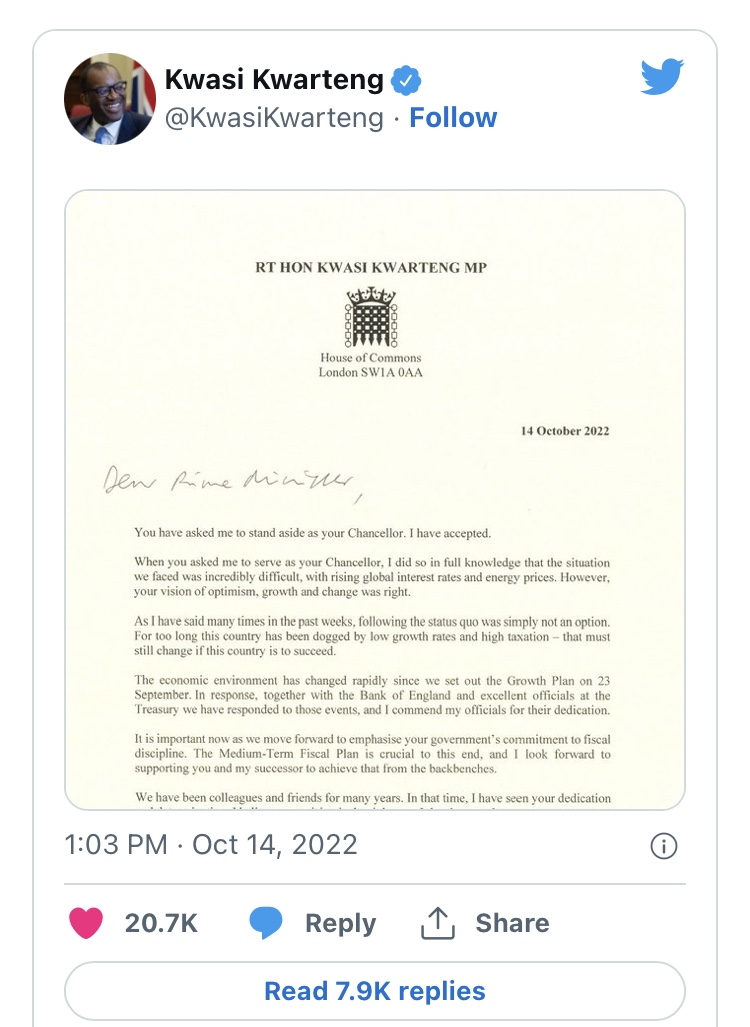
But he insisted that their economic programme was needed because “the status quo was simply not an option”.

In reply, Truss wrote that Kwarteng had “put the national interest first”.

“I know that you will continue to support the mission that we share to deliver a low-tax, high-wage, high-growth economy that can transform the prosperity of our country for generations to come,” she said.

Financial upheaval sparked by the new government’s September 23 plan to slash taxes — financed via billions in more borrowing — has subsided somewhat since the Bank of England intervened in bond markets.

But the central bank was adamant it would end its bond-buying spree on Friday, and market analysts said only a bigger climbdown by Truss following Kwarteng’s disastrous budget announcement last month would avert fresh panic.

Tony Travers, from the London School of Economics, told AFP Kwarteng had been made “the fall guy for the government’s mistakes” — but that the sacking had not taken the pressure off Truss or calmed the Tories.

“It’s very hard to see them coming back from this” by the next election, he added.

– ‘Not going anywhere’ –
Kwarteng was due to have stayed in Washington this weekend to conclude annual meetings of the International Monetary Fund and World Bank, after earned a rebuke from IMF chief Kristalina Georgieva on the need for “coherent and consistent” policies.

Speaking in Washington on Thursday, Kwarteng had insisted that his job was safe. “I’m not going anywhere,” he said.

But UK broadcasters showed live footage of Kwarteng’s British Airways plane landing at Heathrow airport a day early, after Truss held hurried meetings with her own financial advisors on Thursday in his absence.

Speculation was rife that Truss would row back on planned changes to corporation tax, having already changed her mind about cutting income tax for the highest earners.

The promised tax cuts were the centrepiece of Truss’s successful pitch to Tory party members that she,, rather than rival Rishi Sunak, was the best candidate to replace Johnson.

That programme now lies in tatters, and Truss’s judgement is in question more than ever, after Sunak’s warnings were entirely vindicated: higher borrowing to pay for tax cuts served only to terrify the markets and drive up borrowing costs for millions of Britons.

A new YouGov poll for The Times newspaper said 43 percent of Conservative voters want a new prime minister in Downing Street.

Other polls show a mammoth lead up opening up for the main opposition Labour party, threatening electoral meltdown for the Tories.

– ‘Romcom-worthy dash’ –
Junior minister Greg Hands said “I don’t recognise” multiple reports that senior Tory MPs were plotting to unseat Truss by installing a new leadership team under Sunak and Penny Mordaunt, who also ran to succeed Johnson.

Pressed on whether Truss will still be in 10 Downing Street in a week, Hands told ITV: “Oh definitely.”

The chancellor’s September 23 budget sparked market chaos because of fears it would drive up state debt.

The pound tumbled to a record dollar low near parity with the greenback and bond yields surged, before stabilising thanks to interventions by the Bank of England (BoE).

But with that costly BoE crutch ending on Friday, markets had already priced in a fresh about-turn by the government, leaving Downing Street with no room for manoeuvre.

Sophie Lund-Yates, lead equity analyst at Hargreaves Lansdown, said before Kwarteng’s sacking that his “romcom-worthy dash through the airport” showed the government waking up to financial reality.

But for many pundits, the self-inflicted damage risks proving terminal for Truss and her hard-right platform.

Another new poll by Ipsos showed Truss’s net satisfaction score at minus 51, lower than any of her predecessors this century, while Kwarteng left office with historically low ratings for a chancellor.

Comments

News

Tegbe clarifies: No 3-month promise on power grid, outlines realistic reform timeline

Published

on

The Minister-designate for Power, Joseph Olasunkanmi Tegbe, has firmly clarified that he never promised to fix Nigeria’s national electricity grid within three months, describing such claims circulating in sections of the media as a misrepresentation of his Senate screening remarks.

A statement issued  after his appearance before the Senate stressed that Tegbe was deliberate and cautious in his presentation, avoiding unrealistic timelines while outlining a structured reform pathway for the power sector.

According to the clarification, Tegbe explained that while Nigerians can expect early signs of progress, particularly in grid stabilisation within his first 100 days in office, comprehensive reforms will be guided strictly by technical assessments, stakeholder consultations, and sector realities.

He noted that critical challenges such as gas supply constraints, metering gaps, infrastructure decay, and commercial inefficiencies require coordinated interventions that cannot be resolved through arbitrary timelines.

“My commitment to this distinguished chamber and to Nigerians is clear: we will deliver visible and measurable improvement in the power sector,” Tegbe stated during the screening.
He assured that his focus would include stabilising the national grid, modernising transmission and distribution infrastructure, strengthening commercial frameworks, and enforcing accountability across the electricity value chain.

On tariff policy, the minister-designate reaffirmed that reforms would be carefully designed to balance sustainability with social protection, ensuring that vulnerable households are shielded while also restoring investor confidence in the sector.

The statement further emphasised that Tegbe’s approach reflects discipline, technical understanding, and a reform-minded agenda aimed at delivering lasting solutions rather than short-term political promises.

It added that he remains open to responsible media engagement and constructive clarification where necessary, noting that accurate reporting is essential to public understanding of ongoing efforts to reposition Nigeria’s power sector.

Tegbe reaffirmed his readiness to lead a transparent, results-driven reform process anchored on accountability, realism, and measurable progress.

Continue Reading

News

Yoruba Heritage Festival Honouring Ogedengbe Begins July 29

Published

on

A grand cultural renaissance celebrating the enduring legacy of legendary Yoruba war hero and statesman, Ogedengbe Agbogungboro, will take centre stage as the 2026 edition of Ogedengbe Fiesta holds from July 29 to 31 across Osun State and Ekiti State.

The three-day heritage festival, unveiled by organisers on Wednesday, is themed, “Ogedengbe Agbogungboro Legacy: Leadership, Security, and Statecraft for Modern Governance in Nigeria.”

The event is designed to preserve Yoruba cultural heritage, deepen historical consciousness, promote tourism and stimulate national conversations on leadership, peacebuilding and governance.

According to the organisers, the fiesta will commence with traditional homage at Atorin and heritage excursions to notable Kiriji War historical sites in Imesi-Ile, where participants will relive significant moments in Yoruba military and political history.

The programme will also feature guided visits to the historic Ogedengbe Cave, Ibu Latoosa Site and the Yoruba Peace Treaty Grove, all regarded as symbolic monuments of Yoruba resilience, diplomacy and unity.

As part of activities lined up for the celebration, participants will tour the gardens of renowned legal icon and elder statesman, Afe Babalola, in Okemesi-Ekiti.

The organisers further disclosed that a Legacy Awards and Hall of Fame Investiture ceremony would hold in Ilesa to honour individuals who have contributed immensely to the promotion of Yoruba culture, leadership and community development.

A distinguished personality lecture in honour of Aare Afe Babalola, SAN, OFR, CON, and Arole Fabunmi of Okemesi-Ekiti is also expected to headline the event, with scholars, traditional rulers, cultural enthusiasts and public intellectuals billed to discuss pathways to strengthening governance and security through indigenous values and historical lessons.

The organisers noted that all activities would commence daily by 11am, adding that the festival would serve as a rallying point for lovers of Yoruba culture, history and tourism across Nigeria and beyond.

They described the fiesta as not only a celebration of the heroic exploits of Ogedengbe Agbogungboro, but also a strategic platform to inspire a new generation of leaders through the ideals of courage, unity, patriotism and visionary leadership.

Continue Reading

News

No Return to Fuel Subsidy, FG Insists Amid Rising Hardship

Published

on

Minister of Finance and Coordinating Minister of the Economy, Taiwo Oyedele

The Federal Government on Tuesday ruled out any plan to reinstate fuel subsidy despite worsening economic hardship and mounting public pressure.

The Minister of Finance and Coordinating Minister of the Economy, Taiwo Oyedele, stated this in Paris, France, during a meeting with global investors alongside President Bola Tinubu.

Oyedele said the government would also not introduce price controls, stressing that market forces remain the preferred mechanism for determining petrol prices.

“We will not bring back fuel subsidy because it creates distortions for the economy, and we won’t introduce price control because we believe in the market,” he said.

The minister argued that the subsidy regime had long undermined economic efficiency, adding that emerging global energy shifts, including developments in Iran, present fresh investment opportunities for Nigeria.

The removal of petrol subsidy in May 2023 triggered a steep rise in inflation, worsening the country’s cost-of-living crisis.

Nigeria’s headline inflation climbed from 22.41 per cent in May 2023 to 34.19 per cent by June 2024 — its highest level in nearly two decades — driven by surging fuel, food, and transportation costs.
Food inflation further accelerated, exceeding 39 per cent by October 2024, while transport fares soared by nearly 300 per cent, compounded by currency devaluation.

Despite the economic strain, Tinubu defended the policy, saying it had stabilised the foreign exchange market.

“Subsidy that was a burden to the entire country was removed, and ever since we have achieved FX stability,” the President said, according to his Special Assistant on Social Media, Dada Olusegun.

In a related statement, the President’s Special Adviser on Information and Strategy, Bayo Onanuga, said the administration’s reforms were aimed at eliminating structural distortions, strengthening macroeconomic stability, and laying the foundation for inclusive growth.

He added that the government remained committed to fiscal discipline and transparency.

Highlighting economic progress, Oyedele disclosed that Nigeria recorded an 11.2 per cent growth in Gross Domestic Product in dollar terms in 2025, describing it as a major step towards the country’s ambition of building a $1tn economy by 2030.

He also pledged that the government would begin publishing quarterly financial reports to enhance accountability and public trust.

Also speaking, the Director-General of the Debt Management Office, Patience Oniha, assured investors of Nigeria’s commitment to prudent borrowing and sustainable debt management.

The Federal Government has continued to defend its reform agenda despite growing public discontent, insisting that the long-term gains will outweigh the current economic pains.

Continue Reading

Advertisement

Entertainment

Advertisement

MegaIcon Magazine Facebook Page

Advertisement

MEGAICON TV

Advertisement

Trending