
Opinion
The Mohbad in Nigeria at 63 |By Festus Adedayo

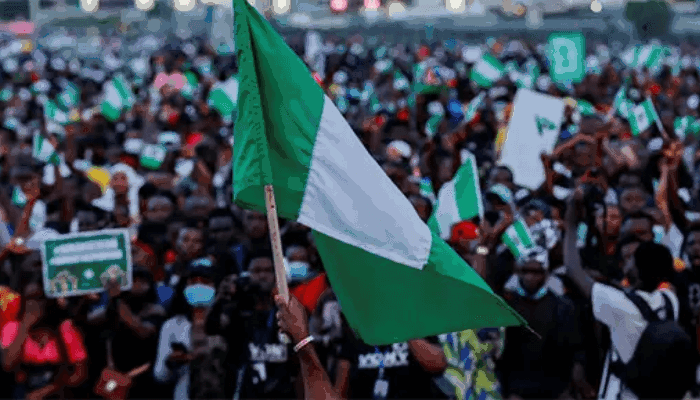

Humour and laughter often serve as a powerful tool in driving home words that may otherwise be difficult to communicate. An example is Nigeria celebrating her 63rd anniversary and yet enmeshed in several dysfunctions that cannot be explained. One of the many popular jokes about the Nigerian crisis available on the streets has attempted to humourize the ailment and drive home the complexity of the Nigerian problem.
It goes thus: “There is absolute (turmoil) – economic collapse, political commotion, wars, social dislocation, tsunamis etc – in the world, and all nations decide to meet God in Heaven to ask for when their great tribulations would come to an end. Every single country that comes before God does so in sublime supplication and with torrents of tears, pleading for knowledge of when its problems would come to an end. The Almighty obliged each country, telling it when all would be well. Some got 10 years, others were promised 25 years, others about 50 years. When Nigeria staggers before the Almighty to ask God for when her problems would be over, God bursts into tears…”
Although an engaging comic, the humour speaks to Odolaye Aremu, late Ilorin, Kwara State Dadakuada musician’s song. Odolaye sang that when a calamity grieves the heart beyond measurable limit, even tears become incapable of articulating the tragedy, precipitating the need to employ laughter as well. “Oro t’o ba j’ekun lo, erin laa fi rin”, Odolaye sang. Perhaps, God later laughed? He had endowed Nigeria with too much potentials to warrant her getting this stuck in the mud.
Today marks Nigeria’s 63rd Independence Day celebration. In the midst of all diseases that ail Nigeria, apart from the need for gratitude to God by her citizens over their individual existence, there is hardly any cause for cheer. When a situation appears hopeless, the babalawo’s words become poignant in his bid to articulate the sorrowful climate. He says birds have refused to chirp as they are wont to, and rats have lost their squeaks. This equation appears to be Nigeria’s. Nigerians are agreed that today, there is no reason for celebrations.
If anyone ever doubts that there is a synchrony between living and non-living things, dead and the living and that life can be better lived if we take lessons and messages from situations around us, Late Alagba Adebayo Faleti reinforced this binary. In Saworoide, Mainframe International’s satiric movie, a critique of bad leadership that has become a pestilence in Africa, Faleti played the role of an elderly palace staff called Baba Opalanba. Opalanba is a Yoruba name for broken bottle. Anyone who ever once mistakenly stepped on smithereens would remember the discomfiture and pain shards inflict. A knowledgeable and respected thespian and broadcaster steeped in, and a repository of Yoruba culture and tradition, Faleti’s role in this movie was that of a sage. His lacerating words, delivered through music, chastised evil and evil doers. Opalanba demonstrated that music can be used to straighten the curves of bad leadership. Pretending to be asleep while chiefs gathered to hatch details of their evil plots, Opalanba deployed his sagely musical lines to chaperone them off their path of destruction. He warned that birds that perch on rooftops don’t do so merely to rest their aching legs but to gather information. He expressed this as, “Oro l’eye ngbo, eye o dede ba l’orule o, oro l’eye ngbo o”.
Nigeria must be one of the most researched countries in the world. Scholars have dissected her stunted growth from all prisms. At inception, the country held huge promises for the Blackman all over the globe. Three months into Nigeria’s independence in 1960, in its December 5, 1960 edition, the Time magazine, super-excited about her prospects, had written, “In the long run, the most important and enduring face of Africa might well prove to be that presented by Nigeria,” while adding that Nigeria was a “sober voice urging the steady, cautious way to prosperity and national greatness.” On the front page of that Time edition, the picture of Queens English-speaking Tafawa Balewa, Nigeria’s Prime Minister, adorning his native babariga announced to the rest of the world that the Blackman had arrived the global scene. Gradually, like the destructive cells of cancer, Nigeria began to destroy every of those potentials.
Since the destruction started to manifest, from military rule to civilian dictatorship, different theses have been propounded on what led to the quashing of such massive investments of hopes. Not only has Nigeria proved to be a total letdown to the rest of the black world, she has been a major letdown to her citizens themselves.
So many descriptions have been coined to express the colossal letdown that Nigeria is. My teacher at the University of Ibadan, Eghosa Osaghae, labeled the Nigerian fall as that of a crippled giant. Karl Maier, American-born ex-African correspondent for the London-based newspaper, Independent, in a locus classicus biography of Nigeria’s rot, said it was a house (that had) fallen, even remarking that, “(w)ith the benefit of hindsight, it is clear that such optimism (the like of Time magazine’s) was naïve” and that, in retrospect, Nigeria was “the bastard child of imperialism.” To the duo of Nigerian scholars, Wale Adebanwi and Ebenezer Obadare, “Nigeria is the predicted ‘giant’ that has become a disappointing, even aggravating Lilliput.”
In the case of Nigerian rapper, Ilerioluwa Oladimeji Aloba, professionally known as MohBad, and his fatherland, there may be a synchrony, a link of his life with the Faleti bird that perches on the rooftop. A few weeks to today’s Nigerian independence anniversary, specifically on September 12, 2023, hitherto sparsely-known Mohbad suddenly died, aged 27. At death, MohBad seized the klieg like a pestilence, calling global attention to the life he lived, the state of Nigerian music and the ordinariness of death in Nigeria. Apart from being a rapper, he was a singer, songwriter and formerly signed to Naira Marley’s Marlian Records. His hits that have since shot him to top ranking dancehall charts are Ponmo, Peace, Beast and Peace, Sorry, Feel Good and KPK (Ko Po Ke).
Mohbad’s convoluted death has evoked all manner of theories on what exactly could have led to his untimely departure. From suspicion of his having been poisoned, gas-lighted to his grave or probably remote-controlled to his death through native talisman, the likelihood of resolution of the cause of Mohbad’s death, even after the release of an autopsy report carried out on his exhumed body, may be slim. However, at death, Mohbad’s hidden glory became manifest. By September 15, three days after his sudden death, his Beast & Peace, which was the opening track of his Blessed album, oscillated at Number Four and his Feel Good track flicked at Number Five of global music ranking. In the same vein, between September 12 and 14, a space of two days post-death, his streams peaked at 702%, from 990,000 to 8.02 million. During the week of September 2023, Peace, one of his tracks, debuted on Billboard’s Hot Trending Songs chart, occupying its prestigious Number Two. Equally, on September 18, 2023, Blessed peaked at Number Four, and Light hit its first on the chart entry, becoming Number 20 on the Nigerian Official Top 50 Albums chart. On September 21, streams of Blessed catapulted to the top by over 530%, while on September 23, Mohbad rose to become the 46th best-selling digital artist, sidestepping recognized international artists like Nicki Minaj, Eminem, 21 Savage, Lady Gaga and Chris Brown.
Though not as beloved alive as in death, the rash attempt to beatify Mohbad, both as a brand and due to the tragic circumstances of his death, has made apportioning him blame for his own death very unpopular. The truth however is that drug addiction among Nigerian youths and specifically, among musicians, played a major role in the circumstances of his early passage. From testimonies about his life, it was obvious that Mohbad got trapped in the puddle of that destructive belief that drug consumption was an enabler of musical inspiration.
Drug consumption has, from time immemorial, been the bane of music and musicians. It is an affliction that didn’t just start today; it has dragged many notable musicians down the sepulcher, in their scores. Even outside the shores of Nigeria, there exists this subsisting but notorious notion that drug consumption contributes highly to artistic inspiration. While scientific studies locate a liaison between these two, no study has been able to strictly confine inspiration strictly to drug consumption. In other words, there have been artists who got to the topmost height of their careers but who did so while maintaining wide social distancing from drugs. What this means is that, yes drugs can be enhancer of inspiration, other less-dangerous pastimes can evoke even higher inspirations as well. You could count artistes, in remarkable number, who never had any consonance with drugs.
In my book, Ayinla Omowura: Life and Times of an Apala Legend (2020), I drew on a canvas the tragic life of Ayinla, an equally highly talented Yoruba musician whose life was cut short in his prime in 1980. While drug consumption, which he was notorious for, couldn’t be strictly isolated as the cause of his death, it was obvious that if Ayinla had escaped the bar-room violence that eventually took his life, another death lurked in the backyard for him in his addiction to drugs. Many of today’s musicians are enmeshed in a binge of drugs consumption. A couple of years ago, the name of hip-hop singer, Davido, was identified in a messy puddle of group drugs allegation, when some of his friends were caught with the substance, a pastime that claimed the lives of some of them. For this gang in the musical and showbiz world, it is almost an anathema not to be involved in the culture of drugs, which I once dubbed “the water bottle culture.” This has proved to be the graveyard of many in this category.
Whenever the issue is about drug addiction, one musical star close to my heart, which dimmed unceremoniously and whose fatal life I always cite, is Brenda Fassie. A highly talented South African singer, who was so talented that the great Nelson Mandela was not only fascinated by her song and danced with her on the dancehall, Madiba and million others, including me, were her fans. Born on November 3, 1964 in Langa, Cape Town, Brenda was a wonder to watch. Her album, Memeza (Shout), which was released in 1997, is rated as the top of her musical success. It went platinum on the first day of its release. After Yvonne Chaka Chaka, arguably, no musician from that country possessed Brenda’s waltz and voice. She also made a huge contribution to Miriam Makeba’s famous hit, Sangoma, as well as Harry Belafonte’s anti-apartheid song, Paradise in Gazankulu. She was once voted 17th in the Top 100 Great South Africans. Unfortunately, Brenda was a suicidal drug addict and addictively wedged to lesbianism.
Brenda was not only talented but possessed the tantrums of divas, so much that the Time magazine dubbed her the Madonna of the Townships. The world, however, began to notice hiccups in her life when her weird passion spilled into the limelight in 1995. Brenda was found in a hotel room with the remains of her lesbian partner, who passed on during an orgy. She had died of an apparent drug overdose. Brenda herself must have gone in and out of a rehab for about 30 times and on one occasion, sure she had overcome drugs, screamed, “I’m going to become the Pope next year. Nothing is impossible!” A few years after, Brenda reportedly collapsed in her brother’s arms, flung her last cocaine straw on the kitchen floor of her home in Buccleuch, fell into coma and died on May 9, 2004, shortly after suffering from a brain damage. Postmortem report even claimed she was HIV-positive.
Today, hundreds of musicians and emerging stars, especially in Nigeria, are trapped in waltz of drugs. Their excuse is that it is a performance-enhancer. They however fail to come to terms with two facts: one, that you could perform resplendently without drugs and second, drugs could cut your life short at the cusp of stardom.
While hopefully, autopsy should tell us what actually killed Mohbad, the fact that this talented artist stomached innate, bountiful glory in him for 27 years of his earthly existence, while glorying in peripheral stardom, is an area of interest to me. At 63, scholars, spiritualists, international agencies, comity of nations, etc. who speak disappointingly of Nigeria’s Mohbad glory, even as she is bedeviled by underdevelopment and bad governance, have not ceased to marvel.
In the same way as what led to Mohbad’s death and his stunted glory while alive has been a subject of intense debate, in the last 63 years, no conclusion has been reached on what actually led to Nigeria’s stunted growth. For instance, scholars who sought to unlock the secret of the Nigerian crisis, like famous writer, Chinua Achebe, in his The Trouble With Nigeria, have submitted that leadership is at the cusp of the crisis. Osaghae, in Crippled Giant, follows this same conversation. So also did Wole Soyinka, who, while conducting a postmortem on General Sani Abacha, reckoned that Nigerian leaders have “no idea of Nigeria (and) no notion of Nigeria.” Some others even said that Nigeria was such a queer contraption that “it is within disorder or adversity that many social actors in Nigeria have derived profit or advantage.”
Some other scholars locate the Nigerian stunted glory in what they called the “resource curse” thesis, in that the oil find in Nigeria ruined her growth. This thesis is padded by a joke which allegedly transpired in the 1950s between the Nigerian economic minister and the Prime Minister. The minister had told the PM, “I have some good and bad news for you” and the PM asked for the good news first. When told that Nigeria had just discovered a large swathe of petroleum buried deep in the bowel of her soil, excited at the immeasurable possibilities for growth of the find, the PM then asked for the bad news. He was told that, “The bad news is that we have just discovered vast reserves of petroleum!”
To some others, Nigeria’s Mohbad-like stunted glory is due to the fact that blood was not shed in the struggle for her independence, as was done in South Africa and some Southern African countries. I disagree with this thesis because our forefathers indeed sacrificed their lives in the cause of the 1960 independence. Yet, some said that the quality of the led is Nigeria’s problem. This appears very profound because the havoc which followers have wrecked since independence is indeed colossal. To some, it is a sustained history of corruption in Nigeria that has made us a Mohbad.
I tend to agree with those who concluded that Nigeria’s major problem is leadership. We thought 2023 would give us what has clearly posed a stumbling block to our growth. The last four months have been very opaque and do not speak to any hope in the horizon. We still need to continue to search for that leadership. French historian, Fernand Braudel, has argued that “any nation can have its being only at the price of forever being in search of itself.” Unfortunately, Nigeria hasn’t begun or is hypocritical about the search. Leadership makes a huge difference in the life of a people. A comparison is often made about a Nigeria that seems to be free of natural disasters like cyclone, earthquakes, hurricanes and tremors which afflict other countries at the drop of a hat. When such disasters happen in those countries, leadership comes to their rescue. Nigeria, on the reverse, seems to be afflicted by a more tumultuous and deadlier disaster – leadership.
Yet, many others have predicted that it is only when Nigeria dies, like Mohbad, that her glory can materialize. It is then that all her trapped glorious stars (nations) will reach for their utmost heights. This is after she may have been granted opportunity to breathe as independent entities.
Good night, Mohbad.

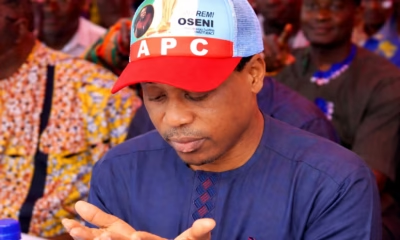




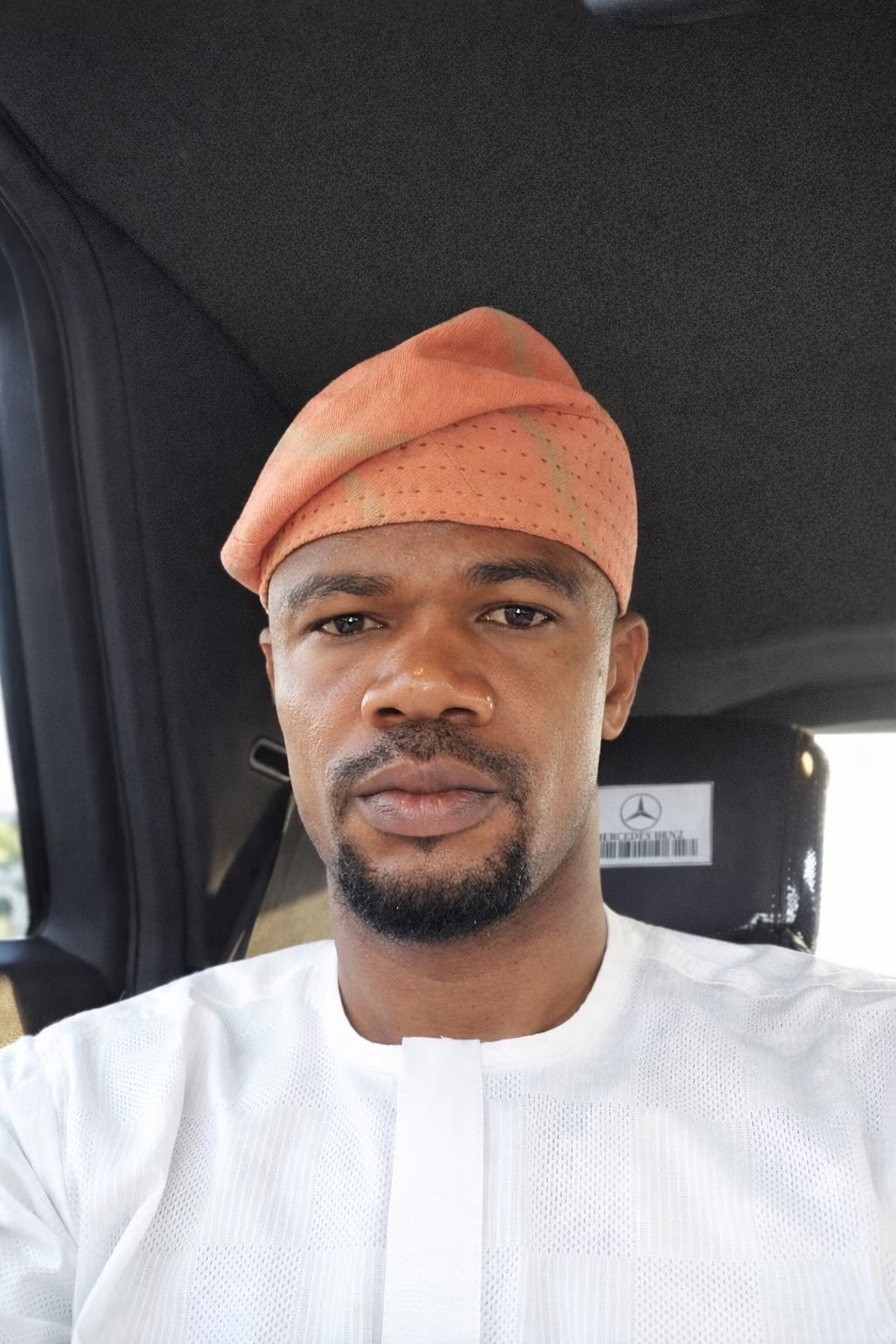
As the road to 2027 gradually unfolds across Oyo State, political conversations are shifting from routine permutations to deeper questions about competence, generational leadership, and measurable impact. In Ibarapa East, that conversation has found a new voice in Yusuf Abiodun Ramon — a Lanlate-born technocrat whose entry into the race for the State House of Assembly is redefining what representation could mean for the constituency.
In a political environment often dominated by familiar faces and conventional calculations, Ramon presents a profile shaped by technical discipline, structured thinking, and solution-driven engagement. His professional background, anchored in analytical precision and systems management, forms the foundation of his public service aspiration.
For him, representation must move beyond ceremonial presence to practical responsiveness — laws that reflect local realities, oversight that protects public resources, and advocacy that translates into visible development.
Ramon argues that the future of Ibarapa East lies in leadership that listens deliberately, plans strategically, and delivers measurably. He speaks of strengthening rural infrastructure, expanding youth-driven economic opportunities, and institutionalising transparency as core pillars of his agenda. In his view, governance must not merely be symbolic; it must be structured, accountable, and people-centred.
Rooted in Ile Odede, Isale Alubata Compound, Ward Seven of Ibarapa East Local Government, and maternally linked to Ile Sobaloju, Isale Ajidun Compound, Eruwa, Ramon’s story is not one of distant ambition but of lived experience. He is, in every sense, a son of the soil — shaped by the same roads, schools, and economic realities that define daily life in Ibarapa East.
“I was born here. I grew up here. I understand our struggles, our strengths, and our untapped potential,” he says. “Representation must go beyond occupying a seat; it must translate into preparation, competence, and genuine commitment to development.”
His academic journey mirrors that philosophy of steady growth. He began at Islamic Primary School, Lanlate (1995–2001), proceeded to Baptist Grammar School, Orita Eruwa (2001–2007), and later earned a National Diploma in Mechanical Engineering Technology from Federal Polytechnic, Ilaro, between 2009 and 2011. Refusing to plateau, he advanced his intellectual horizon and is now completing a Bachelor of Science in Business Administration at the University of Lagos. “Education,” he reflects, “is continuous capacity building. Leadership today requires both technical knowledge and administrative insight.”
That blend of engineering precision and managerial training has defined a professional career spanning more than a decade. Shortly after his diploma, Yusuf joined Mikano International Limited as a generator installer, gaining hands-on experience in industrial power systems — a sector central to Nigeria’s infrastructural backbone. He later transitioned into telecommunications at Safari Telecoms Nigeria Limited, where he received specialized training in Industrial, Scientific, and Medical radio bands, strengthening his expertise in network operations.
In 2013, he became a Field Support Engineer at Netrux Global Concepts Ltd., then a leading ISM service provider in Nigeria. Over four formative years, he immersed himself in telecom infrastructure deployment and maintenance, mastering field coordination, logistics management, and real-time technical problem-solving.
Since July 2017, he has served as a Field Support Engineer with Specific Tools and Techniques Ltd., a power solutions firm providing services to major operators including MTN Nigeria and Airtel Nigeria. In that capacity, he operates at the frontline of ensuring energy reliability and network uptime — responsibilities that demand discipline, accountability, and systems thinking.
For political observers in Ibarapa East, this trajectory matters. It reflects more than résumé credentials; it speaks to a mindset anchored in efficiency, coordination, and measurable outcomes — qualities increasingly demanded in legislative representation.
Beyond the private sector, Ramon’s political exposure is neither sudden nor superficial. A loyal member of the progressive political family in Lagos, he once served as a personal assistant to a former lawmaker, gaining practical insight into legislative procedure and constituency engagement. Within his community, he has quietly extended financial support to small-scale entrepreneurs and students — modest but consistent interventions rooted in personal responsibility.
“My interest is my people,” he states firmly. “Ibarapa East deserves strategic, responsive, and capable leadership at the State Assembly. We must move from rhetoric to results.”
Across the constituency — from Lanlate to Eruwa — development priorities remain clear: youth employment, vocational empowerment, rural road rehabilitation, stable power supply, agricultural value-chain expansion, improved educational standards, and stronger lawmaking that directly reflects community needs.
Political analysts argue that Ramon’s technocratic background positions him uniquely at the intersection of policy formulation and practical implementation. At a time when national discourse increasingly favours competence over grandstanding, his profile resonates with a broader generational shift toward performance-driven governance. His engineering discipline reinforces problem-solving; his business training strengthens administrative understanding; his grassroots roots anchor his empathy.
For Ibarapa East, the 2027 election cycle may represent more than a routine democratic exercise. It may mark a recalibration of expectations — a demand for representation that understands both the soil beneath its feet and the systems that drive modern development. As political alignments gradually crystallize in Oyo State, Yusuf Abiodun Ramon’s declaration signals the arrival of a candidate seeking to translate private-sector structure into public-sector impact.
One thing is clear: the conversation about the future of Ibarapa East has begun — and it is now framed around competence, credibility, and capacity.
Oluwasegun Idowu sent in this piece from Eruwa, Ibarapa East LG, Oyo State
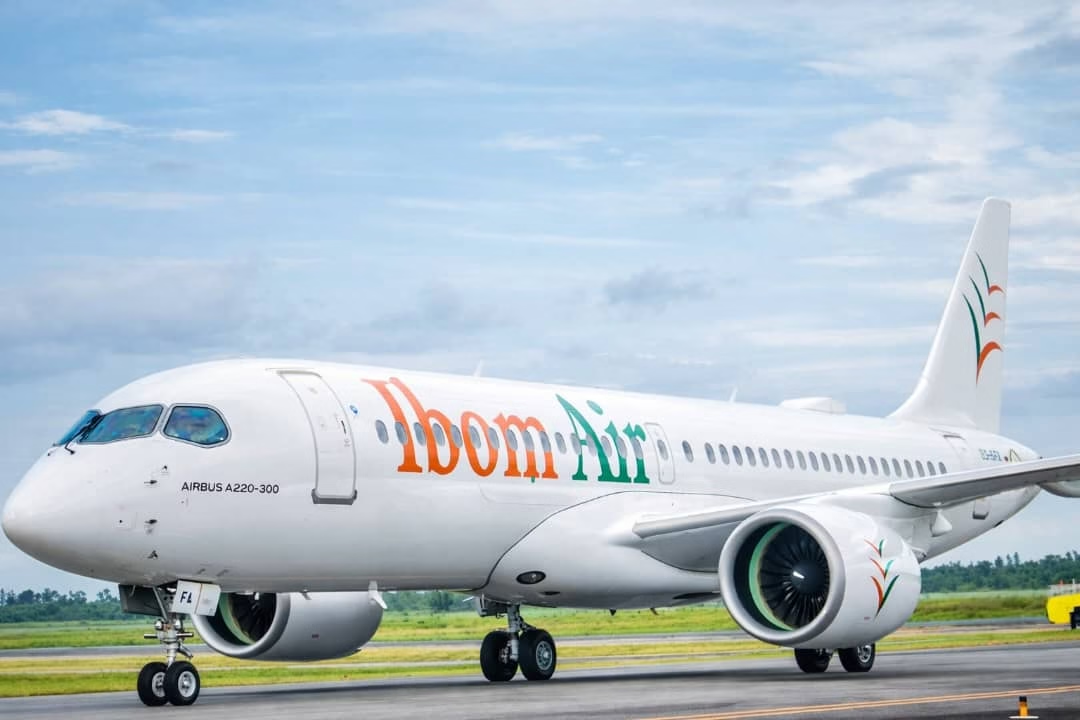
“In a sky where delays are normal, one airline flies with precision and trust. Ibom Air shows that reliability can be a strategy”.
In Nigeria’s skies, where flight delays and cancellations are often taken as routine, Ibom Air has quietly rewritten the rules. From the moment it launched in June 2019, the Akwa Ibom State–owned carrier has treated reliability not as a bonus, but as a core strategy—turning punctuality, discipline, and operational excellence into a competitive edge that passengers can count on.
While most airlines chase rapid expansion or flashy promotions, Ibom Air has chosen consistency. Flights depart on schedule, disruptions are minimal, and communication with passengers is clear and timely. This predictability has quickly earned the airline a loyal following among business travellers, professionals, government officials, and families for whom time is invaluable.
The airline’s approach is methodical. Every flight is treated as a commitment, and operational decisions are guided by structured planning, not improvisation. This discipline underpins everything from scheduling to fleet management, ensuring passengers experience flying without surprises.
Central to this model is Ibom Air’s modern fleet. Its Airbus A220-300 and Bombardier CRJ-900 aircraft are fuel-efficient, comfortable, and rigorously maintained to meet both manufacturers’ specifications and the regulatory standards of the Nigerian Civil Aviation Authority and international aviation bodies. Safety here is a culture, not a compliance exercise.
Cabin cleanliness and aircraft health are equally prioritized. Passengers consistently step into neat, hygienic, and professionally maintained cabins, reinforcing confidence and comfort even before take-off. In a sector where small details signal operational quality, Ibom Air’s standards speak volumes.
Technology quietly drives reliability across operations. From booking and check-in to flight coordination and customer service, modern systems enhance efficiency, reduce disruptions, and ensure smooth communication. These tools allow the airline to anticipate challenges rather than merely react.
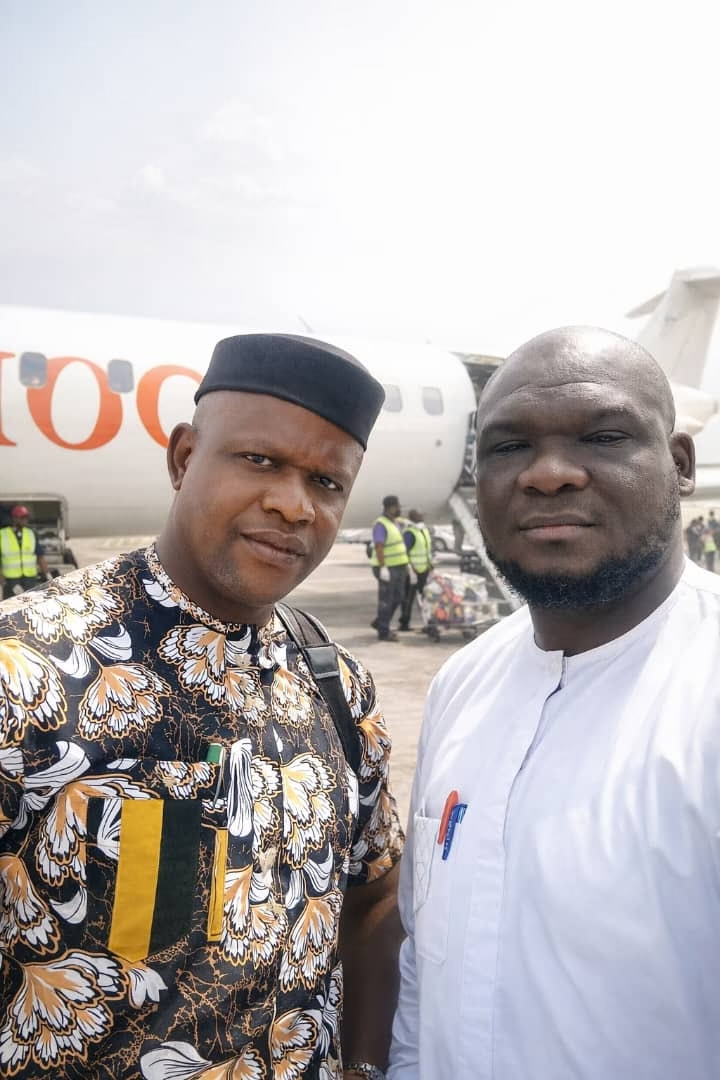
R–L: Dr. Solomon Oroge, a consultant, and Mr. Idowu Ayodele, journalist and media practitioner, aboard an Ibom Air flight.
Service delivery follows the same disciplined pattern. Pilots, cabin crew, engineers, and ground staff operate under strict professional standards. Courtesy is paired with efficiency, and calm, structured service ensures passengers feel confident throughout their journey.
The Ibom Flyer loyalty programme reflects this structured approach, rewarding consistent passengers and fostering long-term engagement. It turns reliability into a tangible benefit for frequent flyers.
From its hub at Victor Attah International Airport, Uyo, Ibom Air serves major Nigerian cities including Lagos, Abuja, Port Harcourt, Calabar, and Enugu, while extending its reach to West Africa with flights to Accra, Ghana. Expansion is deliberate, prioritizing sustainability over rapid growth that could compromise service quality.
Measured growth allows the airline to maintain operational excellence and service consistency even as demand increases—a strategy that contrasts sharply with competitors whose rapid expansion often strains resources.
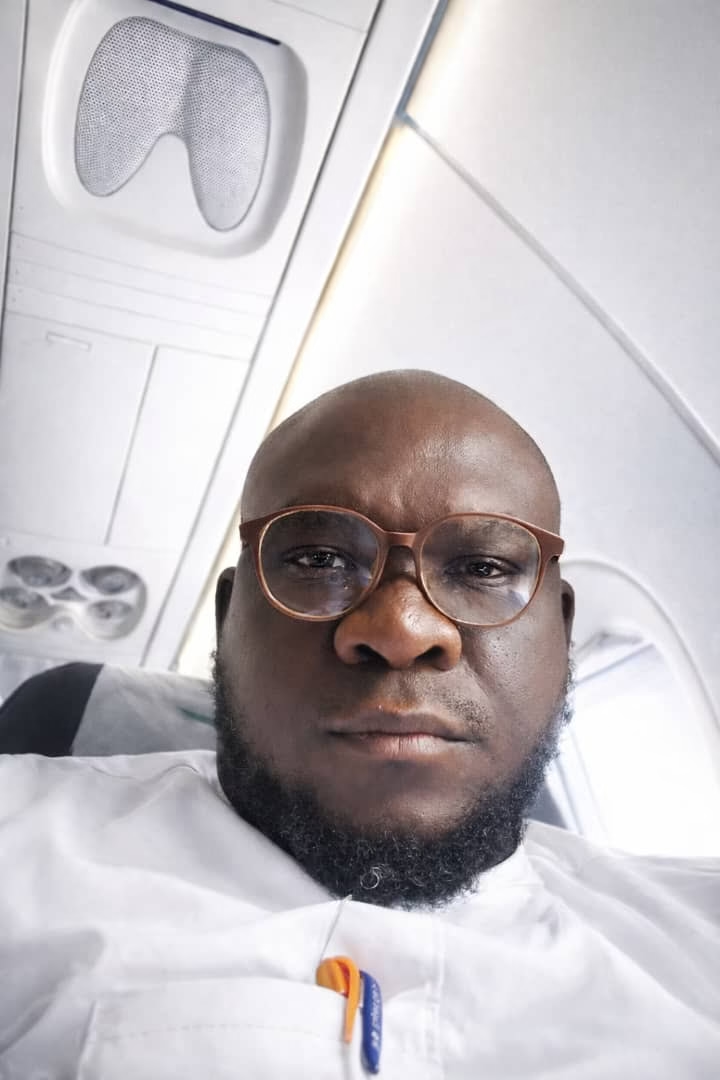
Mr. Idowu Ayodele, journalist and media practitioner, pictured inside an Ibom Air aircraft.
Beyond commercial success, Ibom Air has become a national example. It has created employment, stimulated tourism, and strengthened regional connectivity, projecting a positive image of Nigerian aviation at a time when confidence in the sector is often fragile.
The airline has also challenged assumptions about government-owned enterprises. By combining professional management with operational autonomy, it demonstrates that public investment can achieve efficiency, accountability, and competitiveness.
Reliability, in the case of Ibom Air, is than a promise—it is a deliberate business philosophy. It shapes operations, informs decisions, and builds passenger trust consistently.
Technology, discipline, and attention to detail converge to produce an airline that works. Every element, from fleet maintenance to cabin service, supports the promise that Ibom Air delivers what it advertises—without surprises.
In a market where uncertainty has been the norm, Ibom Air has shown that consistency can be a strategic advantage. Passengers no longer fly with anxiety; they fly with confidence, knowing their schedules will hold and service will meet expectations.
Ultimately, Ibom Air is not just an airline—it is a model of operational excellence in Nigerian aviation. By prioritizing reliability over spectacle, discipline over improvisation, and planning over shortcuts, it sets a benchmark for the industry and a standard for passengers: in the skies, predictability is priceless
Idowu Ayodele – Journalist, Ibadan, Oyo State
0805 889 3736 | megaiconpress@gmail.com
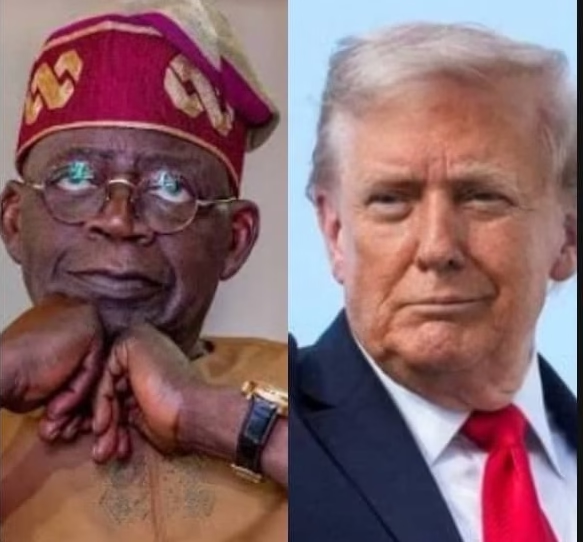
In Homer’s epic poem The Odyssey, the concept of the “Greek gift” was invented. The Trojan Horse became the undoing of Troy, ending a decade-long war in which many Greeks had perished, including the mighty Achilles. The Trojans accepted the Greeks’ gift, and the rest, as they say, is history.
In the past few days, both social and conventional media have been agog with reactions to President Donald J. Trump’s threat to the Nigerian government regarding terrorism. In his words, Nigeria must “address the genocide against Christians in the North and Middle Belt, or else the U.S. will cut aid to the country and, in addition, come into the country guns blazing in an attempt to flush out the terrorists.”
Sincerely speaking, the tweet made by the U.S. President sounded a bit comical to me, as did many other commentaries that followed. Comical not in a ridiculous sense, but in a comedic sense.
This piece is not written to support or oppose any particular view, but to lay down facts in the most succinct and objective manner, thereby allowing for the independence of a balanced position.
In 2009, a terror group named Jama’at Ahl al-Sunna li al-Da’wa wa al-Jihad (popularly referred to as Boko Haram) emerged with the aim of establishing Islamic rule across Nigeria. According to the group, Sharia was the only path to true progress, and any faith other than Islam was haram (forbidden).
Soon after, this group began launching vicious attacks against Christians and Christian places of worship. From singularly attacking Christians, their targets shifted to government institutions and facilities, and on 28 November 2014, one of the greatest attacks against fellow Muslims occurred with the bombing and mass shooting of Juma’at worshippers at the Kano Central Mosque. Over 120 worshippers were killed and another 260 critically injured.
The point here is to underscore the fact that Boko Haram—and indeed all other extremist groups in Nigeria—are not targeting Christians alone, as earlier claimed, but are pursuing a more sinister agenda of land grabbing with the colouration of economic, psychological and socio-political domination of conquered territories, with intentions of spreading across the country.
From the Northeast, the activities of wanton killing and destruction perpetrated by terrorists spread to the North Central region, particularly Plateau and Benue States. What originally began as farmer–herder clashes metamorphosed into full-blown village and community sackings, where Fulani invaders razed entire communities, leaving hundreds dead or wounded while survivors were displaced and left with harrowing experiences in IDP camps.
This wave of destruction continued, with one of the bloodiest in recent times occurring in Yelwata, Guma Local Government Area of Benue State, on the night of 13–14 June 2025. According to Amnesty/CE/UN/NGO, over 200 people were gruesomely massacred, several houses burnt to ashes, and about 3,000 people displaced and rendered homeless. In 2025 alone, Amnesty reported more than 10,000 additional people displaced in Benue across several local governments, ranging from Gwer West to Agatu, Ukum/Gbagir, Logo, Kwande and Guma.
From the North Central, terrorism—or better still, banditry—also found its way to the North West. The activities of bandits, kidnappers and other criminal elements were consistently reported in Zamfara, Kaduna, Kebbi, Sokoto, Kano, and even Katsina, which was once regarded as the true home of hospitality, as its state slogan depicts, and as I can also attest considering how much I enjoyed the peace and serenity of the state during my days therein as a Youth Corps member. Reuters.ng reports that as of 2025, approximately 2,456 people had been killed in the North West region across multiple states. In addition to this, about 7,260 people, including schoolchildren and commuters on highways, had been abducted, with several millions of naira collected by kidnappers as ransom payments. Some parts of the South West, South East and South South have not been spared the atrocities of terrorists and bandits.
Therefore, it is safe to say that the entire country has, at one time or the other, experienced the activities of bandits, terrorists and kidnappers. The intensity of attack, however, differs from region to region.
Late General Sani Abacha once said that “if any insurgency lasts for more than 24 hours, a government official has a hand in it.” This saying more or less amplifies the complexity of the terrorism–banditry–kidnapping problem in Nigeria. Nigeria is a country abundantly blessed with all manners of rich mineral resources. Apart from the vast arable land required for productive agriculture, there is virtually no region of the country that does not possess one valuable solid mineral or another.
From iron ore in Zamfara, Kogi and Enugu; gold in Kaduna, Kebbi and Osun; lithium in Nasarawa, Kwara, Oyo and the FCT; bitumen in Ondo, Edo and Ogun; plus other industrial minerals like gypsum, kaolin and limestone, with deposits of over one billion tonnes across many states—Nigeria is sitting on an incredibly underutilised treasure worth billions of dollars. The government’s inability to adequately manage these vast potentials provides fertile grounds for opportunistic scrambling, illegal mining, chaos and its attendant conflicts.
One can therefore boldly say that the chaos and violence camouflaged as terrorism and banditry is indeed a calculated campaign driven not just by Islamic extremism but by land grabbing and occupation for the purpose of blood mineral extraction and illicit mining.
Thus, a sophisticatedly armed radical Islamic Fulani ethnic militia, often operating under political protection, carries out multiple killings, displacements and kidnappings across the Northeast, North Central and North West, after which reports reveal that foreign miners appear following the death and displacement of indigenes to exploit the lands.
Amnesty International has also reported that Nigeria loses over $9 billion annually to illicit mining of gold, tin and lithium, with a significant portion—estimated at 10%—funding violence and corruption. The report further revealed that the involvement of some government elements in this corruption is not in doubt, as eyewitness reports of survivors and satellite surveillance footage revealed the connivance of certain government personnel. Some survivors have also repeatedly claimed that they witnessed helicopters in the middle of the night dropping weapons and ammunition for the bandits—a disclosure corroborated by Professor Bolaji Akinyemi in an interview on African Stream earlier this year.
So, it is right to say that the violence and carnage are just a smokescreen and a catalyst to a far-reaching economic, psychological and socio-political agenda of certain influential elements in the country. This is part of the reason why the billions of naira spent on security to equip the military to better fight insurgency have not yielded much result to date.
In addressing the threat of President Donald Trump, I would like to start by recounting a little history about the 47th President of the United States and his previous antecedents. In January 2018, at a news conference in the White House, President Trump referred to Haiti and some African countries—including Nigeria—as “shithole countries” that should not be accorded immigrant status in the U.S.
Furthermore, his government’s stern immigration policies and visa restrictions clearly reflect a hostile stance towards Africa and some other Global South countries. In light of this, it is hard to understand where the sudden genuine concern for Nigerian Christians is coming from—more so when a U.S. congressman earlier this year revealed that USAID played a significant role in the funding of Boko Haram and other terrorist groups. This concern was never mentioned when Late President Muhammadu Buhari visited the White House a few months after the “shithole” saga and was praised by the same Trump for his valiant efforts in fighting Boko Haram and ISWAP, despite staggering reports of attacks and killings in the Northeast and North Central during that period.
Under the erudite scholarship of Professor Kunle Ajayi, I learnt several years ago, in one of our Politics of Global Economic Relations lectures, that in world politics and global socio-economic relations, the overriding determinant of states’ decisions and actions is strategic interest. Altruism is hardly ever a factor.
Present realities of Nigeria’s economic relations are fast approaching self-sufficiency—particularly in the oil sector, where Nigeria was once a major importer of finished petroleum products from the U.S. The Dangote refinery, having begun domestic refining and production of petroleum products, is fast taking over a market once dominated by imports from the U.S. This shift, no doubt, is taking jobs away from American oil workers—no cheering news for the country’s oil conglomerates. Secondly, China has since replaced the United States as Nigeria’s foremost trading partner.
According to Nairametrics (2025), the value of trade between Nigeria and China between 2023–2025 totals approximately $50 billion compared to an estimated $30 billion with the U.S. This paradigm shift would certainly not be palatable to the U.S. or her president, who happens to be a dogged businessman that hates the word “no”. From this perspective, it is not difficult to see where President Trump is coming from.
Be that as it may, I think Nigeria needs to employ shrewd diplomacy in dealing with the U.S. under a president like Donald Trump. Regardless of international law and conventions, the U.S. has repeatedly proven itself willing to take unilateral military action against countries, defying the rule of law and popular global opinion. So those hinging on Nigeria’s sovereignty as a deterrent to the U.S. are not good students of history.
What is, however, more important in all of this is that global attention is once again drawn to the horrible atrocities of these criminal elements in Nigeria. The country cannot continue to behave as though it is normal headline news when people are slaughtered daily, and families and homes are torn apart.
I believe this is an opportunity for the government to rejig the entire security architecture of the country, with the needed political will, to once and for all end these killings. Strategic partnership with the United States in this regard is not a bad idea. With its extensive experience in counter-terrorism operations and access to sophisticated military technology and intelligence, the U.S. can assist in identifying and eradicating the major financiers and enablers of terrorism and banditry. It is not rocket science that when the financing of terrorists ends, terrorism ceases to exist.
However, this should be done only on the basis of shared interest, mutual respect, trust, and understanding reflective of a healthy and balanced foreign policy relationship. By prioritising constructive diplomacy, dialogue and partnership, Nigeria can work with the United States in a strategic alliance to restore peace, security and confidence across the nation. That is the way to go.
Olusegun Hassan, Ph.D
Public Policy Analyst and Social Commentator





-
 Politics3 days ago
Ibarapa East Assembly Hopeful, Ramon Congratulates Ajiboye, Says Emergence Good for Oyo APC
-
 Politics1 week ago
Makinde: My Successor Must Be Loyal to Oyo, Not Me
-
 Politics3 days ago
2027: Former Oyo Deputy Governor Adeyemo Emerges APC Chairman (See Full List)
-

 News3 days ago
NERC orders DisCos to refund ₦20.33bn meter costs to customers