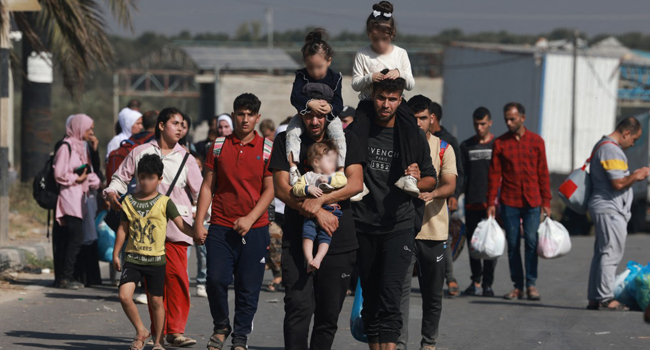
Tens of thousands of Palestinians fled the fighting and bombardment in Gaza, as Israel said it was tightening the “stranglehold” around Hamas and again rejected a ceasefire without the release of hostages.
Calls for a ceasefire to protect civilians have built over a month into the war sparked when Hamas attacked Israel and, according to Israeli officials, killed about 1,400 people, mainly civilians, and seized 239 hostages.
Aiming to destroy Hamas, Israel retaliated with a relentless bombardment and ground invasion of the Gaza Strip that, according to the Hamas-run health ministry in Gaza, has killed more than 10,500 people, many of them children.
But Israeli Prime Minister Benjamin Netanyahu again rejected the prospect of a ceasefire in Gaza, amid reports of negotiations for a temporary truce with Hamas to allow in humanitarian aid.
The Israeli army said 50,000 people left north Gaza for the south of the narrow coastal strip on Wednesday as the fighting raged between Hamas’s armed wing, the Ezzedine al-Qassam Brigades, and Israeli troops.
“We saw today how 50,000 Gazans moved from northern Gaza to southern Gaza,” said military spokesman Daniel Hagari. “They’re leaving because they understand that Hamas lost control in the north, and in the south it’s safer.”
Around 15,000 people had fled on Tuesday, compared with 5,000 on Monday and 2,000 on Sunday, said the UN Office for the Coordination of Humanitarian Affairs (OCHA).
UN rights chief Volker Turk condemned Israel over the forced evacuations during a visit to the Rafah border crossing between Gaza and Egypt, the only way out of the besieged territory that is not controlled by Israel.
“The collective punishment by Israel of Palestinian civilians amounts also to a war crime, as does the unlawful forcible evacuation of civilians,” he told a news conference.
“The aid getting through is a trickle,” Turk said, adding it was Israel’s obligation to “ensure a maximum of basic necessities of life that can reach all who need it.”
A Hamas official told AFP that evacuations of wounded Palestinians and dual nationals were interrupted Wednesday despite a large crowd waiting at the crossing terminal, blaming what they said was Israel’s refusal to approve the list of wounded to be taken across the border.
‘Where can we go?’
A source close to Hamas had said talks were underway for the release of a dozen hostages held by the Islamists, including six Americans, in return for a three-day ceasefire in Gaza.
Earlier a separate source briefed on the talks said Qatar was mediating negotiations in coordination with the US to free “10-15 hostages in exchange for a one- to two-day ceasefire”.
As the talks proceeded, the pace of Palestinian civilians fleeing south from northern Gaza accelerated in the face of Israel’s intensifying air and ground campaign, according to UN observers.
“We’ve lost our homes, we’ve lost our children. Where is the global community? Where are our fellow Muslims? Look at us!” said Nouh Hammouda, who was among those fleeing.
“We left our homes due to the relentless bombardment. Where can we go now?” he said as people streamed southward on the road.
Israel has set an aim of destroying Hamas and said its ground forces were advancing in pursuit of the militants who have a deep network of tunnels and underground bases.
“(Israeli troops) are tightening the stranglehold around the city of Gaza,” Defence Minister Yoav Gallant said.
Israel has air-dropped leaflets and sent texts ordering civilians in northern Gaza to flee south, but potentially hundreds of thousands remained in the worst-hit areas.
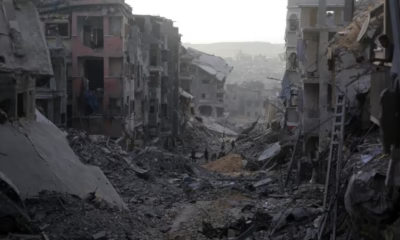
Images taken by an AFP journalist embedded with Israeli troops showed them emerging from tanks to comb the shells of Gaza residential buildings destroyed in the fighting.
Hamas accused the United Nations agency for Palestinian refugees (UNRWA) of “colluding” with Israel in the “forced displacement” of Gazans, after residents followed instructions to flee.
An UNRWA spokeswoman did not immediately respond when contacted by AFP about the Hamas accusation.
Fierce streets battles
G7 foreign ministers said they supported “humanitarian pauses and corridors” in the Israel-Hamas war, but stopped short of calling for a ceasefire.
As fighting intensifies in Gaza, families of people taken hostage by Hamas have been pushing on various fronts for help to bring their loved ones home.
“Every day is like eternity to me and I can’t wait any longer,” Doris Liber, whose 26-year-old son Guy Iluz was shot and taken hostage at a music festival, told reporters in Washington.
Military analysts warned of weeks of gruelling house-to-house fighting ahead in Gaza.
The operation is hugely complicated for Israel because of the hostages, including very young children and frail elderly people, who are believed to be held inside a vast tunnel network.
The Israeli army said it had uncovered around 130 tunnel entrances in Gaza. It also reported the deaths of two more soldiers, bringing to 33 the total number killed in the offensive.
Hamas released video footage of fierce street battles between its armed wing, the Al-Qassam Brigades, and Israeli forces in the northern and southern axis of Gaza City.
In densely packed Gaza — where more than 1.5 million people have fled their homes in a desperate search for safety — the suffering is immense.
Hamas said several cemeteries in Gaza had “no more space for burials”, while the UN Office for the Coordination of Humanitarian Affairs (OCHA) said most of the territory’s sewage pumping stations were shut.
A rare delivery of emergency medical supplies and medicines on Wednesday reached Al-Shifa hospital in Gaza City, the UN and World Health Organization said.
But they highlighted the delivery of life-saving supplies was only the second to reach the hospital since the war erupted and was “far from sufficient to respond to the immense needs”.
Tom Potokar, chief surgeon at the International Committee of the Red Cross who entered Gaza on October 27, described the scene at the European hospital in Khan Yunis as “relentless” and “catastrophic”.
“In the last 24 hours, I’ve seen three patients with maggots in their wounds,” including a six-year-old child, he said in a telephone interview.
“It’s almost like you can’t find somebody who hasn’t lost members of their family” from among the patients and staff, he said, adding there were “cases where you see a child come in where they have nobody, they’ve lost their whole family.”
‘Premature’ for Gaza scenarios
Israel accuses Hamas of building military tunnels underneath hospitals, schools and mosques — charges the militant group denies.
Israel has hammered Gaza with more than 12,000 air and artillery strikes and sent in ground forces that have effectively cut it in half.
An independent UN expert branded Israel’s systematic bombardment of housing and civilian infrastructure in Gaza as well as Hamas’s rocket attacks that hit Israeli dwellings as war crimes.
The Israeli government said Wednesday it was “premature” to predict scenarios for Gaza after it ousts Hamas, but that it was already discussing the prospect with other countries.
Israel withdrew from the Gaza Strip in 2005 and two years later imposed a crippling air, sea and land blockade, as Hamas took control of the Palestinian territory.
“We’re exploring several contingencies together with our international partners for what the ‘day after’ will look like,” said government spokesman Eylon Levy.
But the “common denominator” is that Gaza will be “demilitarised” and “must never again” become a “terror nest”, he said.
Netanyahu had said earlier this week that Israel would assume “overall security” of Gaza.
Violence is also increasing in the West Bank, Palestinian territory occupied by Israel since 1967, where more than 150 Palestinians have been killed by fire from Israeli soldiers or settlers since October 7, according to the Palestinian Authority.
Israeli air strikes on Wednesday killed three pro-Iran fighters as they hit sites belonging to the powerful Lebanese Hezbollah group near the Syrian capital Damascus, a war monitor said.
Israel has struck Syria several times in the past month as regional tensions simmer.