Connect with us

Politics

Samia Suluhu sworn in as Tanzanian first female president

Published

on

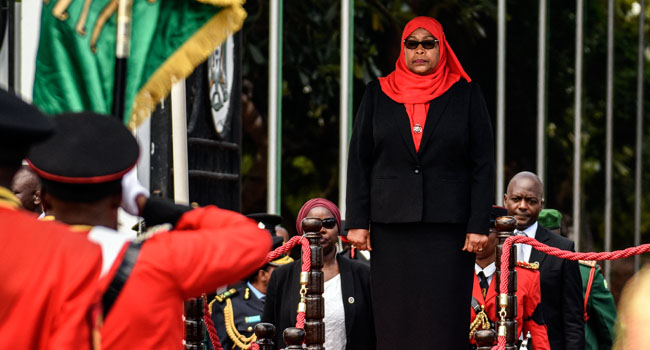
Tanzania’s Samia Suluhu Hassan was on Friday sworn in as the country’s first female president after the sudden death of John Magufuli from an illness shrouded in mystery.

Hassan, 61, a soft-spoken Muslim woman from the island of Zanzibar, will finish Magufuli’s second five-year term, set to run until 2025.

Wearing a bright red headscarf, Hassan was sworn in as the country’s sixth president, at a ceremony in Dar es Salaam, where neither she nor the majority of attendees wore a mask, in the Covid-sceptic nation.

“I, Samia Suluhu Hassan, promise to be honest and obey and protect the constitution of Tanzania,” said the new president, as she took the oath of office before inspecting troops at a military parade and receiving a cannon salute.

She becomes the only other current serving female head of state in Africa alongside Ethiopia’s President Sahle-Work Zewde, whose role is mainly ceremonial.

Hassan was little known outside Tanzania until she appeared on state television on Wednesday night to announce that Magufuli had died aged 61 from a heart condition after a mysterious three -eek absence from public view.

But questions have been raised over the true cause of his death, after multiple rumours that Magufuli — one of the world’s most fervent Covid-sceptic leaders — had caught the virus and had sought treatment abroad.

Main opposition leader Tundu Lissu insists his sources said Magufuli had Covid-19 and had actually died a week ago.

And Kenya’s Daily Nation newspaper, which last week reported an “African leader”, in clear reference to Magufuli, was in a Nairobi hospital, on Friday gave more details of his illness, also indicating Magufuli had in fact died last week.

Citing sources, the paper said Magufuli was discharged from Nairobi Hospital on life support after it was determined he could not be resuscitated, and returned to Dar es Salaam where he died last Thursday.

The paper details his initial evacuation to Nairobi on March 8 in a medical plane, as he suffered “acute cardiac and respiratory illnesses.”

The main question hanging over the new president is whether she will usher in a change in leadership style from her predecessor, nicknamed the “Bulldozer”, notably in the handling of the pandemic.

– ‘A new chapter’ –
Magufuli leaves behind a complex legacy, after a swing to authoritarianism which saw him crack down on the media, activists and free speech, while refusing to take any measures against Covid-19.

He called for prayer instead of face masks, refused to publish case statistics or implement lockdown measures, and championed alternative medicines.

In May last year he revealed a papaya, quail and goat had tested positive for the virus in a secret operation, proving “sabotage” at the national laboratory.

However by February, as cases soared and the vice president of semi-autonomous Zanzibar was revealed to have died from Covid-19, Magufuli conceded the virus was still circulating.

The opposition and rights groups have urged Hassan to change course.

“As we continue mourning, let us use this period to open up a new chapter for rebuilding national unity and respect to freedom, justice, rule of law, democracy and people-centred development,” said Freeman Mbowe, the chairman of opposition group Chadema, in a statement Thursday.

He urged Hassan to “lead the nation toward reconciliation”.

Meanwhile Human Rights Watch said in a statement that the new government “has a chance for a fresh start by ending problematic past practices.”

– ‘Hold your breath’ –
However analysts say Hassan will face early pressure from powerful Magufuli allies within the party, who dominate intelligence and other critical aspects of government, and would try and steer her decisions and agenda.

“For those who were kind of expecting a breakaway from the Magufuli way of things I would say hold your breath at the moment,” said Thabit Jacob, a researcher at the Roskilde University in Denmark and expert on Tanzania.

Hailing from Zanzibar, the semi-autonomous island in the Indian Ocean, Hassan rose through the ranks over a 20-year political career from local government to the national assembly.

A ruling party stalwart, she was named Magufuli’s running mate in the 2015 presidential campaign. The pair were re-elected in October last year in a disputed poll marred by allegations of irregularities.

Hassan must consult the ruling Chama Cha Mapinduzi (CCM) about appointing a new vice president. The party is set to hold a special meeting of its central committee on Saturday.

Tanzania is observing a 14-day mourning period and details on Magufuli’s funeral have yet to be announced.

Magufuli is the second East African leader to die under mysterious circumstances.

Burundi’s equally Covid-sceptic leader, Pierre Nkurunziza, died from “heart failure” last June after his wife was flown to Nairobi to be treated for coronavirus.



Comments

Politics

2027: APC Perfects Consensus Strategy for Oyo

Published

on


Ahead of the 2027 general elections, the national leadership of the All Progressives Congress (APC) on Tuesday held a high-level strategic meeting with the Oyo State chapter of the party as part of efforts to reposition the APC for victory and prevent internal crisis ahead of the polls.

The development was first scooped by OYOINSIGHT.COM which quoted multiple party sources familiar with the closed-door deliberations.

Sources disclosed that the meeting, held in Abuja, focused largely on a consensus arrangement being considered by stakeholders of the party in Oyo State, in line with political templates reportedly being adopted in Lagos and Ogun states ahead of the next electoral cycle.

Party insiders said the move was aimed at strengthening unity within the fold of the opposition party in the state, minimising rancour during the primaries and presenting a formidable front against rival parties in 2027.

It was further gathered that some members of the state executive committee may have been subtly informed about preferred consensus candidates being considered for elective positions across the state.

Though details of the deliberations were still sketchy as of press time, sources hinted that the national leadership stressed the need for cohesion, discipline and strategic alignment among stakeholders to improve the party’s electoral fortunes in Oyo.

Those at the meeting included the Oyo APC Chairman, Moses Alake Adeyemo; the state secretary, Fatai Adesina Adeniyi; the Publicity Secretary, Olawale Sadare; the Organising Secretary, Aderemi Adepoju; and the Legal Adviser, Sunday Aborisade.

Others were the Women Leader, Adekemi Opatunde; the Youth Leader, Olalekan Oladejo; Joshua Oyebamiji; Tunde Oloyede; Sunday Babalola; Joseph Omoniyi; and Mojeed Adebayo.

As of the time of filing this report, the party had yet to issue an official statement on the outcome of the meeting.

Continue Reading

Politics

2027: Oyo APC Set for Credible Direct Primaries, Says Alake Adeyemo

Published

on

The Chairman of the All Progressives Congress (APC) in Oyo State, Chief Moses Alake Adeyemo, on Monday assured aspirants and party members that the party would conduct transparent, peaceful and credible direct primaries ahead of the 2027 general elections.

Adeyemo declared that no aspirant would be victimised or denied a level playing field, stressing that the party leadership remained committed to internal democracy and progressive ideals.

The former deputy governor spoke while receiving members of the APC Screening and Appeal Committees deployed from the party’s National Secretariat in Abuja at the APC Secretariat in Oke-Ado, Ibadan.

He disclosed that although the party initially explored consensus arrangements across elective positions, prevailing realities indicated that direct primaries would be conducted in some areas, including the governorship contest.

Adeyemo said the party had already put necessary structures in place to ensure a hitch-free exercise capable of strengthening unity within the APC.

He said: “We set machineries in motion for us to achieve the aim of consensus across board but reports available to me indicate that we would have to go by the second option which is direct primary in certain cases including the governorship ticket.

“To this end, we shall work towards organising free, fair and credible exercise in all the affected areas even as we cannot rule out the possibility of some aspirants having a rethink and supporting the consensus arrangement as necessary.

“Where we have more than an aspirant, Abuja would send people to conduct primaries and we at the state level would provide the required support to make everything work out in the interest of our great party.”

The APC chairman explained that all registered party members would participate fully in the exercise at their respective wards on dates to be announced by the National Secretariat.

According to him, affirmation would be adopted in areas where consensus candidates emerge, while voting would be conducted wherever direct primaries become necessary.

“For consensus, members will lend their voices for affirmation while voting will be done in the cases of direct primary,” he added.

Speaking earlier, Chairman of the Screening Committee and former Speaker of the Ondo State House of Assembly, Rt. Hon. Taofiq AbdusSalam, assured party faithful that the committee would carry out a thorough, transparent and unbiased screening process.

He said only eligible aspirants would be cleared to participate in the primaries and eventually fly the APC flag in the forthcoming elections.

Other members of the Screening Committee are Kamal Sanusi (Secretary), Smart Oluwole, Tunde Kolade and Olabamiji Agunloye.

Members of the Screening Appeal Committee are Jibola Oduwole (Chairman), Abimbola Jack (Secretary) and Jelil Jimoh.

Continue Reading

Politics

NDC zones 2027 presidency to South, reserves 2031 for North

Published

on

The Nigeria Democratic Congress on Saturday zoned its 2027 presidential ticket to Southern Nigeria, declaring that the party’s candidate would serve a single four-year term if elected.

The decision was reached during the party’s national convention held in Abuja amid growing momentum within the opposition platform following a wave of high-profile defections from other political parties.

Announcing the development on its official social media handle, the party stated, “NDC presidential ticket is zoned to the South!!”

The party also resolved that its 2031 presidential ticket would be ceded to Northern Nigeria as part of efforts to maintain regional balance and internal equity.

The convention comes as key opposition figures, including former Labour Party presidential candidate, Peter Obi, and former New Nigeria People’s Party presidential candidate, Rabiu Kwankwaso, joined party leaders and delegates at the Abuja gathering.

Saturday’s convention is expected to ratify several recent decisions taken by the party’s National Executive Committee, including zoning arrangements, amendments to the party constitution, and the election of new national executives.

According to the convention agenda obtained by journalists, discussions centred on zoning, ratification of the amended constitution, and leadership restructuring ahead of the 2027 general elections.

The NDC has in recent weeks witnessed a surge in defections from rival opposition parties, particularly the African Democratic Congress and the Peoples Democratic Party.

On Tuesday, no fewer than 17 members of the House of Representatives defected from the ADC to the NDC.

Their defections were formally announced during plenary at the House of Representatives.

The lawmakers include Yusuf Datti, Uchenna Okonkwo, Adamu Wakili, Thaddeus Attah, George Ozodinobi, Lilian Orogbu, Oluwaseyi Sowunmi, Peter Aniekwe, Mukhtar Zakari, George Oluwande and Munachim Umezuruike.
Others are Emeka Idu, Jesse Onuakalusi, Ifeanyi Uzokwe, Afam Ogene, Murphy Omoruyi and Abdulhakeem Ado.
The defections came barely two days after Obi and Kwankwaso formally joined the NDC from the ADC.

The duo were presented with the party’s membership cards last Sunday shortly after a closed-door meeting with party leaders.

A former Governor of Bayelsa State and NDC national leader, Seriake Dickson, officially welcomed the opposition figures into the party.

Obi had attributed his exit from the ADC to worsening internal crises, external interference and what he described as increasing hostility within party structures.

The former Anambra State governor said Nigeria’s political environment had become increasingly toxic, marked by intimidation, insecurity and sustained scrutiny of opposition figures.

He also lamented that institutions meant to protect citizens were now often deployed against them, while individuals committed to genuine public service faced mounting pressure both publicly and privately.

Continue Reading

Advertisement

Entertainment

Advertisement

MegaIcon Magazine Facebook Page

Advertisement

MEGAICON TV

Advertisement

Trending