
National Issues
Revisiting Nigeria’s political trajectory



The political formation, which eventually secured Nigeria’s independence, was powered by the ideals of independence and Nigerians expected that the country’s domestic affairs would be wholesome. However, immediately after the independence issue got sorted, her internal socio-political contradictions and gray public administration dynamics became manifest. To put it mildly, things that were hitherto not so observable, even by the political gladiators, were thereafter obvious to the public, especially, the educated Nigerians.
The transfer of power was just a ceremony; the government’s policy contents and implications on the nitty-gritty of the day-to-day administration became dawned on the people onto whom the power was transferred.
Contextually, Nigerians might have been thinking that, once Nigeria attained independence, it was only a matter of time before she would access non-negotiable, reckoned greatness and enter into the Promised Land, where all things would be bright and beautiful. But then, it is unfortunate that Nigeria’s political trajectory is one of missed and/or messed-up opportunities; nothing but a wholesale fraud! The experiential reality of Nigeria is that of a confused society experimenting with the concept and unclear idea of an independent state. Sad, that so far, the pathway through which leaders emerge in Nigeria is lined with malignant cancerous cells which have for long been left unattended. So, leadership remains problematic!
Though debatable, Nigeria’s problems as a nation-state have not been unconnected with how to move the country forward. They were not very many; but, while some Nigerians already had advanced knowledge of how the country should run and develop, others were held back by the primitive ideas of their forebears. To them, truncating this age-long mode of living could be likened to a descent into slavery. Jephthah was careless and lost his only child! Needless to highlight therefore the lack of consensus or an agreeable definition of development among the critical mass of Nigerians; even the elite, to date! The level of education or lack of it, across the board, has also not helped matters. The ability to interpret and process information for the use of the country’s handlers is also at its ebb.
Well, while it is easier to blame the government or third party, it becomes a different ballgame entirely when one is saddled with the responsibility and the power to execute government policies. So, issues like differences in ethnicity, religion, culture, and differential geographical locations not only became manifest,post-independence; they also constituted the fault lines in Nigeria’s geopolitical space. Perhaps, they remain the topical issues till tomorrow!
Take the Hausa culture as a case study! A section of the North never forgave the late Obafemi Awolowo for attempting to introduce western education to the region. Awolowo was already going on the path of Lin Kuan Yew by making education free and compulsory in the then Western Region. Depending on how buoyant the economy was, he had wanted education to be free up to the university level. In his view, the sane option was to train all, regardless of tribe, religion, or gender; because today’s untrained children were most likely to become the future’s serious liability. Whereas the novel idea was embraced in the Western Region, the Northern Region drove Awolowo away with his Free Education and allied ‘jargons.’ With the helpful knowledge of hindsight, is it any wonder that almajirai still thrives in parts of the country, decades after independence? Had we trekked this now-lost path, wouldn’t the country have long overcome the basest challenges that have now paralysed its faith? And, if we may ask, can there be any meaningful development without education?
It is interesting to note that the majority of Nigerians still cling to the hope that their dear country would develop. Why did I say so? It was a tug of war among the regions before the leaders could agree that there should be independence. As fate would have it, the region that welcomed it the least is the region now enjoying the benefits therefrom the most. Come to think of it, immediately Awoism was removed from the system of government, Nigeria began to retrogress. Even, in the Southwest, our pride as the economic powerhouse and epicenter of civilization for the country began to wane. A peep into WAEC results in the last five or six years would confirm how backward the zone has become in its much-touted prowess in education because of the status enhancement, hitherto attached to it in this part of the world, has taken flight. Since leadership is insensitive to anything, the pursuit of excellence via education no longer has any meaning. So, all the efforts of leaders like Awolowo have become redundant!
I have argued elsewhere that Nigeria’s major challenge is the absence of leaders with known aggressive pursuits towards knowledge, innovation, and/or development. On December 31, 1983, the Buhari/Idiagbon regime identified gross indiscipline and corruption as the main reasons for Shehu Shagari’s ouster as Nigeria’s president. In replacement, the junta cheerfully tormented the county with military fiat even as Nigerians hailed the ‘timely’ intervention. But the regime was soon to be accused of high-handedness, especially by Ibrahim Babangida and his gang who put a balm, albeit, temporarily, on the accusation and whetted the appetite of the bureaucratic machinery with subversive generosity and populist rhetoric to the admiration of Nigerians. But the ‘evil genius’ would soon betray his colour!Sani Abacha rode to power on the anvil of Nigeria’s ‘imminent collapse.’ He reduced the pump price of the premium motor spirit, PMS, and Nigerians clapped into the high heavens! But, by the time the apple reportedly dealt him a cruel and decisive blow, Sani had looted the treasury blind! Welcome, Abdulsalami Abubakar, the reluctant Head of State! He was wise and calculative. For obvious reasons to boot, he never rocked any boat. Instead, Abubakar ran a calculatedly-permissive administration with all the perks to his kitty, until he, too, went his own way.
Those who understand the game of power would admit that Nigeria’s democratic experience is like a statue – with neither functional hands nor useful legs. Like butterflies, in search of nectar, the same old guards have been repositioning themselves at the expense of the masses. The same Alhaji Samanja Tumbuleke who contested in the parliamentary election of December 12, 1959, was refurbished and resold to Nigerians as ‘the man to beat during the Second Republic. He came back as the gubernatorial hopeful in 1992 and was a Senatorial top-notch in 2019. Elsewhere, one leader leaves office and replaces himself with his son. But, so far, it’s been a repeated circle of the circus – same old story! We keep on doing the same thing, the same way, repeatedly, all the time; still, expecting different results. How do we expect Nigeria to overcome her challenges?
This is the Year 2022! Disappointingly, we are still in the business of hoping to develop. Nothing has changed. Ours is leadership without conviction! Due to the lopsided social status structure and its debilitating effects on social interaction, the masses work for the leadership; not the other way round. Added to these is the culture-induced feudalism which makes the leadership consider the mass of the people as mere subjects, not citizens with constitutional rights. So, where do we go from here and how do we make Nigeria a country for all? Since we have imposed upon ourselves a socio-cultural value that we want to uphold at all costs, isn’t it a matter of time before Nigeria self-repudiates?
May the Lamb of God, who takes away the sin of the world, grant us peace in Nigeria!
KOMOLAFE wrote in from Ijebu-Jesa, Osun State (ijebujesa@yahoo.co.uk)
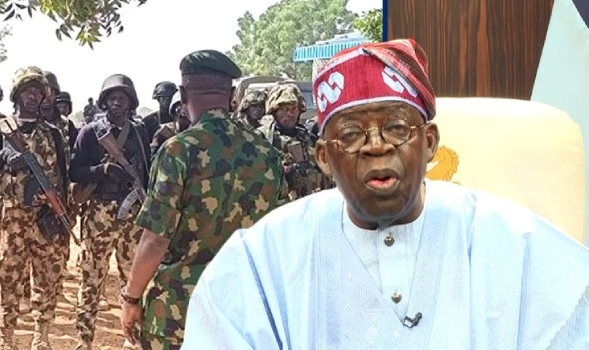
Amid rising killings and a wave of mass abductions by gunmen and suspected terrorists across the country, President Bola Tinubu on Wednesday declared a nationwide security emergency.
The President, in a statement personally signed and released in Abuja, also ordered an immediate expansion of the manpower of the Armed Forces and the Nigeria Police Force as the Federal Government rushes to halt the worsening insecurity.
“Today, in view of the emerging security situation, I have decided to declare a nationwide security emergency and order additional recruitment into the Armed Forces,” Tinubu said.
“By this declaration, the police and the army are authorised to recruit more personnel. The police will recruit an additional 20,000 officers, bringing the total to 50,000.”
Tinubu explained that he had already approved upgrades of police training facilities nationwide and authorised the use of selected National Youth Service Corps camps as police training depots.
He added that officers withdrawn from VIP guard duties would undergo “crash training” before being redeployed to areas battling heightened insecurity.
The President also directed the Department of State Services to immediately deploy all trained forest guards to flush out terrorists and bandits hiding in forests across the country. The DSS was further authorised to recruit additional personnel.
“There will be no more hiding places for agents of evil. This is a national emergency. We are deploying more boots on the ground, especially in vulnerable communities. The times require all hands on deck. As Nigerians, we must all get involved in securing our nation,” he said.
Tinubu commended security agencies for jointly securing the release of 24 abducted schoolgirls in Kebbi State and 38 worshippers in Kwara State. He assured that efforts were ongoing to rescue students of Catholic schools in Niger State and other kidnapped Nigerians still in captivity.
“To the leadership and rank and file of our Armed Forces, I commend your courage and sacrifice. This is a challenging moment for our nation and for the military itself. I charge you to remain resolute, restore peace across all theatres of operation, and uphold the highest standards of discipline. There must be no compromise, no collusion, and no negligence,” he added.
The President announced that the Federal Government would support state governments operating community-based security outfits.
Tinubu also urged the National Assembly to begin reviewing laws that would allow states seeking to establish their own police forces to do so.
He warned states against maintaining boarding schools in remote areas without adequate security and advised churches and mosques in vulnerable areas to engage security agencies when organising large gatherings.
On the lingering farmer–herder clashes, Tinubu restated that the newly created Ministry of Livestock Development would provide long-term solutions. He appealed to herders to embrace ranching, end open grazing, and surrender illegal weapons.
“I sympathise with the families who have lost their loved ones in recent attacks on soft targets in Kebbi, Borno, Zamfara, Niger, Yobe, and Kwara states. I also pay tribute to our brave soldiers who have made the ultimate sacrifice, including Brigadier-General Musa Uba,” he said.
Warning criminal groups not to undermine the state, Tinubu emphasised that his administration possessed the resolve and capacity to secure the country.
“Fellow compatriots, I urge you not to give in to fear or despair. Stand firm to defend our freedom and values. Our administration will continue to guarantee peaceful co-existence and preserve our union.”
He called on citizens to remain vigilant, report suspicious activities, and cooperate with security agencies.
Tinubu’s declaration came amid nationwide outrage after the killing of at least five people in Kebbi and Kwara states, and the abduction of over 300 schoolchildren from Government Girls Comprehensive Secondary School, Maga, in Kebbi State, and St Mary’s Catholic School, Papiri, in Niger State.
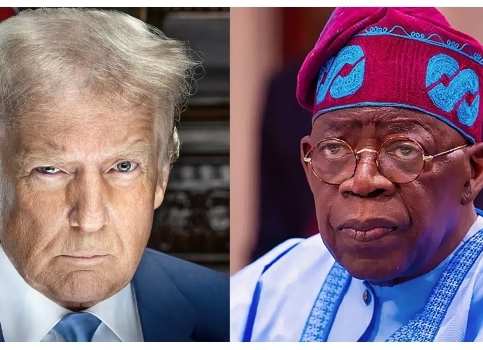
The Presidency on Monday said the United States Government has expressed readiness to deepen security cooperation with Nigeria through enhanced intelligence sharing, supply of defence equipment and other support to boost ongoing operations against terrorists and violent extremist groups.
It said the commitment followed a series of engagements held last week in Washington, DC, between a high-level Nigerian delegation and top US officials aimed at strengthening bilateral security ties and opening new areas of collaboration.
The delegation, led by the National Security Adviser, Nuhu Ribadu, met with senior officials from the US Congress, White House Faith Office, State Department, National Security Council and the Department of War.
Other members of the delegation included the Attorney-General of the Federation, Lateef Fagbemi (SAN); Chief of Defence Staff, Gen. Olufemi Oluyede; Chief of Defence Intelligence, Lt. Gen. Emmanuel Undiandeye; the Inspector-General of Police, Kayode Egbetokun; and two representatives from the Office of the NSA.
According to a statement by the Special Adviser to the President on Information and Strategy, Bayo Onanuga, the Nigerian team used the engagements to debunk allegations of genocide in the country, insisting that violent attacks cut across religious and ethnic divides.
Onanuga said the delegation also rejected what it described as the “wrongful framing” of Nigeria’s security challenges, noting that such portrayals risked further dividing citizens and misrepresenting realities on the ground.
“The discussions provided ample opportunity to correct misconceptions about Nigeria, forged a constructive, solution-driven partnership with the United States, reinforced mutual trust, and advanced a coordinated approach to protecting vulnerable communities, especially in the Middle Belt,” the statement read.
He added that the US expressed willingness to offer complementary support, including humanitarian assistance to affected populations in the Middle Belt and technical aid to strengthen early-warning mechanisms.
Onanuga said both countries agreed to immediately implement a non-binding cooperation framework and set up a Joint Working Group to coordinate agreed areas of collaboration. Nigeria, he added, reaffirmed its commitment to enhancing civilian protection measures.
“The Federal Government restates its awareness of heightened sensitivities regarding religious freedom and security, and urges citizens to remain assured that firm, urgent, and coordinated steps are being taken to secure the nation,” he stated.
The development comes weeks after former US President Donald Trump threatened to deploy American forces to Nigeria “guns-a-blazing” if the government failed to halt what he described as the killing of Christians.
Trump, who also designated Nigeria a “Country of Particular Concern” over alleged persecution, had on his Truth Social platform accused the government of allowing the “mass slaughter” of Christians and warned that Washington could cut aid and take military action.
“If the Nigerian Government continues to allow the killing of Christians, the USA will immediately stop all aid and assistance to Nigeria, and may very well go into that now disgraced country, ‘guns-a-blazing,’ to completely wipe out the Islamic terrorists who are committing these horrible atrocities,” he wrote, adding that he had instructed the US Department of War to prepare for possible operations.
But President Bola Tinubu has repeatedly dismissed claims of genocide against Christians, maintaining that Nigeria remains committed to religious freedom, tolerance and the protection of all citizens regardless of faith.
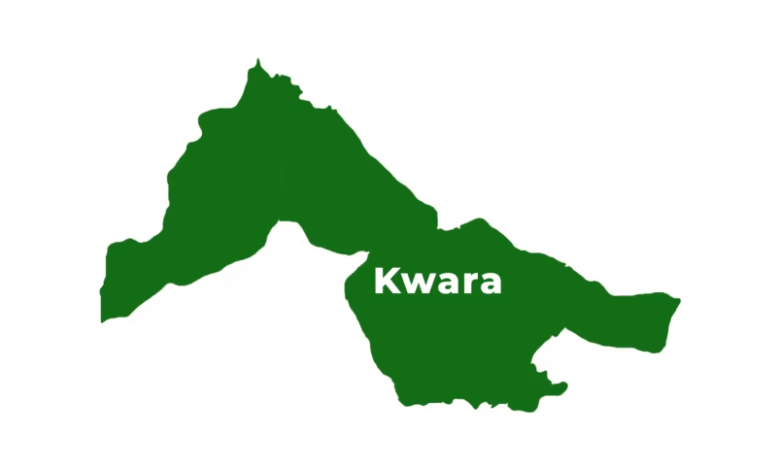
Suspected bandits have abducted four rice farmers in Bokungi community, Edu Local Government Area of Kwara State.
The incident occurred on Wednesday evening while the victims were working on their farms during the peak of the harvest season. It came barely 24 hours after gunmen attacked a church in Eruku, Ekiti LGA of the state, killing two worshippers and abducting several others.
According to sources, the attackers stormed the farms suddenly and surrounded the farmers as they gathered their harvested rice.
“It has been confirmed that bandits struck again at Bokungi under the Lafiagi Emirate. Four people were abducted. Information is still emerging,” the sources said.
Residents said the gunmen operated for several minutes without resistance, forcing the farmers into a nearby bush before whisking them away to an unknown location.
Community members also lamented rising insecurity in Edu LGA, noting that several farming settlements had been abandoned as farmers now fear venturing out during the harvest period when they are most vulnerable.
The Kwara State Police Command and the state government had yet to comment on the incident as of the time of filing this report.







-
 Politics2 days ago
Ibarapa East Assembly Hopeful, Ramon Congratulates Ajiboye, Says Emergence Good for Oyo APC
-
 Politics7 days ago
Makinde: My Successor Must Be Loyal to Oyo, Not Me
-
 Politics3 days ago
2027: Former Oyo Deputy Governor Adeyemo Emerges APC Chairman (See Full List)
-
 Politics7 days ago
Fintiri Dumps PDP for APC, Moves with Cabinet, 14 Adamawa Lawmakers