
Politics
Oyo: Makinde’s Automatic Tickets Ignite Crisis, Fuel Fierce Survival Struggle

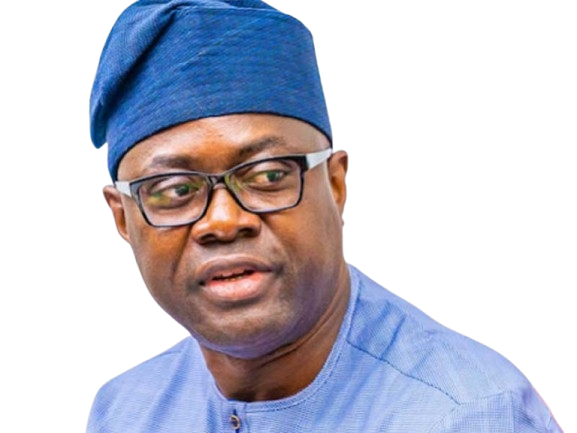

The embattled Governor Seyi Makinde-led Oyo State chapter of the Peoples Democratic Party (PDP) has plunged into a deepening crisis following a controversial declaration granting automatic tickets to serving lawmakers—a move that has unsettled party leaders, disrupted political alignments, and triggered a scramble for alternative positions ahead of the 2027 general elections.
The decision, announced at a pivotal stakeholders’ meeting convened by the governor at the government secretariat in Ibadan weeks ago, was expected to provide clarity on the party’s internal challenges, particularly its festering supremacy battle with the faction aligned to the Minister of the Federal Capital Territory, Nyesom Wike, but instead opened a new fault line within the party.
Multiple sources present at the meeting told Mega Icon Magazine that expectations were high that Governor Makinde would reassure party leaders on efforts to stabilise the PDP and strengthen its position ahead of the next electoral cycle, but his pronouncement endorsing incumbents at both the state and National Assembly levels came as a shock, leaving many stakeholders disillusioned.
A senior party figure, who spoke on condition of anonymity, said the governor’s position had “upturned existing political calculations across the state,” noting that several aspirants who had invested heavily in their ambitions were abruptly shut out of the race. “What was expected to be a reconciliatory and strategic meeting ended up creating fresh tension. Many leaders left more uncertain than they arrived,” the source said.
The immediate effect of the declaration has been a wave of political recalibrations across key constituencies, including Ibadan South East/North East Federal Constituency, where aspirants who had been preparing for the House of Representatives contest have now been forced to abandon their plans.
Among those affected is a former council boss and lawmaker, Hon. Akeem Ademola Ige, who had stepped down during the 2023 elections and was widely tipped to re-contest, but has now reportedly shifted his focus to the Oyo South Senatorial District, a development party insiders linked directly to the closure of opportunities created by the automatic ticket arrangement. A similar trend is unfolding in Ibadan North, where a former member of the House of Representatives, Hon. Dada Awoleye, has also joined the growing list of aspirants for the senatorial seat, while former lawmaker, Gbede Aderemi Waheed and the Chairman of Ibadan North West Local Government, Hon. Rahmon Adepoju, among others have equally indicated interest, further intensifying competition in the senatorial district.
Sources within the party described the development as a “forced convergence,” explaining that the automatic tickets granted to incumbents had effectively blocked access to other elective positions, thereby pushing displaced aspirants into the same senatorial and house of representatives’ races in what one insider termed “a survival-driven political migration.”
Amid the growing discontent, influential stakeholders within the PDP are said to be insisting on a strategic shift that prioritises electoral strength over incumbency, warning that the party risks losing ground to the All Progressives Congress (APC) and other political parties if it fails to present candidates with strong grassroots appeal and financial capacity.
The concern, it was gathered, is heightened by speculations that the APC may field formidable candidates across key positions, including Hon. Aderemi Oseni, while the incumbent senator, Sarafadeen Alli, is being linked with a possible governorship ambition, a scenario PDP leaders fear could tilt the balance of power if not effectively countered.
“This is about winning elections, not rewarding loyalty blindly,” a party chieftain said. “The APC and other parties are preparing, and we must be realistic enough to present candidates who can match them in influence, popularity, structure, and resources.”
Beyond electoral strategy, stakeholders have also raised concerns over what they described as the marginalisation of loyal party members who stood by the PDP during its turbulent moments, arguing that such individuals deserved recognition rather than exclusion under the current arrangement.
According to another source, resentment is growing among party faithful who believe that the majority of the incumbents being favoured with automatic tickets have not demonstrated exceptional performance or contributed significantly to party development, insisting that lawmakers who have completed two terms should either seek higher offices or allow fresh eminently qualified contenders to emerge.
Further fuelling uncertainty is the governor’s reported position that while he would remain in the PDP, aspirants interested in contesting elections might have to pursue their ambitions on another political platform, with assurances of his total support, a stance that has intensified speculations about possible realignments ahead of the polls.
The speculation gained traction following Makinde’s recent engagement with leaders of the African Democratic Congress (ADC), including former Senate President David Mark and former Osun State Governor Rauf Aregbesola, although details of the meeting remain unclear.
Party insiders said the absence of a clear directive from the governor on the outcome of the engagement has heightened anxiety within the PDP, especially as the timeline for party primaries draws closer and aspirants remain uncertain about the platform on which they may eventually pursue their political ambitions.
At the grassroots level, resistance to the automatic ticket policy is said to be intensifying, with several party members across local governments rejecting the move on the grounds of poor performance by some incumbents and their alleged disconnect from party structures and constituents.
A ward leader who spoke with our correspondent warned that enforcing the decision without a broad consensus could have serious electoral consequences, noting that “imposition has never produced victory in a competitive political environment.”
Despite the growing tension, Governor Makinde has yet to publicly address the concerns or provide a definitive roadmap for the party’s direction, even as his recent engagements have done little to calm the situation among the stakeholders.
With the 2027 general elections approaching and internal pressures mounting, the party now faces a critical test of cohesion and strategic clarity, as stakeholders await the governor’s next move in what many believe could ultimately determine their electoral fortunes in Oyo State.
(c) Mega Icon Magazine




The lawmaker representing Akinyele/Lagelu Federal Constituency of Oyo State, Olafisoye Akinmoyede, has denied allegations of violence at the All Progressives Congress (APC) state secretariat, describing claims that he assaulted a party member as false and politically motivated.
An online platform, IMPARTNEWSNETWORK, had alleged that Akinmoyede assaulted one Gafar Oyebade during a meeting convened by the state chairman of the party, Alake Adeyemo, to resolve issues surrounding the executive list of the APC in Lagelu Local Government Area.
However, Akinmoyede, in a statement on Tuesday, said the meeting was peaceful and attended by key members of the state executive, including the chairman, deputy chairman, and secretary, who witnessed the proceedings.
He clarified that contrary to Oyebade’s claim of being the party secretary, the official list presented by the state leadership recognised him as the Public Relations Officer.
According to the lawmaker, following the clarification, the state executive directed the Lagelu Local Government chairman, Fatai Awoyoola, to proceed with the swearing-in of other party officials.
Akinmoyede also faulted attempts to link the incident with the 2019 killing of a former federal lawmaker, noting that a court of competent jurisdiction had already ruled on the matter.
He said, “In Suit No. I/70c/2019, delivered by Justice Mufutau Adegbola on January 23, 2020, all those accused were discharged and acquitted.”
The lawmaker expressed concern over what he described as a deliberate attempt to mislead the public, alleging that Oyebade, a public school teacher under the Oyo State Government, should not be involved in partisan politics.
He described the allegation as a “recycled script” aimed at tarnishing his image ahead of political activities, urging constituents to remain calm.
Akinmoyede also called on journalists to verify information before publication and urged security agencies to take action against individuals who file false reports.
“These tactics surface every election cycle. Those behind them should learn to accept the outcomes of political processes. They failed before and will fail again. Power comes from God,” he added.
The lawmaker representing Akinyele/Lagelu Federal Constituency in the House of Representatives, Hon. Olafisoye Akinmoyede, has denied allegations of assault levelled against him by a member of the All Progressives Congress (APC) in Lagelu Local Government Area, Mr. Gafar Oyebade.
Akinmoyede described the allegation as “false” and “a lie taken too far,” insisting that no physical altercation occurred.
The denial was contained in a statement issued on Monday by his Legislative Aide, Dr. Isiaq Akintunde.
Oyebade had alleged that he was hospitalised following a confrontation during a meeting held at the office of the state party chairman in Oke-Ado, Ibadan, convened to resolve a leadership dispute in the local government.
But the federal lawmaker maintained that the meeting was peaceful and attended by top party officials.
“The meeting was convened to clarify Mr. Oyebade’s position within the local executive, and it was attended by the State Party Chairman, his deputy, the secretary, the publicity secretary, and other key state executives, all of whom witnessed the peaceful proceedings,” the statement read.
He added that contrary to Oyebade’s claim of being the party secretary, the official list presented by the Lagelu Local Government Party Chairman, Hon. Fatai Awoyoola, identified him as the Public Relations Officer.
According to Akinmoyede, the state executive thereafter directed Awoyoola to proceed with the swearing-in of the remaining members of the local government executive.
The lawmaker accused Oyebade of fabricating the allegation to advance political interests.
“I wonder why Mr. Gafar Oyebade, a secondary school teacher, would claim he was assaulted in the presence of the State Executive. This is an attempt to justify money allegedly collected from an aspirant to tarnish my image,” he said.
Akinmoyede further claimed that Oyebade was seen walking freely after the meeting and was not hospitalised as alleged.
He also raised concerns over Oyebade’s involvement in partisan politics, noting that civil servants are restricted from active participation in political activities.
The lawmaker called on security agencies and the media to investigate the incident at the party’s Oke-Ado office to ascertain the veracity of the claims.
Efforts to reach Oyebade for comments were unsuccessful as of the time of filing this report.
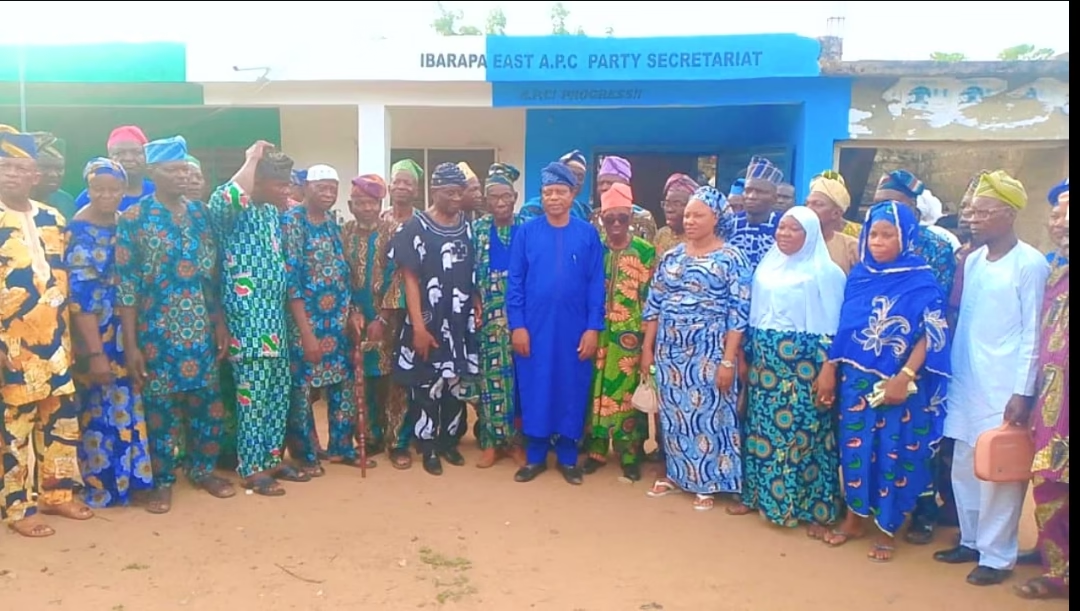
The lawmaker representing Ibarapa East/Ido Federal Constituency and Chairman, House Committee on Federal Roads Maintenance Agency, Aderemi Oseni, has declared his intention to contest the Oyo South Senatorial seat in the 2027 general elections.
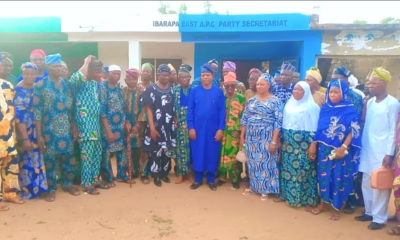
Oseni made his aspiration known during a high-level meeting with the Ibarapa APC Elders’ and Leaders’ Forum, comprising the G9 and the expanded G64 caucus, held at the party secretariat in Eruwa, Ibarapa East Local Government Area, over the weekend.
The G9 and G64 groups consist of influential stakeholders drawn from Ibarapa East, Ibarapa Central, and Ibarapa North local government areas.
In a statement issued on Monday by his media aide, Idowu Ayodele, and made available to journalists in Ibadan, the lawmaker expressed appreciation to the forum for their support and confidence in his leadership and vision.
He said his ambition to represent Oyo South Senatorial District was anchored on a determination to consolidate and expand his record of performance.
Oseni said, “This aspiration is not built on mere rhetoric, but on the continuity and expansion of a proven track record of quality representation and grassroots-oriented governance.”
While soliciting the support of party leaders, he described his ambition as a divine call to serve the people with renewed dedication.
According to him, “This is not a time for self-glory but a sacred responsibility to intensify efforts towards real development, bring more relief to our people and ensure inclusive governance.”
He pledged not to betray the trust reposed in him by party elders and faithful, stressing that his aspiration is rooted in progressive ideals and a genuine commitment to the development of the district.
Oseni also urged leaders in the zone to mobilise support towards delivering one million votes for President Bola Tinubu in the forthcoming election.
Speaking at the meeting, a leader from Ibarapa East, Chief Michael Morawo, lauded the lawmaker for delivering democratic dividends and strengthening the party structure. He added that Oseni has demonstrated commendable leadership through his performance, noting that his impact in stabilising the party within the constituency is evident.
Similarly, a former council chairman in Ibarapa Central, Chief Theophilus Adenrele, commended the lawmaker for not betraying the trust reposed in him. Also, a chieftain from Ibarapa North, Chief Francis Babalola, described Oseni as a humble leader committed to progressive ideals, dismissing speculations about his possible defection if he does not secure the governorship ticket.
In his remarks, the Chairman of the forum, Chief Timothy Jolaoso, said the lawmaker enjoys widespread grassroots acceptance that cuts across political divides.
Jolaoso said, “All indicators consistently point to Oseni as a candidate with acceptance that transcends party lines. He is not only capable but a man of deep faith with proven empathy for the downtrodden.”
He added, “He possesses the goodwill, financial strength, and public trust required for leadership.”
The elder statesman further noted that Oseni’s performance in the House of Representatives, alongside his role as Chairman of the FERMA Committee, underscores his competence and commitment to development.






-
 News6 days ago
Oseni Secures Prestigious City People Political Award Nomination
-
 Politics2 days ago
2027: Oseni kicks off Oyo South Senate bid, rallies support for one million Tinubu votes
-

 Health7 days ago
Oyo confirms Lassa fever death in Ibadan, activates emergency response, traces contacts
-
 Crime & Court6 days ago
Joshua crash: Driver faces fresh charges as court adjourns trial