
Politics
Nigeria at a Crossroads: The Upcoming Elections || By Tibor P. Nagy, Jr



THE Department of State agrees with the view that Nigeria’s February 2019 national elections are a critical test. The conduct of the elections could have significant consequences for the democratic trajectory of Nigeria, West Africa, and the entire continent.
The conduct of the 2015 Nigerian elections, although by no means perfect, was a step forward for Nigeria’s democracy. That contest resulted in Nigeria’s first-ever democratic transfer of power to a non-incumbent party, thereby increasing capacity and improving conduct of Nigerian democratic institutions and election bodies.
Key Goals and Actions
In advance of the 2019 elections, the U.S. government continues to support the Nigerian goal of free, fair, transparent, and peaceful elections that reflect the will of the Nigerian people. Through diplomacy, robust public engagement including with Nigeria’s youth and civil society, and democracy and governance programs, we are helping the country to strengthen its democratic institutions and processes. The United States does not support any single candidate. We support a democratic process that is free, fair, transparent, peaceful, and reflects the will of the Nigerian people.
The U.S. government has developed a comprehensive election strategy to plan and coordinate our efforts. We have three main objectives:
- Support a free and fair electoral process, including technical assistance to Nigeria’s election institutions, civil society, and political parties as well as U.S. government monitoring of the election around the country;
- Prevent and mitigate electoral violence, including conflict monitoring, peacebuilding programs, and peace messaging;
- Support civic and political engagement, including support to Nigerian civil society election observation and parallel vote tabulation, social media campaigns to engage youth including through our Young African Leaders Initiative (YALI), “get out the vote” campaigns, voter education, and Nigerian efforts to counter disinformation.
To advance our strategy, we have sustained high-level diplomatic engagement from Washington as well as robust and regular engagement by our Ambassador, Consul General, USAID Mission Director, and other officials based in Abuja and Lagos. Earlier this year, President Trump welcomed President Buhari to the White House and conveyed our expectations for a credible election. Two Secretaries of State, USAID Administrator Green, Deputy Secretary of State Sullivan, and many others have either traveled to Nigeria or met with senior Nigerian officials in the United States to underscore our commitment to free, fair, transparent, and peaceful Nigerian elections in the last twelve months.
The State Department also hosted the Nigerian Independent National Electoral Commission (INEC) Chairman in late October to observe U.S. preparation for mid-term elections and discuss challenges surrounding Nigeria’s elections. During this visit, INEC Chairman Yakubu observed early voting in Maryland, and met with Congressional staff, U.S. electoral civil society and legal experts, and U.S. government officials. The Chairman also met with USAID Administrator Green and Under Secretary for Political Affairs Hale.
I recently returned from Nigeria as part of my first trip to the continent. It was great to be back in Nigeria where I served as Charge d ’Affairs in 2016 and Deputy Chief of Mission from 1993-1995, and convey our expectations and concerns for the elections in person. I met with leadership from the two main political parties, INEC Chairman Yakubu, and civil society organizations, delivering public messages on the elections in a speech and in press engagements and private messages with key stakeholders.
That is just a summary of our Washington-focused diplomatic engagement on these elections. Our Ambassador and the Mission in Nigeria are working to advance our goals every day. My colleague from USAID will tell you more about the USAID programs in support of our three objectives. And, I can assure you that the U.S. government will remain intensely focused on the Nigerian elections in the coming months.
Expectations and Concerns
I know many of you are watching the election closely. We share many of the areas of concern that you have voiced. We are monitoring and messaging – both publicly and privately – to mitigate a few key areas of risk that could jeopardize a free and fair process. For example:
- potential attacks on the legitimacy of INEC and the electoral process for political gain;
- intimidation and partisanship by security forces;
- heightened insecurity, terrorist attacks on elections institutions, or violence towards voters, observers, or electoral officials;
- an inability of large numbers of internally displaced persons or persons with disabilities to vote;
- voter suppression, the use of armed gangs for voter intimidation, and other drivers of electoral violence, including a lack of official condemnation of hate speech and disinformation;
- wide-spread vote buying that challenges the integrity of the electoral process.
On November 18, the start of official campaigning, our Mission in Abuja released a statement with 25 like-minded missions to express our desire to see free, fair, transparent, and peaceful elections, specifically naming many of these concerns. I can assure you we will be watching closely for instigators of violence or those attempting to undermine the democratic process.
Many of you have expressed particular concern about violence around these elections. I can tell you from my impressions during my travels and my previous service in Nigeria that I fear there will be some violence around these elections, as has been the case with previous elections. I do not anticipate large-scale nation-wide conflict, but rather localized violence. We are already seeing increased tensions and polarization as the election approaches. We assess that politicians are turning to narratives of identity politics in an attempt to improve their popularity, with potentially serious consequences for national unity. However, Nigeria’s political system and society have weathered such tensions before.
But, let me underscore that the U.S. government takes the risk of any loss of human life extremely seriously. As I just mentioned, preventing electoral violence is one of our three main objectives for our diplomacy and programs. When I was in Nigeria, I asked officials from both major parties to sign pledges that their candidates would conduct peaceful campaigns, and both major candidates have now signed a peace pledge. In assessing potential “hot spots” for violence, we look at places that are historically volatile around elections such as Rivers and Borno states. We look at states that are currently tense, especially if state-level politics are contentious like those in Benue, Plateau, as well as those in high-stakes locations with large populations such as Kano. We regularly engage with civil society organizations working in these “hotspots” and support their peacebuilding efforts. USAID programs and our public diplomacy campaigns also support peace campaigns across the country, such as #VoteNotFight. Through our YALI Network Nigeria campaign, Nigerians have made over 10,000 pledges to boost voter participation, reject violence, and vote with integrity.
Conclusion
As I said in a speech in Nigeria, only the Nigerian people can determine lasting solutions and a path forward toward peace and stability. 2019 will be a significant year for Nigerian democracy – it has been 20 years since the country returned to democratic rule and this election’s youngest voters have never known a Nigeria without democracy. The upcoming elections provide Nigerians an opportunity to shape their country and solidify its place as a democratic leader in Africa.
Tibor P. Nagy, Jr. Assistant Secretary, Bureau of African Affairs U.S. House of Representatives, Sub-Committee on Africa, Global Health, Global Human Rights, and International Organizations





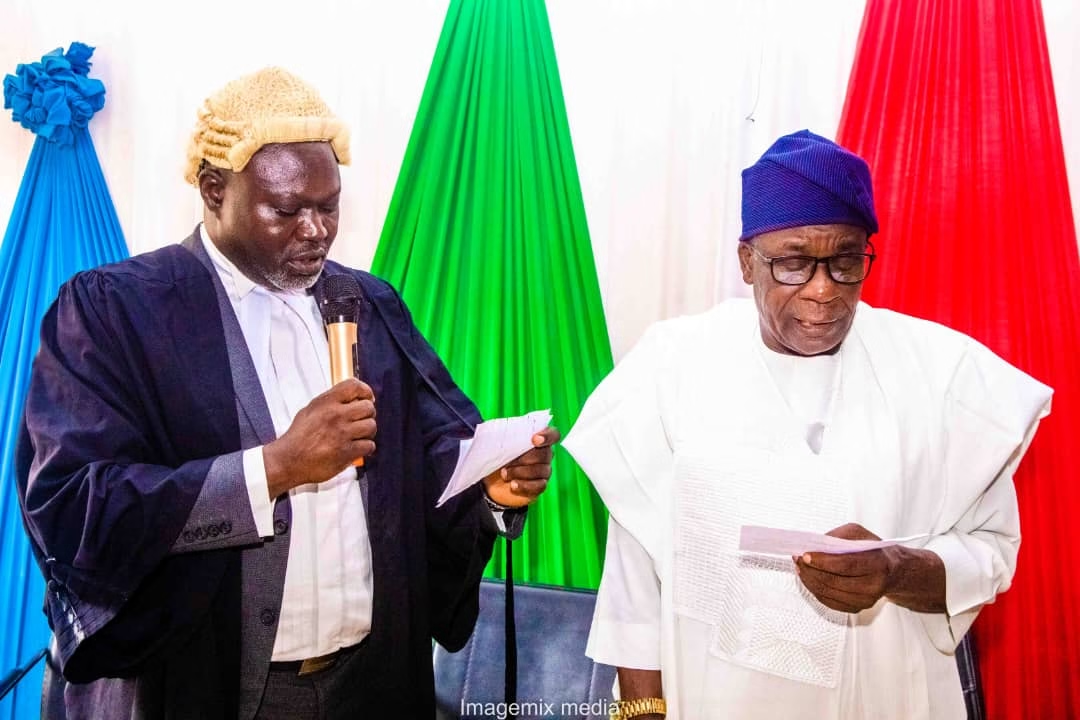
A former Deputy Governor of Oyo State, Chief Moses Alake Adeyemo, has been sworn in as the Chairman of the Oyo State chapter of the All Progressives Congress (APC), urging members of the party to rally support for President Bola Tinubu ahead of the 2027 general elections.
Adeyemo formally assumed office on Friday following the inauguration of the newly elected State Executive Committee members who will manage the affairs of the party in the state for the next four years.
The inauguration ceremony, held at the party’s State Secretariat in Oke-Ado, Ibadan, marked the climax of the party’s 2026 congresses in the state.
The South-West Zonal Legal Adviser of the APC, Kolawole Majaro, administered the oath of office on Adeyemo and 35 other members of the State Executive Committee.
The executives had emerged through a consensus arrangement during the March 3, 2026 state congress held at the Obafemi Awolowo Stadium, Ibadan, under the supervision of a committee led by Amos Gombi from the APC National Secretariat in Abuja.
In his acceptance speech, Adeyemo described his emergence as a renewed call to service, pledging to strengthen the party and sustain unity among members.
He appreciated party leaders within and outside the state for ensuring a smooth and successful congress process.
Adeyemo also commended members of the Local Organising Committee, particularly Fatai Ibikunle and Afeez Bolaji Repete, for their contributions to the success of the exercise.
He said, “This new State Executive Committee under my leadership is being put in place to add value and strengthen our great party in view of the challenges ahead.
“We have used the opportunity of the congresses to showcase our collective commitment to unity and harmony as progressives and democrats.”
The new chairman expressed optimism that the atmosphere of peace within the party would be sustained ahead of future party primaries and the 2027 elections.
According to him, the party’s target is to secure 90 per cent of the votes in Oyo State for President Tinubu while also reclaiming the state’s Government House in 2027.
Adeyemo praised the President’s leadership, saying the administration was delivering on its promises.
“President Tinubu is, no doubt, performing beyond our expectations and the best way to appreciate his good work is to retain him in Aso Rock until 2031,” he said.
“Against all odds, the President is pursuing his Renewed Hope Agenda with vigour and passion, while the positive results are being felt across sectors of the economy and national life.”
Other members of the newly inaugurated executive include Taofeek Lamidi as Deputy Chairman, Fatai Adesina as State Secretary, Adekemi Opatunde as Woman Leader, Olawale Sadare as Publicity Secretary, Olalekan Oladejo as Youth Leader, and Remi Adepoju as Organising Secretary.
Also inaugurated were Ajiboye Akinsanya as Treasurer, Sunday Aborisade as Legal Adviser, Tinuade Adigun as Auditor, Lukman Owonikoko as Assistant State Secretary, Fatimah Hassan as Deputy Woman Leader, and Jimoh Osundara as the Leader of Persons Living With Disabilities, among others.
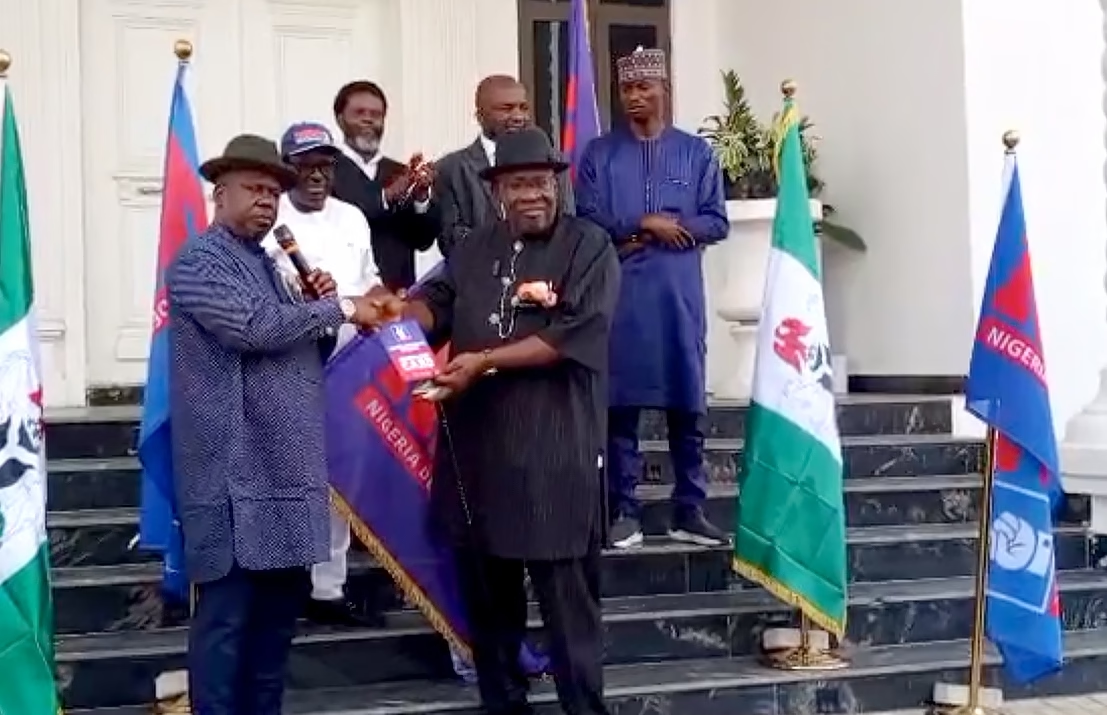
The Senator representing Bayelsa West, Seriake Dickson, on Thursday announced his resignation from the Peoples Democratic Party (PDP), declaring that he had joined the newly registered Nigeria Democratic Congress (NDC).
Dickson, a former governor of Bayelsa State, made the announcement during a media briefing in Abuja, attributing his decision to what he described as irreconcilable differences within the PDP.
The lawmaker said the emergence of the NDC would strengthen Nigeria’s democratic system by providing a credible opposition platform.
According to him, the party recently received its certificate of registration from the Independent National Electoral Commission.
He said, “Last week INEC issued a certificate of registration and we now have the newest party in Nigeria known as the Nigeria Democratic Congress and our symbol is victory, the victory sign.
“So, my dear Nigerians, you now have a credible alternative opposition party known as the Nigeria Democratic Congress.”
Dickson noted that although the party’s registration took longer than expected, its eventual approval was a welcome development for the country’s democratic landscape.
“Yes, it is coming at this time. We would have wished it started some years or months back. We don’t control INEC and their processes; they delayed. We don’t also control the judiciary, but thank God it has finally arrived,” he said.
The senator also stressed that Nigeria’s democracy must not slide into a one-party system, insisting that political diversity remained vital for national stability.
“This nation cannot be a one-party state. Nigeria cannot be a one-party state. Nigeria is not designed to be a one-party state.
“We are a very diverse nation culturally, religiously and politically and that is the beauty of our country.
“So anyone or any party promoting one-party rule in Nigeria is mistaken. We build political parties and get involved in movements to access power for the good of the people, not for our personal benefit,” he added.
Meanwhile, the Independent National Electoral Commission recently announced the registration of two new political parties.
The parties are the Democratic Leadership Alliance and the Nigeria Democratic Congress, bringing the total number of registered political parties in Nigeria to 21.
The announcement was made by the INEC Chairman, Prof. Joash Amupitan, during the commission’s first quarterly consultative meeting with political party stakeholders for 2026.
According to him, the Democratic Leadership Alliance completed the required verification process, while the Nigeria Democratic Congress was registered in compliance with a Federal High Court order.
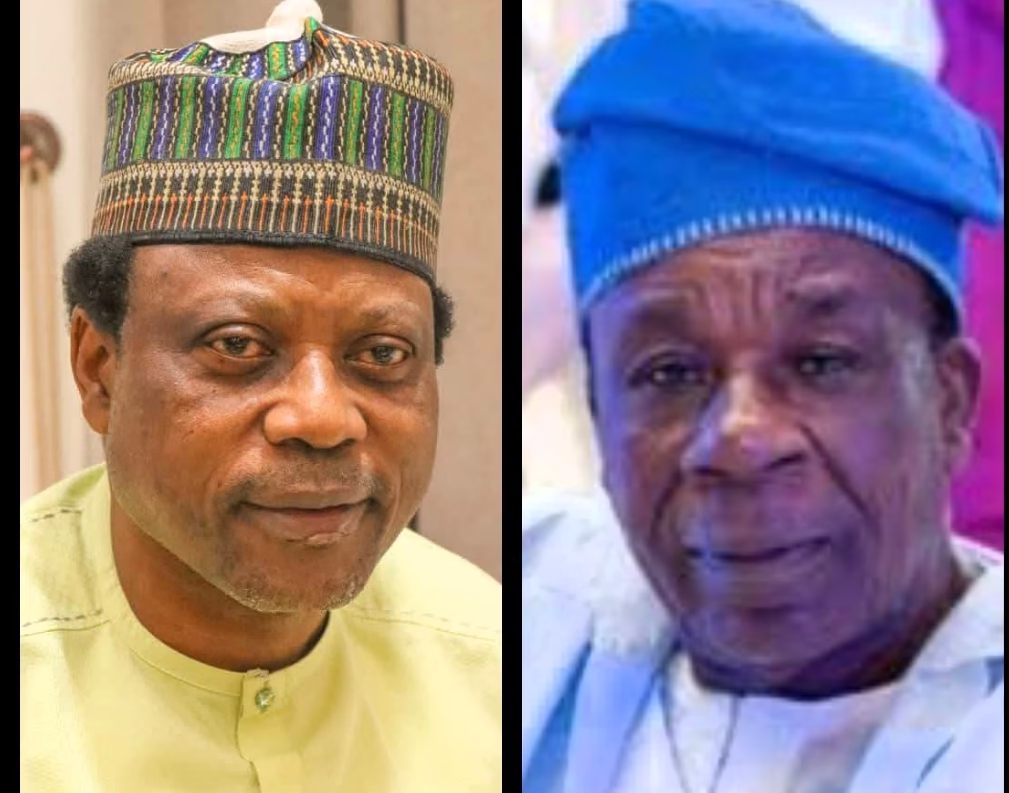
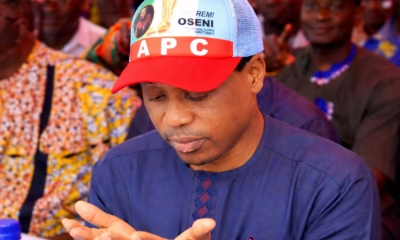
The Chairman, House of Representatives Committee on Federal Roads Maintenance Agency (FERMA) and member representing Ibarapa East/Ido Federal Constituency, Hon. Aderemi Oseni, has congratulated the newly elected State Executive Committee of the All Progressives Congress (APC) in Oyo State.
The party, at its state congress held on Tuesday at Liberty Stadium, Ibadan, elected a former Deputy Governor of the state, Moses Alake Adeyemo, as its new chairman alongside other state executive members.
Oseni, in a statement on Wednesday by his media aide, Idowu Ayodele, described Adeyemo’s emergence as well-deserved, noting that his experience and longstanding commitment to the party would further strengthen its structure in the state.
He said the peaceful conduct of the congress demonstrated the party’s commitment to internal democracy and progressive leadership.
The statement said, “I congratulate our newly elected State Chairman and leader, His Excellency, Moses Alake Adeyemo, and other members of the State Executive Committee on their emergence. This victory reflects the confidence reposed in them by party members across the state.”
Oseni further expressed confidence that the new leadership would reposition the party for greater cohesion and electoral success.
According to him, “This is a critical moment for our party in Oyo State. It calls for unity, reconciliation, and renewed commitment to the ideals that bind us together as progressives.”
The federal lawmaker assured the new executives of his support and cooperation in advancing the programmes of the party and strengthening its grassroots structures.
He urged party members to rally behind the new leadership to ensure stability and secure future victories for the APC in the state.







-
 Politics3 days ago
Ibarapa East Assembly Hopeful, Ramon Congratulates Ajiboye, Says Emergence Good for Oyo APC
-
 Politics1 week ago
Makinde: My Successor Must Be Loyal to Oyo, Not Me
-
 Politics3 days ago
2027: Former Oyo Deputy Governor Adeyemo Emerges APC Chairman (See Full List)
-

 News2 days ago
NERC orders DisCos to refund ₦20.33bn meter costs to customers