Connect with us

News

Lagos govt. moves to boost supply of cooking gas to 20,000 homes

Published

on

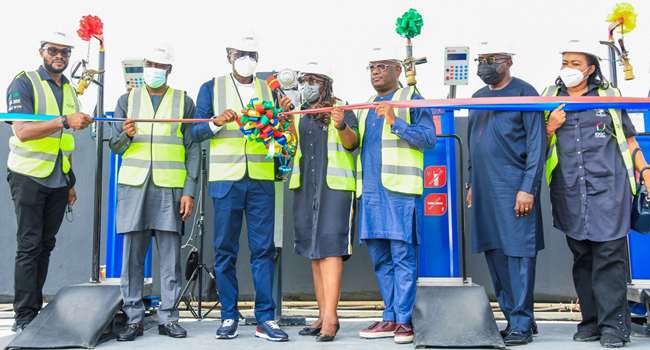
Commissioner for Energy & Mineral Resources, Mr. Olalere Odusote; Deputy Governor, Dr. Obafemi Hamzat; Governor Babajide Sanwo-Olu; Managing Director/CEO, IBILE Oil and Gas Corporation, Doyin Akinyanju; member, Federal House of Representatives, Hon. Jimi Benson; Zonal Operation Controller, Nigerian Midstream and Downstream Petroleum Regulatory Authority (NMDPRA), Mr. Ayorinde Cardoso and Board member of IBILE Oil and Gas Corporation, Omolara Alakija, during the commissioning of a Gas Plant by IBILE Oil & Gas, at Igbogbo, Ikorodu, on Thursday, November 25, 2021.

The Babajide Sanwo-Olu – led Lagos state government has commissioned a 40 metric-ton Liquified Petroleum Gas (LPG) Refill Plant in Ikorodu.

Governor Sanwo-Olu, in the company of his Deputy, Dr. Obafemi Hamzat, commissioned the gas plant on Thursday built by Ibile Oil and Gas Corporation (IOGC), the state-owned energy firm, in Igbogbo-Baiyeku Local Council Development Area (LCDA) to ramp up the supply of LPG for domestic use.

The state gaffer  believes the move will create an alternative gas market for residents, thereby, crashing the rising cost of cooking gas in Lagos.

According to the governor, the energy project was initiated to key into the nation’s ambitious goal to develop the natural gas industry and encourage domestic use of safe cooking gas to cut down the use of dirty fuels responsible for carbon emission and air pollution.

The Ikorodu plant is the fourth facility delivered by the corporation.

Three other refill plants of varying capacities were built in Amuwo Odofin, Alimosho and Iponri areas of the State.

Sanwo-Olu said the inclusion of gas into the State’s energy mix was critical to the continuous prosperity of Lagos, stressing that the project would not only transform the State into a gas economy and stimulate commercial growth but also enhance the quality of life by reducing carbon footprint in the environment.

The target, according to him, is to increase the supply of cooking gas in local communities, thereby raising domestic LPG usage from the current 25 per cent to about 80 per cent before the end of 2023.

“The gas plant being commissioned today reflects the desire of our administration to align with the global action to reduce carbon emission and address the climate change challenge. One of the measures, which this gas plant will support, is promoting increased adoption of LGP for domestic use in Lagos,” Sanwo-Olu said.

He continued, “Our vision is to transit the State into a gas economy and ensure an energy mix that provides different fueling options for residents with the introduction of Gas-for-Transport and Gas-to-Power projects. Expanding the domestic usage of LPG is critical to the continuous prosperity of Lagos and the attainment of our administration’s desire to transform the State into a 21st Century economy.”

The governor expressed concern over the high cost of cooking gas occasioned by the high foreign exchange rate and introduction of 7.5 per cent VAT by the Federal Government, describing the situation as “unacceptable” in the face of the high cost of living.

Sanwo-Olu said the increment in LPG price put the nation at the risk of reversing all gains achieved from awareness on the advantages of using LPG for domestic cooking.

He urged the Federal Government to reverse the trend in order to make the commodity affordable, while also increasing the availability of safe cooking gas in the country.

“Not only are we excited with our modest intervention by Lagos in the LPG market, it is only when we reduce the cost of basic commodities such as cooking gas that the true dividends of democracy can be felt by the people.

“We have done a lot of advocacy for people to appreciate the benefit that comes with the use of gas for domestic cooking, such as reduction in carbon footprint, and improved quality of life. If we have made this great effort, the least the Government can do is not to make the commodity unaffordable for the populace,” he said.

Commissioner for Energy and Mineral Resources, Olalere Odusote, said the plant was built with the highest safety standards, noting that the siting of the facility was deliberate to serve a large number of the populace.

He said the State had the plan to expand the gas facility to 20 units which would be spread across all divisions.

Managing Director of IOGC, Doyin Akinyanju, said the gas plants developed by the corporation had the capacity to supply 20,000 homes within the radius of operation, adding that jobs were created for young people in the supply chain through the use of purpose-built vehicles for door-to-door delivery in neighbourhoods.

“Nigeria has an abundant gas deposit that needs to be rapidly developed. Lagos also is blessed with two known offshore fields – Aje and Ogo – in Badagry with large gas deposits. IOGC is taking steps to develop a bulk offtake facility which will ensure gas security in Lagos, as well as provide a competitive pricing advantage.

“We will continue our sensitisation and awareness campaign in the neighbourhoods where we are located to take Lagosians away from the use of dirty fuels like firewood, charcoal, kerosene to Gas for cooking. Today, we start a new journey with cooking gas by creating a market that will make it safely accessible,” Akinyanju said.

Comments

News

Oseni mourns ex-Oyo lawmaker Akeem ‘Able’, says Oyo APC has lost loyal progressive

Published

on

The lawmaker representing Ibarapa East/Ido Federal Constituency in the House of Representatives, Engr. Aderemi Oseni, has mourned the death of a chieftain of the All Progressives Congress (APC) in Oyo State and former member of the Oyo State House of Assembly, Hon. Akeem Abimbola Oladipupo, popularly known as Able, describing his demise as a painful loss to the progressive family.

Oladipupo, who represented Ibadan North-West Constituency in the Oyo State House of Assembly, was widely regarded as a grassroots politician and committed party loyalist until his passing.

Oseni, who is also the Chairman, House Committee on Federal Roads Maintenance Agency and the APC candidate for Oyo South Senatorial District, said the late politician’s death had created a vacuum within the party and among those who benefitted from his unwavering commitment to public service.

In a condolence statement issued on Monday by his Media Aide, Idowu Ayodele, and made available to journalists in Ibadan, the Oyo State capital, the federal lawmaker described the late Oladipupo as a dependable progressive, humble political actor and loyal party stalwart whose impact would remain indelible.

He said the deceased dedicated his life to serving humanity, strengthening the progressive movement and supporting the aspirations of many at the grassroots.

Oseni said, “The death of Hon. Akeem Abimbola Oladipupo (Able) came to me as a rude shock. Oyo State and the progressive family have indeed lost a committed, loyal and selfless leader whose passion for service, humility and dedication to the people stood him out.

“He was not just a politician but a bridge-builder, a dependable ally and a grassroots mobiliser who believed strongly in the ideals of our great party. His contributions to the growth of the APC in Oyo State and his service to humanity will remain unforgettable.”

The APC senatorial candidate noted that the late former lawmaker remained steadfast in promoting peace, unity and political development, adding that his simplicity and accessibility endeared him to many across political divides.

According to Oseni, the late politician’s legacy of service and sacrifice would continue to inspire younger politicians and party faithful.

He, however, urged members of the APC, associates and family members of the deceased to take solace in the remarkable life he lived and the positive impact he made during his lifetime.

Oseni also prayed for the repose of the deceased’s soul and for God to grant his family the fortitude to bear the painful loss.

Continue Reading

News

Governors Push N100,000 Minimum Wage to Ease Workers’ Economic Burden

Published

on

State governors have proposed a new national minimum wage of N100,000 for Nigerian workers as part of efforts to cushion them from the biting effects of inflation and the rising cost of living.

Governor AbdulRahman AbdulRazaq of Kwara State, who is also the Chairman of the Nigeria Governors’ Forum (NGF), disclosed the proposal on Saturday in a post by the state government’s official Facebook page. He said the move aims to improve workers’ welfare while ensuring that government finances remain sustainable.

“State governments recognise the urgent need to improve workers’ welfare in response to the current economic realities facing Nigerians,” AbdulRazaq said.

“We are actively engaging with the Federal Government and organised labour to arrive at a wage structure that is fair to workers and sustainable for government finances.”

The NGF chairman explained that ongoing discussions are focused on balancing the need to boost workers’ purchasing power with the capacity of governments to deliver essential public services and development projects.

“The goal is to improve the living conditions of workers while ensuring that states can continue to meet their obligations and sustain projects that directly impact citizens,” he added.

The proposed N100,000 minimum wage is expected to intensify national debates on salaries, inflation, and broader economic reforms as Nigerians continue to contend with rising food prices, transportation costs, and other living expenses.

Currently, Nigeria’s statutory minimum wage stands at N70,000 per month. Some states, including Lagos, Rivers, and Imo, are already paying above the national benchmark to support workers amid the country’s economic challenges.

Meanwhile, the Nigeria Labour Congress (NLC) has continued to call for a comprehensive review of salaries, insisting that workers deserve a living wage that reflects present-day economic realities rather than merely guaranteeing survival.

Continue Reading

News

Petrol hits N1,533/litre as cooking gas prices jump nationwide

Published

on

The average retail price paid by consumers for Premium Motor Spirit, popularly known as petrol, rose to N1,532.93 per litre in April 2026, representing a 23.69 per cent increase compared to the N1,239.33 recorded in the corresponding period of 2025, findings by the National Bureau of Statistics (NBS) have shown.

The sharp rise in petrol prices came amid mounting inflationary pressure and worsening living costs, with Nigerians grappling with soaring transportation and food expenses that have continued to shrink household purchasing power.

The NBS disclosed this in its Premium Motor Spirit (Petrol) Price Watch for April 2026, released on Friday.

The report further showed that on a month-on-month basis, petrol prices rose by 18.97 per cent from N1,288.54 recorded in March 2026, underscoring persistent volatility in the downstream petroleum market.

A breakdown of prices across states revealed that Yobe recorded the highest average retail price for petrol at N1,599.05 per litre during the review period.

Edo and Bauchi followed closely with average prices of N1,595.74 and N1,589.07, respectively.

However, Niger residents paid the least for petrol at an average of N1,403.89 per litre, while Sokoto and Katsina recorded N1,404.16 and N1,406.28 respectively.

At the zonal level, the South-South recorded the highest average retail price at N1,566.76 per litre, while the North-West posted the lowest at N1,508.81.

The latest petrol price increase comes as millions of Nigerians continue to battle the ripple effects of rising inflation, with higher energy costs worsening transportation fares and the prices of essential commodities.

Similarly, the NBS said the average retail price for refilling a 5kg cylinder of Liquefied Petroleum Gas, also known as cooking gas, rose by 13.73 per cent month-on-month to N8,706.93 in April 2026 from N7,655.73 recorded in March.
On a year-on-year basis, the price increased by 10.42 per cent from N7,885.60 recorded in April 2025.

Lagos recorded the highest average price for refilling a 5kg cylinder at N9,745.10, followed by Nasarawa at N9,451.70 and Bayelsa at N9,422.74.

In contrast, Anambra recorded the lowest average price at N7,204.76, while Ondo and Ogun followed with N7,239.49 and N7,825.75, respectively.

At the regional level, the North-West recorded the highest average retail price for refilling a 5kg cylinder at N9,025.07, followed by the North-East at N8,847.16, while the South-East posted the lowest average price at N8,224.37.

Also, the average retail price for refilling a 12.5kg cylinder of cooking gas increased by 13.89 per cent month-on-month to N22,382.20 in April 2026 from N19,652.83 in March.

Compared to April 2025, the price rose by 10.43 per cent from N20,268.06.

According to the NBS LPG Price Watch for April, Katsina recorded the highest average retail price for refilling a 12.5kg cylinder at N25,596.71, followed by Kogi at N24,558.25 and Gombe at N24,438.97.

Ogun recorded the lowest average price at N19,564.36, while Bauchi and Anambra followed at N20,178.87 and N20,511.90 respectively.

The North-West recorded the highest zonal average retail price for refilling a 12.5kg cylinder at N23,276.95, followed by the North-Central at N22,865.29, while the South-East posted the lowest average at N21,060.92.

The latest figures signal growing pressure on household energy costs, raising concerns over the implications for inflation and the cost of living in the coming months.

Continue Reading

Advertisement

Entertainment

Advertisement

MegaIcon Magazine Facebook Page

Advertisement

MEGAICON TV

Advertisement

Trending