Connect with us

Top Stories

Fayemi flags off EKIFEST, upgrades Bureau of Arts and Culture to a Ministry

Published

on

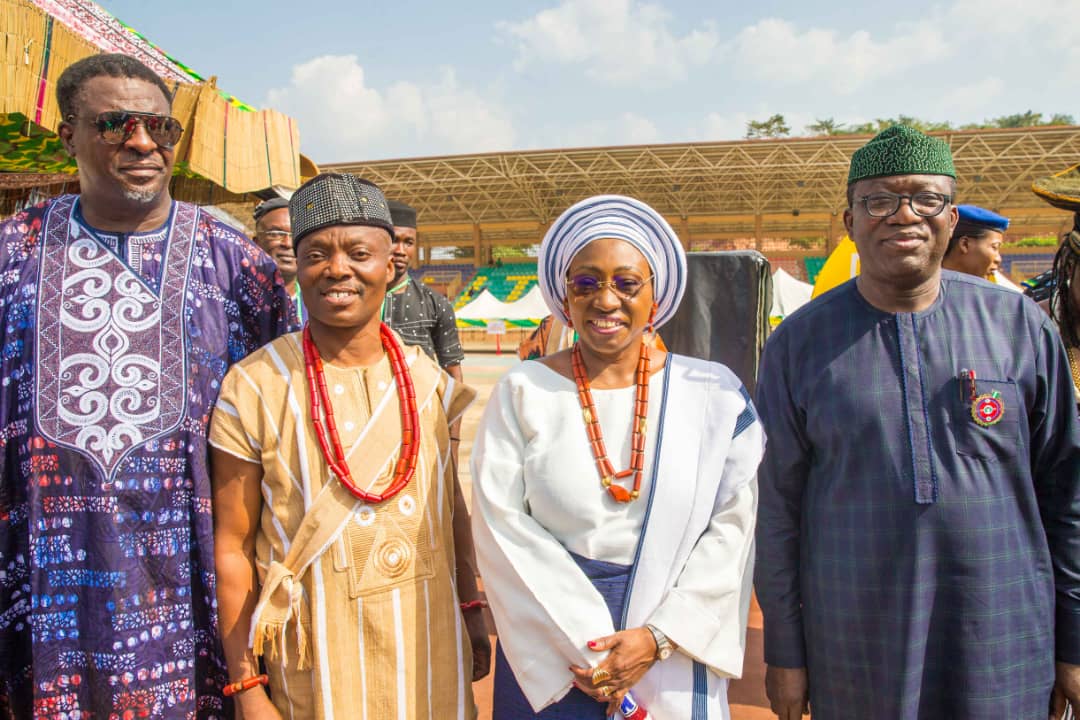
L-R: Ekiti State Governor, Dr Kayode Fayemi; his wife and chairperson, Planning Committee 2019 EKIFEST, Erelu Bisi Fayemi; Director-General, Ekiti State Council of Arts and Culture, Amb. Wale Ojo-Lanre; and an Ekiti based Artist, Tope Adebiyi; at the opening session of Ekiti State Festival of Arts and Culture (EKIFEST) at the Ekiti Parapo Pavilion, Ado-Ekiti, on Wednesday

Ekiti State Governor, Dr Kayode Fayemi on Wednesday reiterated his administration’s determination towards increasing its investment and exploits in the arts and culture sector for the economic prosperity of the State and its citizenry .

The Governor who stated this resolve in Ado Ekiti, the state capital while declaring open the 2019 Ekiti State Festival of Arts and Culture (EKIFEST), equally announced an upgrade of the state’s Council of Arts and Culture to the Ministry of Arts, Culture and Tourism

Fayemi gave the new Ministry the directive to consolidate on its various achievements, enhance the potential of creative practitioners and boost the Internally Generated Revenue of the State.

He added that the role of Arts and Culture as catalysts to progressive multiculturalism is gaining more recognition.

The Governor further described EKIFEST as an economic and social strategy aimed at repositioning the creative industry of the State for optimal performance and drawing attention of the global public to the unique landmarks of the State in tourism and culture.

“In Ekiti State, our cultural heritage keeps our memories alive of how beliefs and cultural expressions have contributed to the development of our society. Ekiti is a state of rich artistic and cultural heritage and endowed with the abundance of talents. Our riches are well demonstrated through arts, dance, literature, music, food and folklore.”

“I commend the efforts of the Ekiti State Council for Arts and Culture towards the attainment of the target set for it. We still want the council to go a step further by consolidating on the various achievements, enhancing the potential of creative practitioners and boosting the Internally Generated Revenue (IGR) of Ekiti State. And to enhance the progress already made in the last year, I have decided to re-establish the Ministry of Arts, Culture and Tourism for better synergy and integration”, the governor said.

Governor Fayemi who assured investors of necessary support and encouragement called on entrepreneurs to visit the various tourism corridors in the State and invest in them, stressing that their investment is not only secured, but bound to yield good dividends.

Also speaking at the event, the Chairperson of EKIFEST 2019 planning committee and Wife of the Governor, Erelu Bisi Fayemi, said the festival was aimed at creating tourism attraction and enhance investment opportunities as well as create viable markets for local businesses.

Mrs Fayemi noted that the previous editions of the festival in 2012 and 2013 increased tourism visits to the State and created the needed exposure for the cultural infrastructure.

“EKIFEST 2019 is designed towards the restoration of our core values as well as empowerment against the scourge of poverty. Our culture is a viable solution to several problems bedeviling our society. It is in our culture to be diligent, honest and peace-loving. Our culture abhors laziness; our culture goes against the shirking of responsibilities”, she said.

In his address, the Director General of the Council of Arts and Culture, Mr Wale Ojo-Lanre said Ekiti people are gradually getting used to EKIFEST as an economic diversification project. He urged the people to promote Ekiti tradition for excellence.

Ojo-Lanre thanked Fayemi for providing the wherewithal for the resuscitation of the Council which has helped remove the State from the blacklist of absentee States at both local and international cultural festivals.

He disclosed that the State Cultural Troupe had been sponsored by Fayemi to Budapest, Edo State and Ogun State to promote the State’s cultural heritage.

Highlights of the opening session of the festival were colourful and carnival-like parade by all the 16 local government areas, Nollywood stars, artists and ethnic groups in the state as well as musical jamboree round the major streets of Ado-Ekiti, the state capital.

Comments

Crime & Court

NDLEA busts Oyo meth lab, arrests Mexican, four Nigerians

Published

on

The National Drug Law Enforcement Agency has uncovered and dismantled a large methamphetamine production facility concealed inside a forest in Oyo State, arresting a suspected Mexican drug expert and four Nigerians in what officials described as a major breakthrough against an international drug trafficking syndicate.

The industrial-scale laboratory was discovered at Tapa Village in Ibarapa North Local Government Area during an operation conducted by NDLEA operatives on June 17.

Among those arrested was a 56-year-old Mexican national, Jose Villa Ochoa, who was allegedly recruited to provide technical expertise for the large-scale production of methamphetamine.
Four Nigerians identified as Maxwell Uche Nevoh, Olatunji Yusuf, Bankole Akeem Owolabi and Ganiu Monsiu were also apprehended during the raid.

The Chairman of the NDLEA, Brig. Gen. Mohamed Buba Marwa (retd.), said the clandestine facility was equipped with substantial quantities of precursor chemicals and industrial processing equipment used in the manufacture of methamphetamine.

According to the agency, forensic analyses conducted at the site confirmed the presence of methamphetamine, while all recovered substances, chemicals and equipment had been secured as exhibits for further investigation and prosecution.

The discovery came barely four weeks after NDLEA operatives dismantled another large methamphetamine laboratory hidden in a forest in neighbouring Ogun State, heightening concerns over attempts by drug cartels to turn the South-West into a hub for synthetic drug production.

Marwa said the latest operation underscored the agency’s determination to dismantle transnational drug trafficking networks operating within Nigeria.

He warned both local and foreign drug syndicates against viewing the country as a safe destination for illicit drug activities.

“Let the message go out clearly to all drug cartels, domestic and international, that Nigeria is not, and will never be, a safe haven for your illicit trade,” Marwa said.

“We will find you in the cities, we will track you into the forests, and we will dismantle your infrastructure of death.

They thought hiding in dense forests would shield them from the long arm of the law. They were wrong.”

The NDLEA described the operation as another significant blow against organised drug trafficking networks and commended the officers involved in the raid for their professionalism, resilience and courage.

Continue Reading

News

Senate passes state police bill, governors to appoint CPs

Published

on

The Senate on Wednesday passed a bill seeking to amend the 1999 Constitution to establish state police services across the country, a major milestone in ongoing efforts to decentralise policing and tackle Nigeria’s worsening security challenges.

The proposed legislation introduces a dual policing framework comprising a Federal Police Service and State Police Services, effectively replacing the existing structure under which policing is exclusively controlled by the Federal Government through the Nigeria Police Force.

The bill was passed after Senate Leader, Opeyemi Bamidele, presented its general principles on the floor of the Red Chamber.

It subsequently scaled second reading, underwent a rigorous clause-by-clause consideration and was passed for third reading after securing the support of more than two-thirds of the senators.

A key provision of the constitutional amendment empowers governors to appoint Commissioners of Police for their respective states, subject to confirmation by the state Houses of Assembly.

Clause 17 of the bill provides that a State Police Service shall be headed by a Commissioner of Police appointed by the governor on the recommendation of the National Police Council and confirmed by the House of Assembly of the state.

The proposed law further defines the operational relationship between governors and state police commands, allowing governors to issue lawful written directives of a general policy nature to Commissioners of Police on matters relating to the maintenance of public safety and order within their states.

To address widespread concerns over possible abuse of the proposed policing structure, lawmakers incorporated safeguards aimed at protecting political freedoms and civil liberties.

The bill expressly states that a state Commissioner of Police shall not arrest, detain, investigate or deploy force against any individual, political party or group merely for criticising the government, except in accordance with the law.

The provision is intended to prevent state police formations from being used to intimidate political opponents, activists, journalists and other dissenting voices while ensuring that all actions taken conform with due process.

The amendment also empowers the Federal Police Service to temporarily intervene in the internal security affairs of a state where there is an actual or imminent breakdown of public order or public safety which the state police are unable or unwilling to contain.

Such intervention must be authorised in writing by the President, who is required to state the grounds, territorial scope, functions and duration of the operation.

The President must also notify the governor, the Speaker of the state House of Assembly, the National Police Council and the National Assembly within 48 hours of the commencement of the intervention.

The bill further provides that no federal intervention shall continue beyond a period to be prescribed by an Act of the National Assembly unless approved by a resolution of the Senate.

The Senate’s approval came barely a day after President Bola Tinubu transmitted the bill to the National Assembly as part of his administration’s efforts to reform Nigeria’s security architecture.

According to the President, the proposed amendment is designed to provide a legal framework for a dual policing structure that would allow states to establish and operate their own police services alongside the federal police.

Tinubu said the proposal is a critical component of ongoing efforts to reorganise the country’s policing system, enhance security and better protect citizens, adding that communities, municipalities and local government areas would play more active roles in policing responsibilities under the new arrangement.

The renewed push for state police comes amid growing concerns over insecurity, banditry and mass kidnappings across parts of the country.

Supporters of the proposal argue that decentralised policing would strengthen grassroots intelligence gathering, deepen community-based security initiatives and ensure quicker responses to crimes and emergencies.

Critics, however, have cautioned against possible political interference by governors, funding challenges and the risk of exacerbating ethnic or communal tensions.

Tinubu had earlier described state police as inevitable in addressing the nation’s security challenges and urged lawmakers to fast-track constitutional amendments aimed at bringing the proposal to fruition.

Continue Reading

News

Tinubu sends state police bill to Senate

Published

on

President Bola Tinubu has transmitted a Constitution Alteration Bill to the Senate seeking the establishment of state police as part of efforts to reform Nigeria’s security architecture.

The proposed legislation, contained in a communication dated June 15, 2026, was read during plenary on Tuesday by Senate President Godswill Akpabio.

Tinubu said the bill was aimed at providing a legal framework for a dual policing structure that would allow states to establish and operate their own police services alongside the Nigeria Police Force.

According to the President, the proposed amendment forms a key component of ongoing efforts to restructure the country’s policing system to improve security and enhance the protection of lives and property.

He explained that under the arrangement, communities, municipalities and local government areas would play more active roles in policing, enabling local authorities to detect suspicious activities and promptly relay intelligence to security agencies.

Following the presentation, Akpabio referred the bill to the Senate Committee on Constitution Review and directed it to report back on Wednesday.

Speaking on the importance of community-based policing, the Senate President said local authorities were better placed to identify security threats and support proactive responses by law enforcement agencies.

“You will know when foreigners infiltrate Nigeria and alert security agencies so they can react proactively rather than reactively,” he said.

Akpabio expressed optimism that sustained collaboration between the executive and legislative arms would ensure the successful passage and implementation of the initiative.

He disclosed that the process would be undertaken in phases through constitutional amendments and subsequent Acts of Parliament.

“We will do it in two phases through alteration and an Act of Parliament. There will be a lot of safeguards; let us come and do this important task. It is extremely important that we come tomorrow,” he said.

The Senate President also informed lawmakers that plenary would not entertain other major business following the death of a member of the House of Representatives, Yahaya Tongo of Gombe State.

Similarly, the Senate Leader urged senators to attend the next sitting, stressing the significance of the proposed state police framework.

“We need a minimum of two-thirds of members to vote on constitutional alterations. The issue of state police is non-partisan and cuts across geopolitical zones and interests,” he said.

The latest development came barely two weeks after the Senate passed an executive bill on state police for second reading.

Akpabio said the fresh Constitution Alteration Bill transmitted by the President builds on the earlier proposal and seeks to provide the constitutional foundation necessary for the establishment and operation of state police services across the country.

Continue Reading

Advertisement

Entertainment

Advertisement

MegaIcon Magazine Facebook Page

Advertisement

MEGAICON TV

Advertisement

Trending