Connect with us

Crime & Court

Drug lord detained in Mexico after helicopter crash kills 14 marines

Published

on

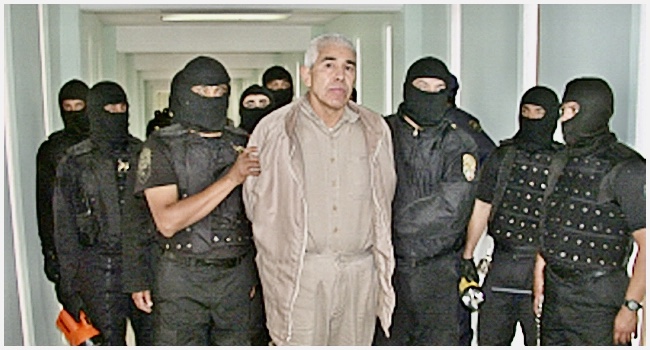
In this file handout picture released by the Mexican Federal Preventive Police (PFP) on January 29, 2005, members of the PFP escort drug trafficker Rafael Caro Quintero, at the Puente Grande prison in Guadalajara, Jalisco State, Mexico. (Photo by Mexican Federal Police / AFP) /

Notorious drug lord, Rafael Caro Quintero, on Friday, was detained in Mexico after 14 Marines who assisted in his capture were killed in a helicopter crash,

Quintero, 69, is accused by the United States of ordering the kidnap, torture and murder of Drug Enforcement Administration (DEA) special agent Enrique “Kiki” Camarena in 1985.

He was detained by Mexican marines in the town of Choix in the northwestern state of Sinaloa, for “the purpose of extradition,” the navy said in a statement.

The Mexican Navy Black Hawk helicopter crashed in Los Mochis, Sinaloa following the operation to capture him, according to the statement. One other Marine was injured and remains in hospital.
The cause of the crash was unknown and an investigation would take place, the statement added

Caro Quintero had already been arrested in 1985, tried in Mexico and sentenced to 40 years in prison for Camarena’s murder.

But in 2013, a Mexican court ordered his release on a legal technicality after he served 28 years, a move that angered US authorities.

By the time Mexico’s Supreme Court overturned the decision, Caro Quintero had already gone into hiding.

The case plunged US-Mexican relations into a crisis, and it took decades for anti-drug agencies on both sides of the border to rebuild trust.

Caro Quintero, alias “Rafa,” has a $20 million bounty on his head and is described by the FBI as “extremely dangerous.”

He is accused of co-founding the now-defunct Guadalajara drug cartel and currently runs an arm of the infamous Sinaloa cartel, according to US authorities.

The US Department of Justice expressed gratitude Friday to Mexican authorities over Caro Quintero’s arrest, confirming the US plans to seek his extradition.

“There is no hiding place for anyone who kidnaps, tortures, and murders American law enforcement,” Attorney General Merrick Garland said in a statement.

– Denial of guilt –

In 2016, in an interview published by news magazine Proceso, Caro Quintero denied killing Camarena, whose story was depicted in the Netflix show “Narcos: Mexico.”

“I did not kidnap, did not torture and did not kill him,” Caro Quintero said, adding that he wanted to “live in peace” and work as a cattle rancher.

“I apologize to the society of Mexico for the mistakes I made, to the Camarena family, the DEA, and the US government. I apologize,” he added.

Camarena’s murder was considered a vendetta for investigations by the DEA agent that led to the seizure of a massive marijuana field in Chihuahua.

Last year a Mexican court ruled that Caro Quintero could be extradited to the United States if caught, rejecting an appeal from his lawyers who argued that he had already been tried in his home country.

The Guadalajara drug cartel, powerful in the 1980s, is considered the forefather of modern Mexican drug cartels.

It was one of the first to establish contacts with Colombian drug lords to transport cocaine from the South American country to the United States.

The cartel’s other founders, Miguel Angel Felix Gallardo and Ernesto Fonseca Carillo were also handed long prison sentences in Mexico for Camarena’s murder.

The organization’s disappearance led to the rise of the powerful Sinaloa drug cartel led by Joaquin “El Chapo” Guzman.

In 2017, Mexico extradited Guzman to the United States where he is serving a life sentence.

A wave of cartel-related violence has left more than 340,000 people dead in Mexico since the government deployed the military in the war on drugs in 2006.

 

Comments

Crime & Court

Police recover Rivers SUV stolen five years ago in Gombe

Published

on

Operatives of the Gombe State Police Command have recovered a Toyota Highlander reported stolen in Port Harcourt, Rivers State, five years ago.

The vehicle was recovered on June 8, 2026, during a routine verification exercise conducted by detectives attached to the State Intelligence Department in collaboration with officials of the Federal Road Safety Corps at the Gombe State Internal Revenue Service vehicle licensing office.

The spokesperson for the command, DSP Buhari Abdullahi, disclosed this in a statement issued on Saturday, saying the vehicle was flagged as suspicious during the process of uploading and verifying vehicle records.

According to him, the joint team identified the Toyota Highlander bearing registration number FH823PHC and subjected it to further scrutiny, which revealed that it had been declared stolen on September 17, 2021.

Preliminary findings showed that the vehicle belonged to one Cecilia A. Duru of Akwaka Lane, Rumuodumaya, Port Harcourt, Rivers State.

Abdullahi said investigators subsequently uncovered a transnational movement of the vehicle, establishing that it was taken to the Niger Republic in 2023 before returning to Nigeria through Illela Local Government Area of Sokoto State on October 17, 2025.

He added that the sport utility vehicle was later sold in Kaduna State and eventually brought to Gombe for re-registration, where it was detected and recovered by security operatives.

“Investigation is ongoing, as efforts are being intensified to identify and apprehend those involved,” the police spokesperson stated.

He urged members of the public to exercise caution when purchasing vehicles, advising intending buyers to verify ownership documents and authenticate vehicle records through the appropriate authorities before concluding any transaction.

The command reaffirmed its commitment to combating vehicle theft and other trans-border crimes, assuring residents that efforts were underway to arrest all those linked to the theft and illegal trafficking of the recovered vehicle.

Continue Reading

Crime & Court

Court Jails Bandit Kingpin’s Mother, Sister 40 Years for Terrorism Support

Published

on

A Federal High Court sitting in Abuja has sentenced two women linked to a slain suspected terrorist kingpin, Kachallah Ibrahim Battujo, to a total of 40 years imprisonment for offences bordering on terrorism and aiding criminal activities.

The convicted women — Safiya Salihu and Halima Abdullahi — who are said to be the mother and sister of the late bandit leader, were handed the sentence on Wednesday by Justice Hauwa Yilwa after they pleaded guilty to parts of a five-count terrorism charge filed by the Office of the Attorney-General of the Federation.

Battujo, described by security operatives as a notorious bandit kingpin, was earlier eliminated by security forces on June 10, 2026, during an operation in a forest near Iluke in Kabba/Bunu Local Government Area of Kogi State.

During proceedings, the court heard that the defendants were implicated in aiding and abetting the activities of the deceased, including passing information through telephone communications and concealing aspects of his criminal operations.

According to the prosecution, both women admitted guilt to count two of the charge, which bordered on supporting and facilitating the activities of a known bandit leader in violation of Section 26 of the Terrorism (Prevention and Prohibition) Act, 2022.

Halima Abdullahi was further convicted on count four, which involved concealing information regarding illegal firearms allegedly acquired by her brother after she reportedly visited his forest hideout.

Safiya Salihu, on her part, also pleaded guilty to count five, which accused her of withholding information about terrorist activities linked to her son.

Although the charges also included allegations of receiving ₦490,300 suspected to be proceeds of terrorism and sponsorship of pilgrimage using illicit funds, the Director of Public Prosecutions, Rotimi Oyedepo, SAN, urged the court to discount those counts while proceeding with conviction on others.

Justice Yilwa, in her judgment, imposed 20 years imprisonment on each of the counts, but ordered that the sentences should run concurrently, effectively making the total jail term 40 years for each convict.

The court further directed that after serving their jail terms, the convicts should undergo rehabilitation, underscoring the judiciary’s position on balancing punishment with reintegration.

Continue Reading

Crime & Court

EFCC arraigns Blessing CEO over alleged N36m duplex scam

Published

on

The Economic and Financial Crimes Commission has arraigned popular social media influencer and relationship therapist, Okoro Blessing Nkiruka, widely known as Blessing CEO, before the Federal High Court in Ikoyi, Lagos, over an alleged N36m fraud linked to a property transaction.

Blessing CEO was docked before Justice Deinde Dipeolu on a two-count charge bordering on obtaining money by false pretence and stealing.

At the resumed proceedings on Thursday, defence counsel, P. I. Nwafor, told the court that the defendant had refunded part of the money allegedly obtained from the complainant.

According to him, the influencer had refunded N24m out of the N36m involved in the matter and was making moves to settle the outstanding balance.

“We have an application to make. The defendant approached the nominal complainant and refunded N24m out of the N36m,” Nwafor said.

“We are asking for a short adjournment to resolve the outstanding balance. The nominal complainant agreed that if the balance is paid, they can prevail on the EFCC to drop the case.”

But prosecuting counsel, Suleiman I. Suleiman, opposed the request, insisting that the anti-graft agency was not part of any settlement discussion between the parties.

“The complainant here is the Federal Government of Nigeria, and we are here for the arraignment. We urge that the defendant take her plea, as that is the business of the day,” he said.

Ruling on the submission, Justice Dipeolu held that any discussion between the defendant and the nominal complainant would not stop the criminal proceedings.

“The defence and the nominal complainant can have discussions even during the pendency of the charge. It does not affect the proceedings before the court. The defendant will take her plea,” the judge ruled.

According to one of the charges, Blessing CEO allegedly obtained N36m from one Mrs Ifeyinwa Nonye Okoye between July 14 and 17, 2024, under the guise of securing for her a six-bedroom detached duplex located at No. 1B, Tunbosun Osobu Street, off Kuboye Road, Lekki, Lagos.

The EFCC alleged that the representation was false and violated Section 1(3) of the Advance Fee Fraud and Other Fraud Related Offences Act, 2006.

The second charge accused the defendant of fraudulently converting the said N36m, property of the complainant, to personal use, contrary to Sections 383 and 390 of the Criminal Code Act.

The defendant, however, pleaded not guilty to the charges.

Following her plea, the prosecution urged the court to remand her in a correctional facility and fix a date for trial.

However, the defence counsel informed the court that the defendant had only been served with the charges on May 14, 2026, adding that efforts were ongoing to file her bail application.

He thereafter appealed to the court to allow the defendant remain in EFCC custody pending the perfection of her bail conditions.

Justice Dipeolu granted the request and ordered that Blessing CEO be remanded in EFCC custody.

The case was subsequently adjourned till June 5, 2026, for commencement of trial.

Continue Reading

Advertisement

Entertainment

Advertisement

MegaIcon Magazine Facebook Page

Advertisement

MEGAICON TV

Advertisement

Trending