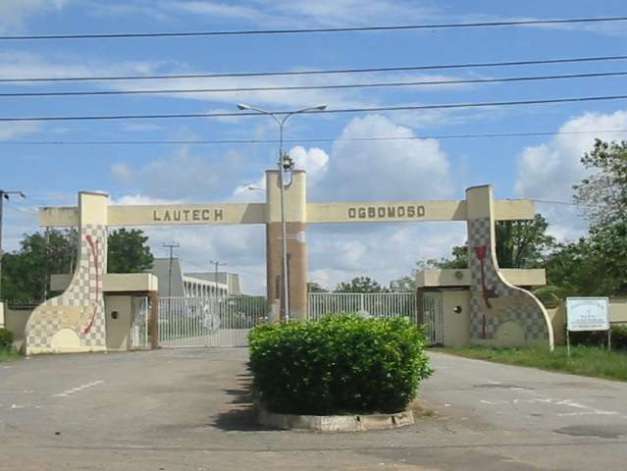
IT has become imperative for Management to put the records straight regarding the current situation in Ladoke Akintola University of Technology LAUTECH, Ogbomoso, more so, that the general public is being fed with a lot of untruth on the issues involved.
This Administration came into office on July 29, 2011 at the height of the ownership crisis which threatened the very existence of the University. The entire membership of staff was polarised along ethnic divides resulting in serious distrust. This took its tolls on the academic programmes of the University with many of them, including medical programme, losing their accreditation.
The daunting challenges notwithstanding, the Administration braced up and with the strategies put in place, peace returned to the University and until June 2016, tremendous progress and achievements were recorded. Some of these are highlighted as follow:
1. On the Use of IGR to Augment subventions from State Governments and pay Salary
The total sum of Nineteen billion, one hundred and seven million, one hundred and fifty four thousand, five hundred and forty Naira, sixty six kobo (=N=19,107,154,540.66) only being the total salaries excluding casual labour wages for the period between January, 2012 to December, 2016 was paid by this Management. A total sum of eleven billion, ninety-eight million, seven hundred and seventy three thousand, nine hundred and fifty eight Naira and fifty six kobo (=N=11,098,773,958.56) only represents the total subvention released by the States for the same period.
Out of this amount, the Government of Oyo State contributed a total sum of Seven billion, five hundred and forty seven million, one hundred and thirty-eight thousand, one hundred and fifty-seven Naira, twenty four kobo (=N=7,547,138,157:24) only while the State of Osun paid a total subvention of Three billion, five hundred and fifty one million, six hundred and thirty five thousand, eight hundred and one Naira, thirty two kobo (=N=3,551,635,801:32) only within the stated period.
If we deduct the total amount paid as subventions by the two State Governments from the expected subventions due to the University within the period, it gives a difference of Six billion, Seven hundred and forty eight million, seven hundred and fifty seven thousand, eight hundred and seventy one Naira and fifty kobo (=N=6,748,757,871.50) only which was what the present Management used to augment the subvention released by the two States during this period using IGR. Please note that the two State Governments did not provide a kobo as running or Capital Grants to the University during the period.
When the University began to experience funding challenges in 2014, (owing to non-release of subventions, first by the State of Osun and later by Oyo State) Management was constrained by its desire not to allow a reversal of the good progress being made; it, therefore resorted to using Internally Generated Revenue (IGR) to pay salaries. The reasoning then was that Management could not be watching staff members starving while funds (which they actually worked for) are kept in banks for the benefits of the banks. This decision was taken after due consultation with the Staff Unions and approval sought from the Governing Council.
It is important to note that all of these were made possible because of the commitment and cooperation of the members of the University community particularly the members of the Management who agreed to make sacrifices in forgoing some legitimate perquisites. Some of them are non-collection of Imprest for over two (2) years, reduction of per diem of members of Management while on official trip/assignment, non-attendance of conferences, seminars and workshops to mention some but a few.
2. Use of IGR for other staff welfare since 2011
Before the assumption of office of this Management, a sum of Two hundred and fifty million Naira (=N=250,000,000:00) only being the balance of loan obtained by one of the past Administrations was settled by the present Administration using Internally Generated Revenue (IGR).
The sum of Ten million Naira (=N=10,000,000:00)only being loan obtained by the past Management of LAUTECH Ventures was also outstanding and only got settled by this Management using IGR. The Council and Management then put in place the process of complete reorganisation of the Ventures with a view to meeting the economic challenges and generating expected revenue to the University. This process was at the final stage of implementation before the commencement of the industrial strike actions embarked upon by the unions on campus last year.
Another debt of One hundred and thirteen million, five hundred and thirty three thousand and sixty five Naira, sixty eight kobo (=N= 113,533,065.68) only, representing the outstanding retirees’ gratuity was settled by the present Management, on assumption of office, using IGR. In addition to this, about four (4) months’ salary deductions and promotion arrears were inherited by this Management and settled using IGR.
The total sum of One billion, eight hundred and twenty nine million, twenty six thousand, nine hundred and forty four Naira, forty six kobo(=N=1,829,026,944.46) only being the arrears of CONUSS/CONPUA and Hazard Allowances on the assumption of duty of the present Administration and was equally settled using IGR.
The total sum of One billion, five hundred and ninety eight million, five hundred and sixteen thousand, thirty nine Naira and seventy six kobo(=N=1,598,516,039.76) only being arrears of Earned Academic Allowances (EAA) and Earned Allowances (EA) was paid to workers between 2012 and 2013 also using IGR. It should be noted that the Federal Government made provisions for the payment of these arrears to Federal Universities. The University Management wrote several letters to the Owner-States for the refund of this amount paid on their behalf to the workers up till date the refund is yet to be effected.
Furthermore, In order to ensure transparency and prudency, Management had always involved the Staff Unions in the decisions to disburse the IGR. A University Finance Committee with its membership drawn from all the Unions and the Management, has been put in place.
3. Academic Activities
Given the peaceful atmosphere and a little motivation to the staff, the University was able to run its academic calendars smoothly. Two convocation ceremonies were held in 2014 and 2015 in addition to the installation of the Chancellor, Asiwaju Bola Ahmed Tinubu. This was made possible by the selfless contributions of the University Staff and approval by Senate and Council.
All the academic programs, including the Bachelor of Medicine, Bachelor of Surgery (MB, BS)
regained accreditations from the different Professional Bodies and the National Universities Commission (NUC). The academic culture of inaugural lectures was restored. Both students and staff shone brilliantly at National and International conferences and competitions winning laurels. The University made good progress as regards collaborations and linkages with Universities within and outside Nigeria.
4. Operating ninety seven (97) Bank Accounts
It is important to state that majority of the bank accounts were opened and maintained by the past Administrations and inherited by the present Administration in 2011 when it assumed office. It is equally important to state that the decision to prune down the number of accounts was recommended by Management and approved by Council. This is contrary to claims made by the representatives of the two Governments. Up till today, there is no single correspondence from either Oyo or Osun States before the University Management to operate a Treasury Single Account.
5. Bursary Department having ten (10) Chief Accountants
The University was established twenty seven (27) years ago and has been expanding both in size and operations. The staff of Bursary Department just like that of any other departments in the University was inherited by this Administration and the staff has just been growing with the University. It is pertinent to state that the present Administration since its assumption of office in 2011 has employed only one staff who is a professional to head the Public and Alumni Relation Unit (PARU) of the University to work on the redemption of the battered image of the University as a result of the ownership crises during the past Administration in the year 2010.
6. Bursary Department Using Manual Accounting System
Since the inception of this Administration a lot of efforts have been made by Council and Management to ensure that the operations of both Bursary and Audit Departments are computerised. The process of awarding the contract was at the final stage awaiting the approval at the next Council meeting before the commencement of the industrial action embarked upon by the unions on campus last year.
7. Comparing LAUTECH with UNIOSUN
LAUTECH was licensed on 23rd April, 1990 and commenced academic business on 19th October, 1990 twenty (27) years ago while UNIOSUN was licensed on 21st December, 2006 and commenced operations on 21st September, 2007 precisely ten (10) years ago, comparing these two Universities may not give a fair result for the following reasons:
Age of the two Universities which tends to make LAUTECH to be bigger than UNIOSUN in terms of size and operating costs/overheads;
The staff strength of LAUTECH is higher than that of UNIOSUN in view of the age of the later.
The retirement benefits being paid monthly and annually by LAUTECH cannot be compared with that of UNIOSUN.
8. The KPMG Issue
The University has been in communication with the KPMG and in the latest mail received on Monday, June 5, 2017, the organisation stated categorically that a new date for the commencement of the auditing would be conveyed to the University once some contractual issues are sorted out with Oyo State Government. Management had indeed confirmed its readiness to cooperate with KPMG knowing fully well that the audit exercise would be in the interest of the University on the long run.
9. Concluding Remark
Management wishes to appreciate the concern of all stakeholders especially the Governments and people of the two Owner-States of Oyo and Osun and indeed all Nigerians who are contributing their own quota to the efforts to resolve the crisis in LAUTECH. The students should please know that all the stakeholders share in their plight and are determined to find a lasting solution to the crisis. The cooperation and support of the Staff Unions to the concerted efforts being made towards moving the University forward are well appreciated.
Given the determination of the Governments of the two Owner-States to end the crisis in the shortest time possible, it is certain that normalcy will return to the University soon. Management also hopes that the University will soon be able to resume its progressive march towards the highest level of excellence.