Connect with us

Education

COVID-19: DAWN commission partners NGO to drive digital education in Southwest

Published

on

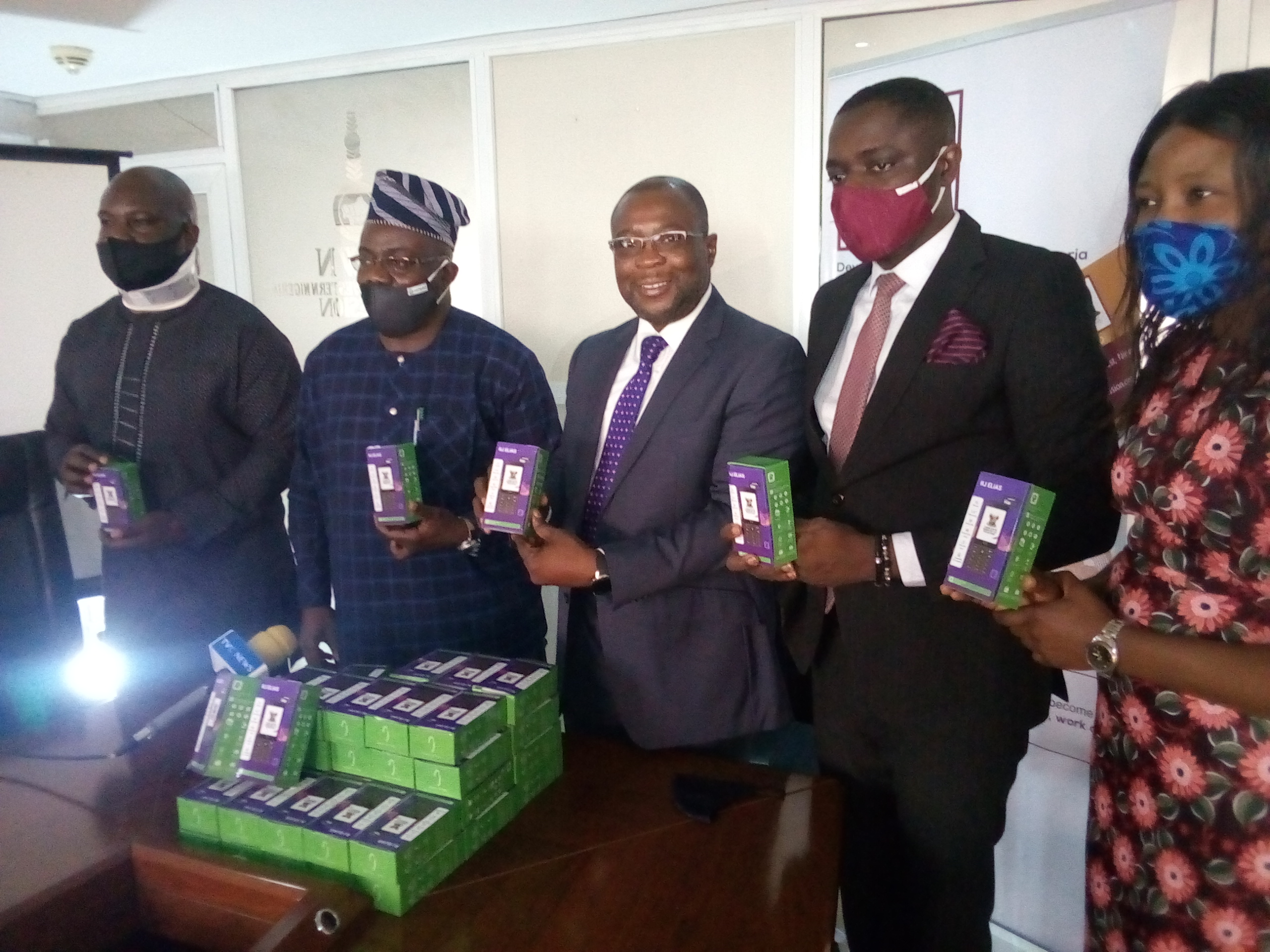
In response to the shutdown of schools due to the deadly Coronavirus pandemic (COVID-19), the Development Agenda for Western Nigeria, DAWN Commission on Tuesday took advantage of  the Fourth Industrial Revolution driven by digital technology by entering into a partnership with a non-governmental organisation, Ibironke Adeagbo Foundation (IAF), to revolutionize education through the introduction of e-learning device, especially amongst children from less privileged families in the South West states.

At the official handover ceremony of the devices which was held at the commission’s office, Cocoa House, Dugbe, Ibadan, the Director General of DAWN, Mr Seye Oyeleye noted that the closure of schools in the country, occasioned by the coronavirus pandemic has changed the landscape of education.

The DG assured that the development will not only bridged the increasingly evident digital education divide in the Southwest as pupils cannot continue to stay at home without finding a way for them to continue learning, but also bring education to the people at the lowest affordable cost. He added that the e-learning devices would be used to engage the governors in the region as well as other critical education stakeholders and concerned private individuals and organizations.

Oyeleye emphasized that the aim of introducing the device was to ensure that no child will be left behind because of pandemic, noting that the future of education is digital, and that the future only suddenly arrived with COVID-19.

According to him, “In the quest to make sure that everyone is carried along, we said let us have an irreducible minimum of digital education soon the kids will have access to. Because we know that we can’t afford the high end digital education that is being provided In Europe, we then look at our own peculiarities and say that how can we bring this education to the people at lowest affordable cost.

“So we have to be creative in the ways and manners we can accommodate all our children. How do you get the child in the towns and rural places connected so they don’t miss out on classes. Our pupils had gone home for months and we realised coronavirus is not going to go tomorrow morning and we are not just going to put the kids at home without finding a way for them to continue learning and we live in a part of the world where data for digital education is not that easy to come by. How do we then move forward to make sure that our children at home at thoroughly educated.

“We know without deceiving ourselves that vast majority of our pupils don’t have that luxury of a device and internet. Does that mean we now neglect them? If you neglect them, you are neglecting your future. Here at DAWN commission, our job is to think critically even for the states”.

He disclosed that apart from Ibironke Adeagbo Foundation, the commission also have one or two other organisations that it is working actively with on the digital education project.

Continuing, Oyeleye maintained that though, the device will not be free but it will be very affordable for the states, urging the states to invest in it.

“What we are saying is how can we make it easily accessible? It means that the states need to invest in it. It is something they can easily afford.

” It is partnership. It is preloaded and there is data on it. Our thinking is long term. We are talking to those who will give us the devices and data, even the content providers are not left out. The aim is that no child will be left behind because of pandemic .We shouldn’t say because some kids can’t go to school, then they are left behind. If we do that we are creating trouble for our immediate future,” he concluded

Justifying the NGO’s decision, earlier in his remarks, a trustee of Ibironke Adeagbo Foundation (IAF), Mr. Diran Famakinwa, informed that the foundation decided to partner DAWN commission because they were both working towards ensuring that majority of children who cannot afford the kind of data and electronic means to link up with their schools continue their education.

Famakinwa explained that how states will implement the use of the device would be down to the peculiarities in each state, adding that the device, comes with preloaded school syllabus in reading, writing and mathematics. He stressed that the need for a remote education will have to continue because things have changed and the kind of education before COVID-19 will not be sustainable going forward.

“Fortunately the two organisations are thinking along the same line and we saw good examples in Europe. Europe had free internet access and broadband. We’ve caught the bug of what DAWN commission is doing.

“Lagos State pioneered some mobile devices that come with six preloaded school syllabuses as well as the data credit to be able to make sure that the children while they are remotely at home were able to continue their education .So, in partnership with DAWN, we decided that everything that happened in Lagos, we need to share that broad knowledge across the whole South West region. We invested in purchasing these devices that would be shared across the other states that have not been able to use this and we would be working with them to get a feedback .

“We would be handing them over to the DAWN commission because they have a better logistics to make sure that these get to the true end user. The device is for every child and it comes with preloaded school syllabus as well as the credit. We feel this is a step in the right direction for those children that are currently not able to continue their education and we believe that even When the schools resume which we certainly hope as soon as the government is able to do deal with all the issues.

“The children will still have the need to be able to remotely access their school and be able to continue their education. We are really delighted that we can work in partnership with DAWN on this,” he remarked.

Famakinwa, however urged other stakeholders in the education sector, including philanthropists, clubs, religious organisations and societies to assist in making sure that every child in the region will be able to afford the device.


Comments

Education

Oyo teachers begin indefinite strike over abducted colleagues, pupils

Published

on

The Nigeria Union of Teachers (NUT), Oyo State Wing, has directed all public primary and secondary school teachers in the state to embark on an indefinite strike over the continued abduction of teachers and pupils.

The strike, which takes effect from Monday, June 1, 2026, is expected to ground academic activities across public schools in the state.

The union said the action became imperative following what it described as growing insecurity in schools and the prolonged captivity of abducted teachers and pupils whose whereabouts remain unknown.

In a statement jointly signed by the Chairman of the Oyo State Wing of the NUT, Hassan Fatai, and the Secretary, Salami Olukayode, the union expressed concerns over the psychological impact of the incidents on teachers, learners and parents.

According to the union, the lingering abduction cases have created fear and anxiety among teachers, weakened confidence in the safety of schools and discouraged many parents from sending their children to school.

The statement read in part, “The Nigeria Union of Teachers, Oyo State Wing, hereby directs all public primary and secondary school teachers across the state to commence an indefinite strike action effective from Monday, June 1, 2026, pending urgent and decisive action by relevant authorities on the abduction of teachers and pupils.”

The union explained that the industrial action was aimed at compelling the government and security agencies to intensify efforts toward the immediate and unconditional release of the victims.

It urged teachers across the state to comply fully with the directive, remain peaceful and law-abiding, and prioritise their safety while staying away from classrooms during the strike.

The NUT also expressed solidarity with the abducted victims and their families, assuring that it would continue to engage relevant authorities until the victims were safely rescued.

The union reaffirmed its commitment to the welfare, safety and security of teachers and pupils, stressing that the protection of school communities remained non-negotiable.

Continue Reading

Education

2.24m candidates participate in 2026 UTME, police assure security

Published

on

No fewer than 2,243,816 candidates on Thursday commenced the 2026 Unified Tertiary Matriculation Examination conducted by the Joint Admissions and Matriculation Board across accredited Computer-Based Test centres nationwide.

The figure represents a 10.5 per cent increase from the 2.03 million candidates recorded in 2025.

The examination, which began on April 16, is being conducted in about 1,000 CBT centres nationwide, with candidates scheduled in four daily sessions to reduce congestion and improve verification processes.

The board said it had deployed biometric verification and real-time monitoring systems to safeguard the integrity of the exercise, noting that candidates whose biometric details could not be authenticated would be rescheduled.

Candidates were advised to print their examination slips from the JAMB portal to confirm their schedules and arrive at least one hour before their examination time.

Under the revised timetable, first-session candidates are expected at 7:00 a.m., followed by 9:00 a.m. for the second session, 11:00 a.m. for the third session, and 2:00 p.m. for the final session.

JAMB disclosed that Lagos State recorded the highest number of registered candidates with 381,814, followed by Ogun with 137,156 and Oyo with 122,662. Kaduna recorded 103,498 candidates, while the Federal Capital Territory had 102,961.

Other states include Rivers with 105,584 candidates and Kano with 83,167, while Borno and Zamfara recorded the lowest figures with 13,483 and 14,861 candidates respectively.

Outside Nigeria, participation remained low, with Côte d’Ivoire recording 32 candidates, followed by Equatorial Guinea with 16, Burkina Faso with 14, and the United Kingdom with 12 candidates.

As part of efforts to enhance efficiency, the board increased the number of CBT centres but delisted 23 centres across several states, including Lagos, Ogun, Oyo, Delta, Edo, Plateau and the Federal Capital Territory, over technical deficiencies observed during the mock examination.

The board said the action was necessary to maintain operational standards and ensure the credibility of the examination process.

Meanwhile, the Nigeria Police Force dismissed reports of insecurity at some centres, describing such claims as unfounded.

The police said it had deployed additional personnel, including patrol teams, perimeter surveillance units and rapid response squads, to ensure the safety of candidates nationwide.

The force added that it was collaborating with other security agencies to monitor the exercise and respond swiftly to any threats.

It assured parents and candidates of adequate security, urging candidates to comply with examination guidelines, arrive early and report suspicious activities.

The police also advised the public to disregard unverified information on social media and rely on official communication channels.

JAMB reiterated its commitment to transparency, warning candidates against accepting admissions outside its Central Admissions Processing System.
It stressed that any admission conducted outside CAPS would be considered illegal and would not be recognised.

Continue Reading

Education

JAMB delists 23 CBT centres over technical glitches ahead UTME

Published

on


The Joint Admissions and Matriculation Board has delisted 23 Computer-Based Test centres nationwide following technical deficiencies recorded during the 2026 mock Unified Tertiary Matriculation Examination.

The Board disclosed this in a bulletin issued on Friday and signed by its Public Communication Advisor, Fabian Benjamin, as preparations intensify for the 2026 UTME scheduled to hold across the country from April 16 to April 25.
According to JAMB, the mock examination was designed to assess operational readiness and identify centres that failed to meet the required technical standards.

“Following the conduct of the 2026 Mock Unified Tertiary Matriculation Examination, the Board has delisted 23 Computer-Based Test centres for technical deficiencies,” the statement read.
The Board added that several centres with minor issues had been placed on notice, warning that continued non-compliance could lead to further sanctions. It also stated that one centre would no longer be used for any of its examinations.

JAMB disclosed that a total of 2,243,816 candidates registered for the 2026 UTME, with Lagos recording 321,814 candidates, Kaduna 303,498, the Federal Capital Territory 302,963, and Ogun 137,156.

To improve accessibility and logistics, the Board said it increased the number of approved examination centres to 1,000 nationwide, up from fewer than 800 in 2025.

However, an internal review conducted after the mock exercise revealed that some centres failed to meet operational and technical benchmarks, prompting their removal from the approved list.

The delisting followed reports of widespread technical glitches during the mock examination, including network failures, system malfunctions and delayed commencement of tests in several locations. Some candidates and parents also complained about hours-long waiting periods at affected centres.

The affected centres are located in Abia, Anambra, Bayelsa, Delta, Edo, the Federal Capital Territory, Lagos, Ogun, Osun, Oyo and Plateau states.

Among the delisted centres are Micben Seat of Wisdom Academy, Ukwa West, Abia; Bishop Crowther Seminary CBT Centre, Awka, and The Oracle Lens, Nnokwa, Anambra; Derby’s Young ICT Centre, Yenagoa, Bayelsa; Avid ICT Solutions CBT Centre, Asaba, Delta; and Daniet Global Resources CBT Centre, Benin City, Edo.
Others include De-Lite CBT Centre, Maitama, Abuja; Florin High School CBT Centre, Ejigbo; Folbob CBT Centre, Lakowe; Great Kezino College CBT Centre, Ikorodu; Obans CBT Centre, Ikorodu; and Teesas Learning and CBT Centre, Lekki, all in Lagos.

Also affected are Braingate Model Schools CBT Centre, Arepo, and Greenhills Academy CBT Centre, Itele, Ogun State; Oduduwa University CBT Centre, Ile-Ife, Osun State; Lasting Glory Schools CBT Centre, Ibadan; Nesam International School CBT Centre, Ibadan; SAF Polytechnic CBT Centre, Iseyin, Oyo State; and Rabjib Computer Academy, Jos, Plateau State.

JAMB stated that the decision formed part of efforts to safeguard the integrity of its examination process and ensure that only centres that meet its operational requirements are used for the main UTME.

The Board assured candidates that necessary measures had been put in place to ensure a smooth conduct of the examination nationwide.

Continue Reading

Advertisement

Entertainment

Advertisement

MegaIcon Magazine Facebook Page

Advertisement

MEGAICON TV

Advertisement

Trending