Connect with us

News

Cambodia PM unveils plan to favour son on path to power

Published

on

After nearly four decades as Cambodian leader, Hun Sen goes into elections this weekend certain of victory and vowing to eventually hand power to his eldest son.

But the 70-year-old has given no timeframe for his dynastic succession and signalled he will continue to wield influence even after standing down.

Sunday’s vote is widely deemed a sham thanks to the near-total absence of genuine opposition parties, and critics say that more than 30 years after UN-brokered peace accords ended decades of bloody conflict, Cambodian democracy is in a sorry state.

“Nobody can block the steps forward of Hun Sen or Hun Manet,” the prime minister told voters in June.

“After Hun Sen, it will be Hun Manet.”

While no fixed date has been given for a transfer of power, Hun Manet, 45, has taken on a number of his father’s campaign duties this year.

In a highly symbolic gesture at a rally for the ruling Cambodian People’s Party (CPP) this month, Hun Sen passed the party flag to Hun Manet, who led a crowd of supporters on a march through Phnom Penh.

Hun Manet has also travelled around the country to preside over ceremonies and meet soldiers, workers and CPP members, repeating his father’s campaign mantras of peace and development.

“As long as the CPP continues to lead the country, can keep the peace and can keep balance, we all live with happiness,” he said in a clip posted to Telegram this month.

– ‘Like North Korea’ –
Phil Robertson of Human Rights Watch told AFP that the prospect of a dynastic handover “makes Cambodia look more like North Korea than a genuine democracy”.

Hun Sen has five children and has carved out political roles for all three of his sons, with the most senior responsibilities entrusted to his eldest.

Hun Manet, already a member of the CPP’s powerful permanent committee, will contest a parliamentary seat this weekend for the first time.

He has served as commander of the Royal Cambodian Army since 2018 and met with foreign dignitaries and world leaders including President Xi Jinping of China — Cambodia’s main ally and benefactor.

Hun Sen’s politics are shaped by his experiences of revolution and war as a young man during the genocidal Khmer Rouge regime.

Those privations moulded him into one of the most effective — and most ruthless — politicians of his generation and thrust him into the prime ministership in 1985, aged just 32.

He has since consolidated his power by co-opting, jailing, sidelining or effectively exiling any opponents.

By contrast, his son was raised in luxury and educated abroad, including at the US military academy West Point.

But a Western education is no guarantee of a more liberal approach, exiled politician Sam Rainsy, a longstanding foe of the prime minister, told AFP — pointing to Syria’s brutal Assad dynasty.

“Syria’s Bashar al-Assad is more educated than Hafez al-Assad, but the son is politically worse than the father,” he said.

Sebastian Strangio, author of a book about Hun Sen’s rule, told AFP that so far Hun Manet had shown “little evidence that he will introduce anything more than cosmetic reforms to the current political system”.
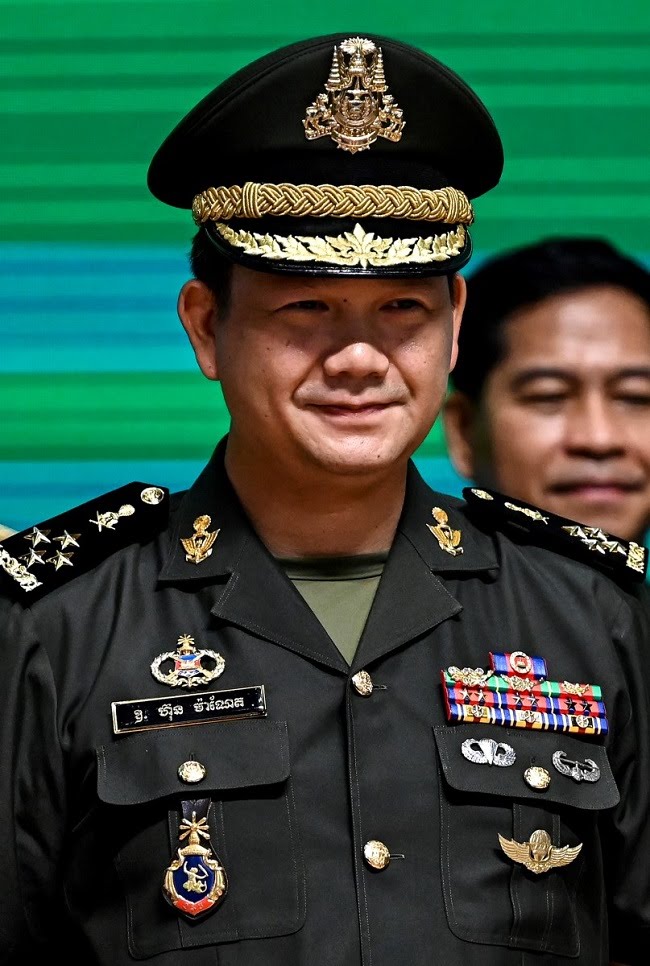
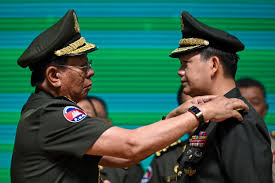
(FILES) General Hun Manet, commander of the Royal Cambodian Army and eldest son of Prime Minister Hun Sen, looks on during a promotion ceremony at the Ministry of National Defence in Phnom Penh on April 20, 2023. – Cambodia’s Prime Minister Hun Sen has for years made it clear that his eldest son Hun Manet — a four-star general educated in the United States and Britain — would replace him when he finally called time on nearly four decades of national leadership. (Photo by TANG CHHIN Sothy / AFP)

– ‘Golden spoon’ –
Without his father’s backing it is not clear Hun Manet would be able to make changes even if he wanted to.

And he remains untested in the political arena, said political analyst Ou Virak, comparing him to an unproven, if well trained, martial arts fighter.

“The problem is he’s been spoon-fed, mostly with a golden spoon,” Ou Virak told AFP.

“You put them in the ring, they are going to get knocked out first round. You have to allow them to fight, to spar, to survive,” he said.

Hun Sen, 70, was hospitalised for “exhaustion” in Singapore six years ago and was a heavy smoker for most of his life until recently kicking the habit.

But he has given no indication of exactly when he intends to step down and has also told voters he will continue to exert power after leaving his post.

“Although Hun Sen won’t be the prime minister, the political management will be still in the hands of Hun Sen,” said the leader, who habitually refers to himself in the third person in public speeches.

He told voters at the end of June not to worry and said he would not let his son damage the country.

“I am still the PM candidate, and my son is the future candidate.”

Sam Rainsy, who was banned on Monday from running for office for 25 years for urging people to spoil their ballots, told AFP that without “a new leader drawn from outside the Hun family”, there would be no change to Cambodia’s autocratic political system.



Comments

News

Kano Assembly Moves to Impeach Deputy Governor Gwarzo Over ₦1.6bn Alleged Fraud

Published

on

By

Deputy Governor of Kano State Aminu Gwarzo

The Kano State House of Assembly has initiated impeachment proceedings against Deputy Governor Aminu Abdussalam Gwarzo over allegations of gross misconduct, abuse of office, and breach of public trust.

The notice was presented yesterday during plenary by the Majority Leader, Lawan Hussaini Dala, who said the action follows Section 188 of the 1999 Constitution of the Federal Republic of Nigeria.

Dala said the allegations stem from Abdussalam’s tenure as Commissioner for Local Government (2023–2024) and his current role as deputy governor. He accused the deputy governor of diverting funds meant for the 44 local government councils.

According to the majority leader, Abdussalam allegedly received N1.5 million monthly from each council between June 2023 and January 2024, totaling N462 million. Between February and July 2024, he allegedly collected N3.255 million monthly from each council under the guise of special assignments, amounting to N726 million.

Dala also accused the deputy governor of abuse of office, claiming he facilitated payments of N10 million from each council to NovoMed Pharmaceuticals Limited, totaling N440 million, in violation of state procurement laws.

“The misuse of official capacity to confer undue advantage constitutes abuse of power and undermines public trust,” Dala told lawmakers, adding that the allegations amount to gross misconduct under the Constitution.

The impeachment notice was reportedly endorsed by 38 lawmakers, meeting the constitutional threshold to proceed. The Speaker has acknowledged receipt, and the House is expected to serve the allegations on the deputy governor.

If approved, a panel may be constituted by the state Chief Judge to investigate the claims.

As of filing, Abdussalam had yet to respond publicly to the allegations.

Continue Reading

News

IGP Inaugurates State Police Committee, Gives Four-Week Deadline

Published

on

By

State policing has been on the frontburner in Nigeria in recent years. Photo: X@PoliceNG

The Inspector-General of Police, Tunji Disu, on Wednesday inaugurated a seven-member committee on the establishment of state police, giving it four weeks to submit its report.

The inauguration was held during his maiden conference with senior police officers at the Peacekeeping Conference Centre, Force Headquarters, Abuja.

Charging members of the panel to discharge their duties with professionalism and objectivity, Disu described the assignment as “both significant and timely,” noting that it would shape the framework through which state policing may operate in Nigeria.

“In carrying out this assignment, your deliberations must be guided by professionalism, objectivity, and a clear appreciation of the unique complexities of policing a diverse nation such as our own,” the IGP said.

He stated that if properly designed and effectively implemented, state policing holds significant potential benefits for the country.

“By bringing law enforcement closer to communities, state police institutions can deepen local knowledge of security dynamics and enable quicker and more targeted responses to emerging threats,” he added.

The committee is expected to review existing policing models within and outside Nigeria, assess community security needs and emerging risks, and propose an operational framework for the establishment and coordination of state police structures.

It will also address issues relating to recruitment, training, standards and resource allocation, as well as develop accountability and oversight mechanisms to ensure professionalism and public trust.

The panel is chaired by Olu Ogunsakin, with Bode Ojajuni as secretary. Other members are Emmanuel Ojukwu, Okebechi Agora, Suleyman Gulma, Ikechukwu Okafor and Tolulope Ipinmisho.

Disu said the committee had about four weeks to conclude its assignment and submit a comprehensive report.
The move marks one of the first major steps taken by the new police chief since his appointment and confirmation a few days ago.

The development comes amid rising security concerns across the country, with several stakeholders advocating state policing as part of measures to tackle insecurity.

President Bola Tinubu had earlier asked the National Assembly to commence the process of amending relevant laws to pave the way for the creation of state police.

Continue Reading

News

Tinubu swears in Disu as IGP, inaugurates RMAFC, FCSC commissioners

Published

on

By

President Bola Tinubu on Wednesday swore in Olatunji Disu as the Inspector-General of Police (IGP).

Disu took the oath of office at the Council Chamber of the Presidential Villa, Abuja, shortly before the commencement of the Federal Executive Council (FEC) meeting.

The President also administered the oath of office to six commissioners of the Revenue Mobilisation Allocation and Fiscal Commission (RMAFC) and two commissioners of the Federal Civil Service Commission (FCSC).

The ceremonies were witnessed by ministers, senior government officials and family members of the appointees.
The council meeting began shortly after the swearing-in.

In attendance were Vice President Kashim Shettima; the Secretary to the Government of the Federation, Senator George Akume; the Chief of Staff to the President, Femi Gbajabiamila; the National Security Adviser (NSA), Nuhu Ribadu; and the Head of the Civil Service of the Federation, Mrs EsthMrs.Walson-Jack.

Disu was appointed acting IGP on February 25, 2026, by President Tinubu, following the resignation of former IGP Kayode Egbetokun.

His appointment was subsequently endorsed by the Nigeria Police Council (NPC).

The former Assistant Inspector-General of Police assumed office last Wednesday.

He previously served as Assistant Inspector-General in charge of the Force Criminal Investigation Department (FCID) Annex, Alagbon, Lagos, after his promotion to the rank last year.

A former head of the Lagos Rapid Response Squad (RRS), Disu has pledged to deliver accountable, modern and professional policing.

Continue Reading

Advertisement

Entertainment

Advertisement

MegaIcon Magazine Facebook Page

Advertisement

MEGAICON TV

Advertisement

Trending