
News
Britain and the world bid adieu to Queen Elizabeth II

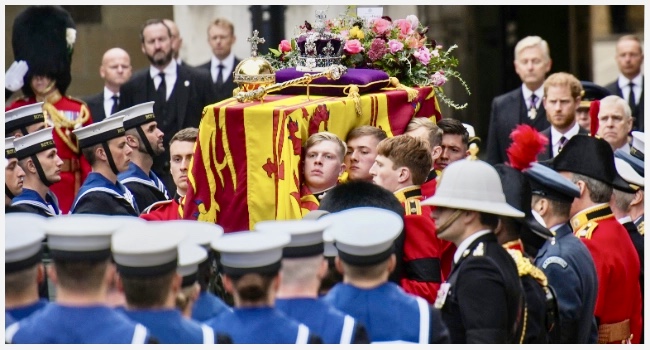

Britain said farewell to Queen Elizabeth II on Monday at a state funeral attended by world leaders, before a historic last ceremonial journey through the streets of London packed with sorrowful mourners.
Huge crowds gathered in near silence to watch as the queen’s flag-draped coffin, topped with the Imperial State Crown, her orb and sceptre, was carried slowly to a gun carriage from parliament’s Westminster Hall where it had lain in state since Wednesday.
To the tune of pipes and drums, the gun carriage — used at every state funeral since Queen Victoria’s in 1901 — was then drawn by 142 junior enlisted sailors in the Royal Navy to Westminster Abbey.
The thousand-year-old church’s tenor bell tolled 96 times at one-minute intervals — one for every year of her life — stopping a minute before the service began at 11:00 am (1000 GMT).
In his funeral sermon, Archbishop of Canterbury Justin Welby praised the queen’s life of duty and service to the UK and Commonwealth.
“People of loving service are rare in any walk of life. Leaders of loving service are still rarer,” he told the 2,000 guests, who included US President Joe Biden and Japan’s reclusive Emperor Naruhito.
“But in all cases, those who serve will be loved and remembered,” the Anglican leader added, before the coffin was borne on another procession towards her final resting place in Windsor Castle, west of London.
The longest-serving monarch in British history died at Balmoral, her Scottish Highland retreat, on September 8 after a year of declining health.
Her eldest son and successor, King Charles III, dressed in ceremonial military uniform, followed the solemn processions, alongside his three siblings.
‘She was my boss’
Charles’s eldest son Prince William accompanied them alongside William’s estranged brother, Prince Harry, and other senior royals.
William’s two eldest children, George and Charlotte, who are next in line to the throne, also walked behind the coffin inside the abbey.
Late Sunday, Charles, 73, and his wife, Queen Consort Camilla, said they had been “deeply touched” by the public’s flood of messages.
“As we all prepare to say our last farewell, I wanted simply to take this opportunity to say thank you,” he said.
Britain, a country much changed since the queen’s coronation in the same abbey in 1953, has dug deep into its centuries of tradition to honour the only monarch that most of its people have ever known.
“It’s once in a lifetime,” said student Naomi Thompson, 22, camped out in the crowds at London’s Hyde Park.
“It’s a moment of history… She’s everyone’s granny,” added engineer Alice Garret, 28.
Others unable to be in London gathered in cinemas and churches around England, Scotland, Wales and Northern Ireland to watch the service and procession on big screens.
Auto engineer Jamie Page, a 41-year-old former soldier, stood on Whitehall to observe the funeral procession, wearing his military medals from service in the Iraq war.
“Sixteen years old, I swore an oath of allegiance to the queen. She’s been my boss. She means everything, she was like a gift from God,” he said.
Two minutes of silence
But on Charles, the oldest person yet to ascend the British throne, Page added: “Who knows, time will tell.”
The funeral lasted just under an hour, brought to an end by a bugler playing “The Last Post”, before two minutes of silence and the reworded national anthem, “God Save the King”.
After an hour-long procession that was to go past Buckingham Palace, the coffin was to be taken west by road to Windsor Castle, where thousands had lined the route since early morning.
Some 6,000 military personnel have been drafted in to take part in proceedings in what Britain’s highest-ranking military officer has called “our last duty for Her Majesty the Queen”.
The queen will be buried alongside her father king George VI, her mother queen Elizabeth and sister princess Margaret, reuniting in death the family who once called themselves “us four”.
The coffin of her husband, Prince Philip, who died last year aged 99, will also be transferred to lie alongside her.
Elizabeth’s funeral could not be more different from Philip’s at St George’s Chapel, Windsor, in April 2021.
Coronavirus restrictions limited mourners to just 30, led by the queen, a solitary figure in mourning black and a matching facemask.
The contrast was profound on Monday, the abbey packed with dignitaries and some ordinary Britons who were honoured for their military or community service, especially during the Covid pandemic.
Biden’s tribute
“You were fortunate to have had her for 70 years; we all were,” Biden said on Sunday after signing a book of condolence. “The world is better for her.”
In the abbey pews was Liz Truss, whom the queen appointed as the 15th British prime minister of her reign just two days before her death, in her last major ceremonial duty.
All of Truss’s living predecessors were there plus her counterparts and representatives from the 14 Commonwealth countries outside Britain where Charles is also head of state.
Whether they remain constitutional monarchies or become republics is likely to be the defining feature of Charles’s reign.
The queen’s death has prompted deep reflection about the Britain she reigned over, the legacy of its past, its present state and what the future might hold, as well as the values of lifelong service and duty she came to represent during her 70-year reign.
Hundreds of thousands of people are estimated to have queued, sometimes for up to 25 hours and overnight, to file past the queen’s coffin as it lay in state.
Chrissy Heerey, a serving member of the Royal Air Force who joined the marathon queue twice, was the last person through the doors and described the experience as “amazing”.
“When they came to me and said, ‘right, you’re the last person’, I said, really?!” she told AFP, before heading off to join the crowds for the coffin’s procession through London.
Big Ben tolls
Throughout the procession after the funeral, Big Ben, the giant bell atop the Elizabeth Tower at one end of the Houses of Parliament, tolled and military guns fired at one-minute intervals.
At Windsor, the Sebastopol Bell — captured in Crimea in 1856 — and the Curfew Tower Bell also sounded.
A vast television audience was expected to watch the funeral worldwide and live online, in a sign of the enduring fascination with the woman once described as “the last global monarch”.
Those lining the streets of London — already jammed at sunrise on Monday — said they had to bear witness.
“I will talk about this moment to my children,” said Jack Davies, 14, camped out for the procession with his parents at Hyde Park Corner, where the coffin will be transferred from the gun carriage for the drive to Windsor.
“I’ll say: ‘I was there!’”
At Windsor, the queen’s crown, orb and sceptre will be removed and placed on the altar.
The most senior officer of the royal household, the lord chamberlain, breaks his “wand of office” and places it on the coffin, symbolising the end of her reign.
The lead-lined oak casket, draped with the queen’s colours, will be lowered into the Royal Vault as a lone bagpiper plays a lament.
A private interment ceremony will take place at the adjoining King George VI Memorial Chapel at 1830 GMT.
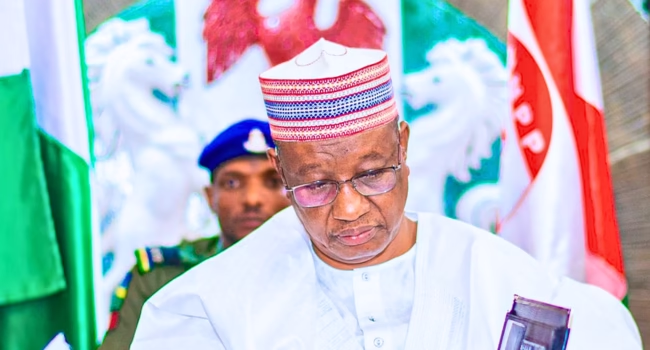
The Kano State House of Assembly has initiated impeachment proceedings against Deputy Governor Aminu Abdussalam Gwarzo over allegations of gross misconduct, abuse of office, and breach of public trust.
The notice was presented yesterday during plenary by the Majority Leader, Lawan Hussaini Dala, who said the action follows Section 188 of the 1999 Constitution of the Federal Republic of Nigeria.
Dala said the allegations stem from Abdussalam’s tenure as Commissioner for Local Government (2023–2024) and his current role as deputy governor. He accused the deputy governor of diverting funds meant for the 44 local government councils.
According to the majority leader, Abdussalam allegedly received N1.5 million monthly from each council between June 2023 and January 2024, totaling N462 million. Between February and July 2024, he allegedly collected N3.255 million monthly from each council under the guise of special assignments, amounting to N726 million.
Dala also accused the deputy governor of abuse of office, claiming he facilitated payments of N10 million from each council to NovoMed Pharmaceuticals Limited, totaling N440 million, in violation of state procurement laws.
“The misuse of official capacity to confer undue advantage constitutes abuse of power and undermines public trust,” Dala told lawmakers, adding that the allegations amount to gross misconduct under the Constitution.
The impeachment notice was reportedly endorsed by 38 lawmakers, meeting the constitutional threshold to proceed. The Speaker has acknowledged receipt, and the House is expected to serve the allegations on the deputy governor.
If approved, a panel may be constituted by the state Chief Judge to investigate the claims.
As of filing, Abdussalam had yet to respond publicly to the allegations.
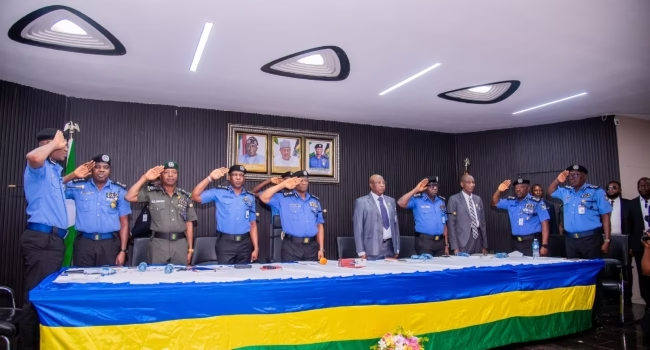
The Inspector-General of Police, Tunji Disu, on Wednesday inaugurated a seven-member committee on the establishment of state police, giving it four weeks to submit its report.
The inauguration was held during his maiden conference with senior police officers at the Peacekeeping Conference Centre, Force Headquarters, Abuja.
Charging members of the panel to discharge their duties with professionalism and objectivity, Disu described the assignment as “both significant and timely,” noting that it would shape the framework through which state policing may operate in Nigeria.
“In carrying out this assignment, your deliberations must be guided by professionalism, objectivity, and a clear appreciation of the unique complexities of policing a diverse nation such as our own,” the IGP said.
He stated that if properly designed and effectively implemented, state policing holds significant potential benefits for the country.
“By bringing law enforcement closer to communities, state police institutions can deepen local knowledge of security dynamics and enable quicker and more targeted responses to emerging threats,” he added.
The committee is expected to review existing policing models within and outside Nigeria, assess community security needs and emerging risks, and propose an operational framework for the establishment and coordination of state police structures.
It will also address issues relating to recruitment, training, standards and resource allocation, as well as develop accountability and oversight mechanisms to ensure professionalism and public trust.
The panel is chaired by Olu Ogunsakin, with Bode Ojajuni as secretary. Other members are Emmanuel Ojukwu, Okebechi Agora, Suleyman Gulma, Ikechukwu Okafor and Tolulope Ipinmisho.
Disu said the committee had about four weeks to conclude its assignment and submit a comprehensive report.
The move marks one of the first major steps taken by the new police chief since his appointment and confirmation a few days ago.
The development comes amid rising security concerns across the country, with several stakeholders advocating state policing as part of measures to tackle insecurity.
President Bola Tinubu had earlier asked the National Assembly to commence the process of amending relevant laws to pave the way for the creation of state police.
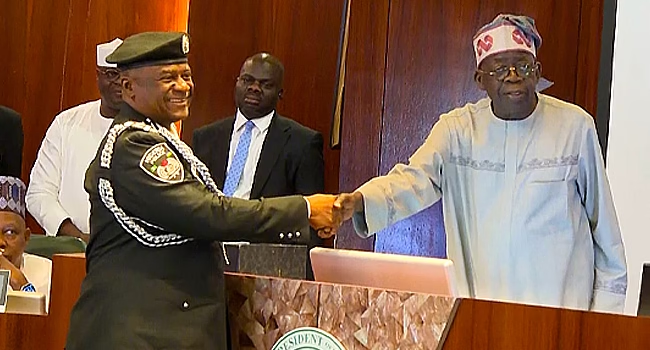
President Bola Tinubu on Wednesday swore in Olatunji Disu as the Inspector-General of Police (IGP).
Disu took the oath of office at the Council Chamber of the Presidential Villa, Abuja, shortly before the commencement of the Federal Executive Council (FEC) meeting.
The President also administered the oath of office to six commissioners of the Revenue Mobilisation Allocation and Fiscal Commission (RMAFC) and two commissioners of the Federal Civil Service Commission (FCSC).
The ceremonies were witnessed by ministers, senior government officials and family members of the appointees.
The council meeting began shortly after the swearing-in.
In attendance were Vice President Kashim Shettima; the Secretary to the Government of the Federation, Senator George Akume; the Chief of Staff to the President, Femi Gbajabiamila; the National Security Adviser (NSA), Nuhu Ribadu; and the Head of the Civil Service of the Federation, Mrs EsthMrs.Walson-Jack.
Disu was appointed acting IGP on February 25, 2026, by President Tinubu, following the resignation of former IGP Kayode Egbetokun.
His appointment was subsequently endorsed by the Nigeria Police Council (NPC).
The former Assistant Inspector-General of Police assumed office last Wednesday.
He previously served as Assistant Inspector-General in charge of the Force Criminal Investigation Department (FCID) Annex, Alagbon, Lagos, after his promotion to the rank last year.
A former head of the Lagos Rapid Response Squad (RRS), Disu has pledged to deliver accountable, modern and professional policing.




-
 Politics3 days ago
Ibarapa East Assembly Hopeful, Ramon Congratulates Ajiboye, Says Emergence Good for Oyo APC
-
 Politics7 days ago
Makinde: My Successor Must Be Loyal to Oyo, Not Me
-
 Politics3 days ago
2027: Former Oyo Deputy Governor Adeyemo Emerges APC Chairman (See Full List)
-
 Politics7 days ago
Fintiri Dumps PDP for APC, Moves with Cabinet, 14 Adamawa Lawmakers