Connect with us

News

Biden Vows Arms Suspension as Israel Shells Rafah

Published

on

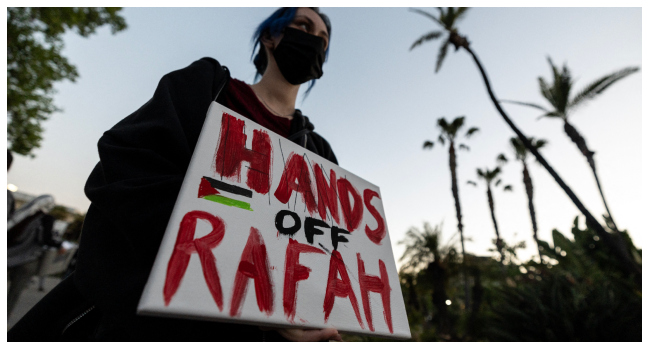
Demonstrators protest during a rally in support of Rafah, next to a pro-Palestinian encampment at California State University, Los Angeles (Cal State LA) in Los Angeles, California, on May 7, 2024. (Photo by Etienne LAURENT / AFP)

Israel shelled Rafah on Thursday as US President Joe Biden offered his starkest warning yet over the conduct of its war against Hamas, vowing to cut off arms transfers if an offensive into the southern Gaza city goes ahead.

Israel has defied international objections by sending in tanks and conducting “targeted raids” in the border city, which it says is home to Hamas’s last remaining battalions — but is also crowded with displaced Palestinian civilians.

AFP journalists reported heavy shelling in Rafah early Thursday, and the Israeli military later said it was also striking “Hamas positions” further north in the centre of the Gaza Strip.

In an interview with CNN on Wednesday, Biden warned he would stop US weapons supplies to Israel if it pushed ahead with its long-threatened Rafah ground offensive.

“If they go into Rafah, I’m not supplying the weapons that have been used… to deal with the cities,” Biden said. “We’re not gonna supply the weapons and the artillery shells that have been used.”

On Tuesday, Israel forces seized Rafah’s border crossing into Egypt, which has served the main entry point for aid into besieged Gaza.

The White House condemned the interruption to humanitarian deliveries at the time, and the secretary of defence later confirmed Washington had paused, for the time being, a shipment of heavy bombs to Israel after it failed to address concerns over its Rafah ground incursion.

“Civilians have been killed in Gaza as a consequence of those bombs,” Biden said in his interview. “It’s just wrong.”

He insisted, however, that the United States was “not walking away from Israel’s security”.

The United States, along with Egypt and Cairo, has been heavily involved in talks currently under way in Cairo aimed at brokering a ceasefire in the seven-month war.

– ‘Extreme fear’ –

The Israeli military said Wednesday it was reopening another major aid crossing into Gaza, Kerem Shalom, as well as the Erez crossing.

But the UN agency for Palestinian refugees, UNRWA, said the Kerem Shalom crossing — which Israel shut after a rocket attack killed four soldiers on Sunday — remained closed.

Late Wednesday, the army said a soldier was lightly wounded when Kerem Shalom was again targeted by rockets.

The heavy shelling in Rafah overnight into Thursday followed a day of what the Israeli military said were “targeted raids on the Gazan side of Rafah crossing”, in the city’s east.

An army statement later on Wednesday said that Hamas naval commander Mohammed Ahmed Ali was killed in an air strike “in the past day”. Hamas did not immediately comment.

Civilian life in Rafah, meanwhile, “has completely ceased”, said displaced Gazan Marwan al-Masri, 35, noting “the streets are empty” in the western part of the city.

“We are living in Rafah in extreme fear and endless anxiety,” said Muhanad Ahmad Qishta, 29.

“Places the Israeli army claims to be safe are also being bombed,” he told AFP.

– ‘Catastrophic’ health situation –

An emergency doctor working in Rafah and nearby Khan Yunis said that with humanitarian access compromised, the health situation was “catastrophic”.

“The smell of sewage is rife everywhere,” said the doctor, James Smith. “It’s been getting worse over the course of the last couple of days.”

World Health Organization chief Tedros Adhanom Ghebreyesus said Wednesday that hospitals in southern Gaza had only “three days of fuel left” because of the border closures.

“Without fuel all humanitarian operations will stop.”

The war in Gaza was sparked by Hamas’s unprecedented October 7 attack on Israel, which resulted in the deaths of more than 1,170 people, mostly civilians, according to an AFP tally of Israeli official figures.

Israel in response vowed to crush Hamas and launched a military offensive that has killed at least 34,844 people in Gaza, mostly women and children, according to the Hamas-run territory’s health ministry.

Militants also took about 250 hostages. Israel estimates 128 of them remain in Gaza, including 36 who officials say are dead.

– Truce talks –

Talks involving Qatari, US and Hamas delegations aimed at cementing a long-stalled ceasefire deal were ongoing Wednesday in Cairo, said Al-Qahera News, which is linked to Egyptian intelligence.

It noted that there were “points of contention” during the discussions, but also reported some “convergence” without elaborating.

A senior Hamas official said the latest round of negotiations would be “decisive”.

Hamas “insists on the rightful demands of its people”, the official said on condition of anonymity because he was not authorised to speak publicly about the negotiations.

In Jerusalem, CIA director Bill Burns met Israeli Prime Minister Benjamin Netanyahu to discuss the “possibility of Israel pausing the operation in Rafah in exchange for hostage releases”, an Israeli official said, also on condition of anonymity.

The Hamas official had previously warned the Cairo talks would be Israel’s “last chance” to free the hostages still in militants’ hands.

Mediator Qatar also appealed “for urgent international action to prevent Rafah from being invaded and a crime of genocide being committed”.

Palestinian analyst Mkhaimar Abusada said Israel’s seizure of the Rafah crossing could be an attempt to create new facts on the ground, or a bid to “sabotage the truce talks”.

Israel’s seizure of the Palestinian side of the Rafah crossing came after Hamas said it had accepted a truce proposal — one Israel said was “far” from what its own negotiators had previously agreed to.

Netanyahu has described the Rafah operation as “a very important step” in denying Hamas “a passage that was essential for establishing its reign of terror”.

 

Comments

News

Oseni mourns ex-Oyo lawmaker Akeem ‘Able’, says Oyo APC has lost loyal progressive

Published

on

The lawmaker representing Ibarapa East/Ido Federal Constituency in the House of Representatives, Engr. Aderemi Oseni, has mourned the death of a chieftain of the All Progressives Congress (APC) in Oyo State and former member of the Oyo State House of Assembly, Hon. Akeem Abimbola Oladipupo, popularly known as Able, describing his demise as a painful loss to the progressive family.

Oladipupo, who represented Ibadan North-West Constituency in the Oyo State House of Assembly, was widely regarded as a grassroots politician and committed party loyalist until his passing.

Oseni, who is also the Chairman, House Committee on Federal Roads Maintenance Agency and the APC candidate for Oyo South Senatorial District, said the late politician’s death had created a vacuum within the party and among those who benefitted from his unwavering commitment to public service.

In a condolence statement issued on Monday by his Media Aide, Idowu Ayodele, and made available to journalists in Ibadan, the Oyo State capital, the federal lawmaker described the late Oladipupo as a dependable progressive, humble political actor and loyal party stalwart whose impact would remain indelible.

He said the deceased dedicated his life to serving humanity, strengthening the progressive movement and supporting the aspirations of many at the grassroots.

Oseni said, “The death of Hon. Akeem Abimbola Oladipupo (Able) came to me as a rude shock. Oyo State and the progressive family have indeed lost a committed, loyal and selfless leader whose passion for service, humility and dedication to the people stood him out.

“He was not just a politician but a bridge-builder, a dependable ally and a grassroots mobiliser who believed strongly in the ideals of our great party. His contributions to the growth of the APC in Oyo State and his service to humanity will remain unforgettable.”

The APC senatorial candidate noted that the late former lawmaker remained steadfast in promoting peace, unity and political development, adding that his simplicity and accessibility endeared him to many across political divides.

According to Oseni, the late politician’s legacy of service and sacrifice would continue to inspire younger politicians and party faithful.

He, however, urged members of the APC, associates and family members of the deceased to take solace in the remarkable life he lived and the positive impact he made during his lifetime.

Oseni also prayed for the repose of the deceased’s soul and for God to grant his family the fortitude to bear the painful loss.

Continue Reading

News

Governors Push N100,000 Minimum Wage to Ease Workers’ Economic Burden

Published

on

State governors have proposed a new national minimum wage of N100,000 for Nigerian workers as part of efforts to cushion them from the biting effects of inflation and the rising cost of living.

Governor AbdulRahman AbdulRazaq of Kwara State, who is also the Chairman of the Nigeria Governors’ Forum (NGF), disclosed the proposal on Saturday in a post by the state government’s official Facebook page. He said the move aims to improve workers’ welfare while ensuring that government finances remain sustainable.

“State governments recognise the urgent need to improve workers’ welfare in response to the current economic realities facing Nigerians,” AbdulRazaq said.

“We are actively engaging with the Federal Government and organised labour to arrive at a wage structure that is fair to workers and sustainable for government finances.”

The NGF chairman explained that ongoing discussions are focused on balancing the need to boost workers’ purchasing power with the capacity of governments to deliver essential public services and development projects.

“The goal is to improve the living conditions of workers while ensuring that states can continue to meet their obligations and sustain projects that directly impact citizens,” he added.

The proposed N100,000 minimum wage is expected to intensify national debates on salaries, inflation, and broader economic reforms as Nigerians continue to contend with rising food prices, transportation costs, and other living expenses.

Currently, Nigeria’s statutory minimum wage stands at N70,000 per month. Some states, including Lagos, Rivers, and Imo, are already paying above the national benchmark to support workers amid the country’s economic challenges.

Meanwhile, the Nigeria Labour Congress (NLC) has continued to call for a comprehensive review of salaries, insisting that workers deserve a living wage that reflects present-day economic realities rather than merely guaranteeing survival.

Continue Reading

News

Petrol hits N1,533/litre as cooking gas prices jump nationwide

Published

on

The average retail price paid by consumers for Premium Motor Spirit, popularly known as petrol, rose to N1,532.93 per litre in April 2026, representing a 23.69 per cent increase compared to the N1,239.33 recorded in the corresponding period of 2025, findings by the National Bureau of Statistics (NBS) have shown.

The sharp rise in petrol prices came amid mounting inflationary pressure and worsening living costs, with Nigerians grappling with soaring transportation and food expenses that have continued to shrink household purchasing power.

The NBS disclosed this in its Premium Motor Spirit (Petrol) Price Watch for April 2026, released on Friday.

The report further showed that on a month-on-month basis, petrol prices rose by 18.97 per cent from N1,288.54 recorded in March 2026, underscoring persistent volatility in the downstream petroleum market.

A breakdown of prices across states revealed that Yobe recorded the highest average retail price for petrol at N1,599.05 per litre during the review period.

Edo and Bauchi followed closely with average prices of N1,595.74 and N1,589.07, respectively.

However, Niger residents paid the least for petrol at an average of N1,403.89 per litre, while Sokoto and Katsina recorded N1,404.16 and N1,406.28 respectively.

At the zonal level, the South-South recorded the highest average retail price at N1,566.76 per litre, while the North-West posted the lowest at N1,508.81.

The latest petrol price increase comes as millions of Nigerians continue to battle the ripple effects of rising inflation, with higher energy costs worsening transportation fares and the prices of essential commodities.

Similarly, the NBS said the average retail price for refilling a 5kg cylinder of Liquefied Petroleum Gas, also known as cooking gas, rose by 13.73 per cent month-on-month to N8,706.93 in April 2026 from N7,655.73 recorded in March.
On a year-on-year basis, the price increased by 10.42 per cent from N7,885.60 recorded in April 2025.

Lagos recorded the highest average price for refilling a 5kg cylinder at N9,745.10, followed by Nasarawa at N9,451.70 and Bayelsa at N9,422.74.

In contrast, Anambra recorded the lowest average price at N7,204.76, while Ondo and Ogun followed with N7,239.49 and N7,825.75, respectively.

At the regional level, the North-West recorded the highest average retail price for refilling a 5kg cylinder at N9,025.07, followed by the North-East at N8,847.16, while the South-East posted the lowest average price at N8,224.37.

Also, the average retail price for refilling a 12.5kg cylinder of cooking gas increased by 13.89 per cent month-on-month to N22,382.20 in April 2026 from N19,652.83 in March.

Compared to April 2025, the price rose by 10.43 per cent from N20,268.06.

According to the NBS LPG Price Watch for April, Katsina recorded the highest average retail price for refilling a 12.5kg cylinder at N25,596.71, followed by Kogi at N24,558.25 and Gombe at N24,438.97.

Ogun recorded the lowest average price at N19,564.36, while Bauchi and Anambra followed at N20,178.87 and N20,511.90 respectively.

The North-West recorded the highest zonal average retail price for refilling a 12.5kg cylinder at N23,276.95, followed by the North-Central at N22,865.29, while the South-East posted the lowest average at N21,060.92.

The latest figures signal growing pressure on household energy costs, raising concerns over the implications for inflation and the cost of living in the coming months.

Continue Reading

Advertisement

Entertainment

Advertisement

MegaIcon Magazine Facebook Page

Advertisement

MEGAICON TV

Advertisement

Trending