
News
AfDB, Big Win Philanthropy, Dangote Foundation launch ambitious plan to improve child nutrition, fight stunting



Working with Big Win Philanthropy and Aliko Dangote Foundation, the African Development Bank has unveiled a new Multi-Sectoral Nutrition Action Plan that aims at raising investments towards reducing stunting by 40% in African children aged under 5 by 2025.
Africa loses $25 billion per year in costs attributed to child morbidity and mortality, impaired cognitive, physical, and economic development caused by malnutrition. Yet these losses are almost entirely preventable.
The ambitious Action Plan is looking for additional support and commitments from governments for nutrition.
Jennifer Blanke, Vice-President, Agriculture, Human and Social Development at the African Development Bank, stressed the importance of engaging energetically and substantially with the private sector, “if we want to achieve long-lasting results.”
Through the Multi-Sectoral Nutrition Action Plan the Bank commits to scale up the proportion of investments that are ‘nutrition-smart’ in agriculture, water, sanitation and hygiene, social and health sectors.
“In terms of human development, nutrition is as important as investments in infrastructure and power in stimulating economic growth. Big Win Philanthropy is thrilled with President Adesina’s leadership in giving greater priority to nutrition and the wider human capital investment agenda,” said Jamie Cooper, Chair and President, Big Win Philanthropy.
“By leveraging investments across five sectors, and encouraging its member countries to do the same, the African Development Bank is achieving ‘double wins’ for every dollar spent: improving lives and generating economic growth.”
Nutrition is inextricably linked to the Bank’s High 5 priorities: nutrition-smart investments could be catalytic for realizing equitable growth agenda.
Speaking at the launch, Chief Executive Officer of Dangote Foundation, Zouera Youssoufou, said, “We know we cannot do this by ourselves, so it made sense to put money at the African Development Bank to develop this nutrition strategy. We are really happy to see the strategy come together following a two-year journey.”
In 2017, more than a third of the world’s stunted children under the age of five lived in Africa with stunting rates ranging from 35.6% in East Africa to 32.1%, 29.9%, 29.1%, and 17.3% in Central Africa, West Africa, Southern Africa and Northern Africa respectively, according to the Plan, which also revealed that Africa is the only region in the world where the number of stunted children has risen in the past few years.
The Plan will focus on integrating nutrition smart interventions into projects in the Bank’s extensive agriculture pipeline. The Bank’s Feed Africa Strategy executes the Comprehensive Africa Agriculture Development Programme (CAADP) goals of contributing to elimination of extreme hunger, malnutrition, and poverty. In addition to improved productivity, the Action Plan looks into the potential to nourish Africa, by including commodity value chains that offer broad-based nutrition value, instead of just calories.
This will include leveraging flagship initiatives including Technologies for African Agricultural Transformation (TAAT), the Staple Crop Processing Zones Programme, and Integrated Agro-Industrial Parks.
To realise its human and economic potential, Africa must invest in nutrition – particularly during the 1,000 days between conception and the age of two – as a crucial foundation for productivity later in life, said Oley Dibba-Wadda, the Bank’s Director Human Capital, Youth and Skills Development Department.
“The African continent has the potential to become a powerhouse of productivity in the 21st century but cannot sustain rates of economic growth and at the same time integrate its burgeoning youth population without addressing these high rates of stunting.”
The Bank is strengthening political engagement and building partnerships by enlisting Heads of State, ministers, and eminent leaders as champions to spur and build a high-level political movement and leadership for nutrition, known as the African Leaders for Nutrition (ALN), which was endorsed by the Assembly of Heads of State and Governments of the African Union (AU) at the 30th Ordinary AU Summit, held in Addis Ababa, Ethiopia on 31 January 2018.






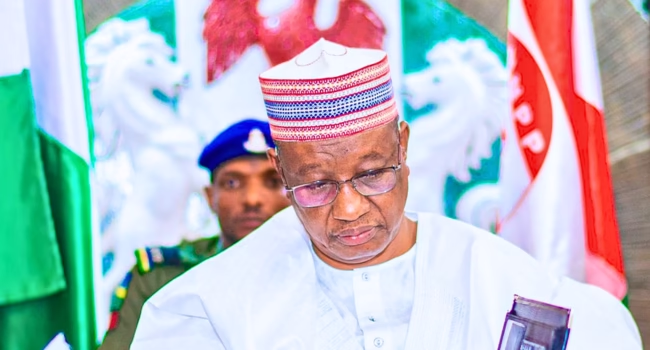
The Kano State House of Assembly has initiated impeachment proceedings against Deputy Governor Aminu Abdussalam Gwarzo over allegations of gross misconduct, abuse of office, and breach of public trust.
The notice was presented yesterday during plenary by the Majority Leader, Lawan Hussaini Dala, who said the action follows Section 188 of the 1999 Constitution of the Federal Republic of Nigeria.
Dala said the allegations stem from Abdussalam’s tenure as Commissioner for Local Government (2023–2024) and his current role as deputy governor. He accused the deputy governor of diverting funds meant for the 44 local government councils.
According to the majority leader, Abdussalam allegedly received N1.5 million monthly from each council between June 2023 and January 2024, totaling N462 million. Between February and July 2024, he allegedly collected N3.255 million monthly from each council under the guise of special assignments, amounting to N726 million.
Dala also accused the deputy governor of abuse of office, claiming he facilitated payments of N10 million from each council to NovoMed Pharmaceuticals Limited, totaling N440 million, in violation of state procurement laws.
“The misuse of official capacity to confer undue advantage constitutes abuse of power and undermines public trust,” Dala told lawmakers, adding that the allegations amount to gross misconduct under the Constitution.
The impeachment notice was reportedly endorsed by 38 lawmakers, meeting the constitutional threshold to proceed. The Speaker has acknowledged receipt, and the House is expected to serve the allegations on the deputy governor.
If approved, a panel may be constituted by the state Chief Judge to investigate the claims.
As of filing, Abdussalam had yet to respond publicly to the allegations.
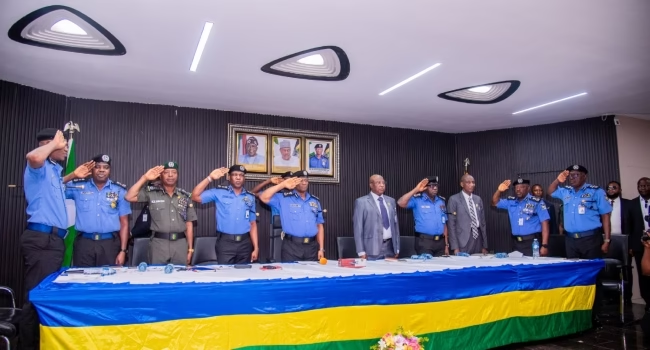
The Inspector-General of Police, Tunji Disu, on Wednesday inaugurated a seven-member committee on the establishment of state police, giving it four weeks to submit its report.
The inauguration was held during his maiden conference with senior police officers at the Peacekeeping Conference Centre, Force Headquarters, Abuja.
Charging members of the panel to discharge their duties with professionalism and objectivity, Disu described the assignment as “both significant and timely,” noting that it would shape the framework through which state policing may operate in Nigeria.
“In carrying out this assignment, your deliberations must be guided by professionalism, objectivity, and a clear appreciation of the unique complexities of policing a diverse nation such as our own,” the IGP said.
He stated that if properly designed and effectively implemented, state policing holds significant potential benefits for the country.
“By bringing law enforcement closer to communities, state police institutions can deepen local knowledge of security dynamics and enable quicker and more targeted responses to emerging threats,” he added.
The committee is expected to review existing policing models within and outside Nigeria, assess community security needs and emerging risks, and propose an operational framework for the establishment and coordination of state police structures.
It will also address issues relating to recruitment, training, standards and resource allocation, as well as develop accountability and oversight mechanisms to ensure professionalism and public trust.
The panel is chaired by Olu Ogunsakin, with Bode Ojajuni as secretary. Other members are Emmanuel Ojukwu, Okebechi Agora, Suleyman Gulma, Ikechukwu Okafor and Tolulope Ipinmisho.
Disu said the committee had about four weeks to conclude its assignment and submit a comprehensive report.
The move marks one of the first major steps taken by the new police chief since his appointment and confirmation a few days ago.
The development comes amid rising security concerns across the country, with several stakeholders advocating state policing as part of measures to tackle insecurity.
President Bola Tinubu had earlier asked the National Assembly to commence the process of amending relevant laws to pave the way for the creation of state police.
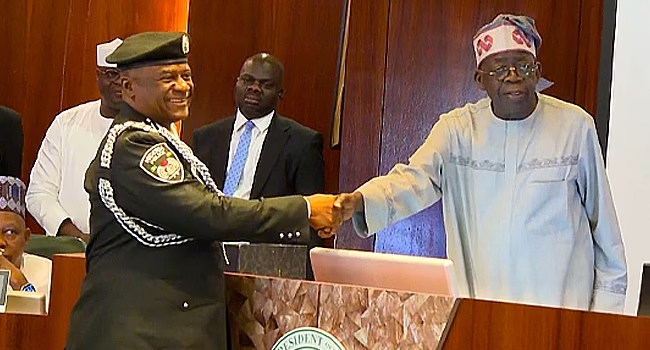
President Bola Tinubu on Wednesday swore in Olatunji Disu as the Inspector-General of Police (IGP).
Disu took the oath of office at the Council Chamber of the Presidential Villa, Abuja, shortly before the commencement of the Federal Executive Council (FEC) meeting.
The President also administered the oath of office to six commissioners of the Revenue Mobilisation Allocation and Fiscal Commission (RMAFC) and two commissioners of the Federal Civil Service Commission (FCSC).
The ceremonies were witnessed by ministers, senior government officials and family members of the appointees.
The council meeting began shortly after the swearing-in.
In attendance were Vice President Kashim Shettima; the Secretary to the Government of the Federation, Senator George Akume; the Chief of Staff to the President, Femi Gbajabiamila; the National Security Adviser (NSA), Nuhu Ribadu; and the Head of the Civil Service of the Federation, Mrs EsthMrs.Walson-Jack.
Disu was appointed acting IGP on February 25, 2026, by President Tinubu, following the resignation of former IGP Kayode Egbetokun.
His appointment was subsequently endorsed by the Nigeria Police Council (NPC).
The former Assistant Inspector-General of Police assumed office last Wednesday.
He previously served as Assistant Inspector-General in charge of the Force Criminal Investigation Department (FCID) Annex, Alagbon, Lagos, after his promotion to the rank last year.
A former head of the Lagos Rapid Response Squad (RRS), Disu has pledged to deliver accountable, modern and professional policing.








-

 Politics3 days ago
Ibarapa East Assembly Hopeful, Ramon Congratulates Ajiboye, Says Emergence Good for Oyo APC
-

 Politics1 week ago
Makinde: My Successor Must Be Loyal to Oyo, Not Me
-
 Politics3 days ago
2027: Former Oyo Deputy Governor Adeyemo Emerges APC Chairman (See Full List)
-
 Politics1 week ago
Fintiri Dumps PDP for APC, Moves with Cabinet, 14 Adamawa Lawmakers