News
Taxi service, ‘Lag Ride’, with 1,000 new cars launched in Lagos


The Babajide Sanwo-Olu -led Lagos state government, on Wednesday, launched a new taxi scheme with no fewer than 1,000 brand-new GAC-branded cars.
The taxi scheme, codenamed ‘Lag Ride’, was launched at a well attended ceremony held at the State House in Alausa .
Gboyega Akosile, the Chief Press Secretary to the Lagos state governor, in a statement explained that the ride-hailing taxi initiative, which is being operated on a lease-to-own basis, is a component of the state government’s multimodal transportation blueprint being executed under the Traffic Management and Transportation pillar of the THEMES agenda of the Sanwo-Olu administration.
The initiative, according to him, is a partnership between Lagos State-owned IBILE Holding Limited and CIG Motors Company Limited, with the objective to provide clean and reliable means of taxis movement across the metropolis at affordable cost, using brand-new vehicles.
Operators are required to pay about N1.9 million down payment, of which the sum covers the 20 per cent equity of cost of vehicle, registration and insurance. Each car being used in the scheme comes with technology-enabled security features that monitor every journey undertaken.
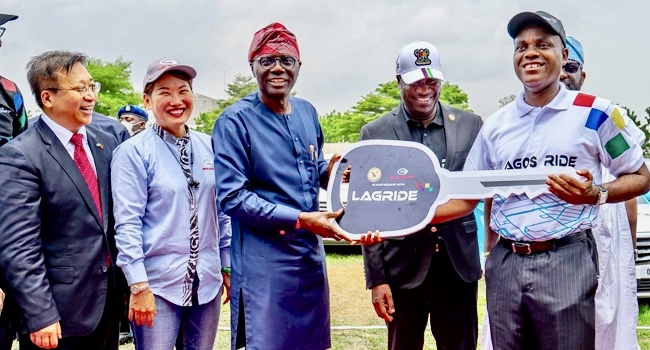
L-R: Ambassador of China to Nigeria, Amb. Cui Jianchun; Chairman, Choice International Group, Chief Diana Chen; Lagos State Governor, Mr. Babajide Sanwo-Olu; Deputy Governor, Dr. Obafemi Hamzat and Chief Executive Officer, IBILE Holdings Limited, Mr. Abiodun Amokomowo during the formal launch of 1000 Cars for Lagos Ride Taxi Scheme, at the Sports Ground, Lagos House, Alausa, Ikeja, on Wednesday, 23 March 2022.
Launching the scheme, Governor Sanwo-Olu, said the state had moved another step forward in its drive to develop an efficient transportation model in tune with modernity and comfort.
He noted that the aim was not to run existing hailing ride operators out of the business, but to offer a safer alternative and clear the roads of rickety cars being used for taxi business.
Sanwo-olu maintained that the schemes will provide opportunities to the operators to become owners of the vehicles within a three to four year period.
“The need to provide better, dignifying and more rewarding means of transportation and livelihood for unemployed and underemployed population gave birth to the new ‘Lagos State Taxi Scheme’, which will be operated on a lease-to-own basis. Under this arrangement, a beneficiary will be provided a brand-new car which will become the driver’s property after completion of the payment of the vehicle’s subsidised cost.
“This taxi scheme will complement the various bus services which are making significant impact in the lives of our people; the water transport service, which is recording unprecedented patronage, as well as the Blue and Red Line Rail services which are on course to commence commercial operations between the last quarter of this year and the first quarter of 2023,” Sanwo-Olu said.
To improve riders’ and passengers’ security, the governor said a full security gadget, including a 360 dashboard camera that will give 24-hour audio-visual feeds to the control centre, had been pre-installed on each car deployed for the scheme.
He added that each car came with a physical panic button that could be used by anyone on board in case of assault or emergency. The panic button, the Governor said, is also on the mobile application and is connected to the Control and Command Centre.

Sanwo-Olu disclosed that the automobile assembly plant being set up in Lagos – another component of the partnership between CIG Motors’ and the State Government – stood at 60 per cent completion, with the launch of its operations expected in September.
“What we are witnessing today is that Lagos is moving away from the era of rickety ‘Kabu Kabu‘ to a brand-new, comfortable and safe transport system. The multiplier effect of this singular initiative on job creation, youth employment and economic growth and development in the State cannot be overstated,” he said.
Commissioners for Transportation, Dr. Frederic Oladehinde, described the scheme as “another milestone achievement” by the State Government, noting that the initiative had joined an array of other innovative solutions initiated in the transport sector, which were targeted at redefining public transportation.
To make the rides affordable, the Commissioner said the technology on which the scheme is operated had made ride-sharing possible for passengers, who would agree to share rides and share transit costs.
Chairman of CIG Motors in Nigeria, Mrs Diana Chang, said the roadmap for the urbanisation of the transportation system in Lagos started in November 2019 when the Governor and members of his cabinet visited the Republic of China for bilateral partnership. The launch, she said, is the glorious end of the partnership sealed with Chinese investors.
“We are using this partnership to promote a Greater Lagos where opportunities abound for citizens of the state, while creating a win-win model for all stakeholders,” she said.
Also speaking at the event, the Managing Director of IBILE Holding, Mr. Abiodun Amokomowo, said over 5,700 drivers had downloaded the driver’s mobile apps as at last Tuesday, out of which 1,786 drivers submitted applications.
Amokomowo added that registration and enrolment fees have been accepted from 359 drivers, while others are awaiting screening.
As part of the process, each operator is expected to undergo full verification which will include their Lagos State Drivers’ Institute (LASDRI) ID cards, medical history, verification of NIN and Lagos resident registration numbers and other background checks to ensure the safety of passengers.
“The launch of the taxi scheme was received with a warm embrace by ride hailing drivers, who described the initiative as a “unique, better alternative”, the IBILE Holding boss added.
Sam Mfuk, who is the first successful driver to get on board of the scheme, said: “When we first heard about Lagos Ride, we were sceptical. But, when we attended the stakeholders’ meetings, we changed our minds. Lagos Ride has become the answer to our prayers in ride hailing sector”.


Traditional rites, medical outreach, sporting events and youth competitions feature in weeklong celebration
AGO-IWOYE came alive with cultural displays, sporting activities and community development initiatives as indigenes and residents gathered for the 2026 Ago-Iwoye Day celebration.
The weeklong programme, which began on Monday, October 5, brought together indigenes from across Nigeria and the diaspora to celebrate the town’s cultural heritage and promote unity and grassroots development.
The celebration opened with the traditional Woro Plucking Programme at Ojuade Olooto at 7am on Monday. This was followed by intellectual and strategy games at the Ebumawe Palace, where participants competed in chess, draughts, Scrabble and Ayo Olopon.
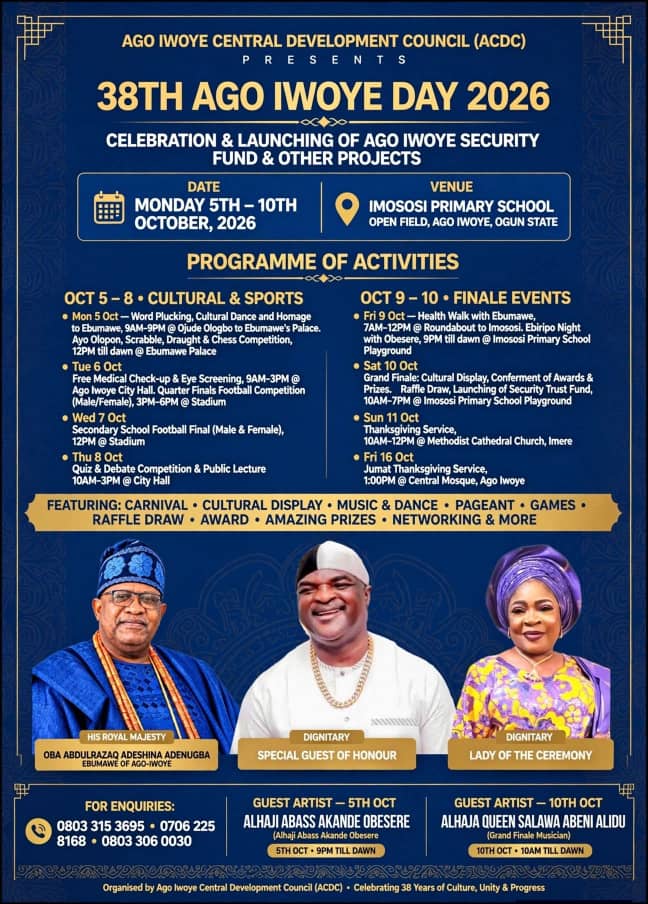
Health and sports featured prominently on Tuesday, October 6, as residents took part in a medical check-up and eye screening exercise at the Ago-Iwoye City Hall.
At the Ago-Iwoye Stadium, sports enthusiasts watched the table tennis finals and the final of the Quarters Football Competition.
The activities continued on Wednesday, October 7, with the finals of the secondary school football competition for male and female categories at the stadium.
Students returned to the spotlight on Thursday, October 8, for a quiz and debate competition at the City Hall. The academic activities were complemented by a public lecture on sustainable community development and youth empowerment.
On Friday, October 9, the Ebumawe of Ago-Iwoye led a health walk from the Omoedumare Roundabout at 7am, drawing residents into another activity designed to promote healthy living and community participation.
The day ended with Ebiripo Night at the Imososi Primary School Field, where music, dance and folklore accompanied celebrations around the town’s popular local delicacy.
The grand finale is scheduled for today, Saturday, October 10, at the Imososi Primary School Field, with traditional performances, civic honours and fundraising activities on the programme.
A thanksgiving service at the Methodist Cathedral, Imere, Ago-Iwoye, is expected to bring the celebration to a close on Sunday, October 11.
Speaking on the significance of the event, the Secretary of the Planning Committee, Dr Samuel O. Awobona, said the turnout demonstrated the commitment of indigenes and residents to preserving the town’s identity and advancing its development.
He said, “This weeklong celebration underscores our collective resolve to preserve our identity while driving grassroots development. The massive turnout across all generations reflects the enduring spirit of Ago-Iwoye.”
The annual celebration provides an opportunity for the community to showcase its traditions while bringing residents, young people and indigenes in the diaspora together around shared cultural and developmental goals.

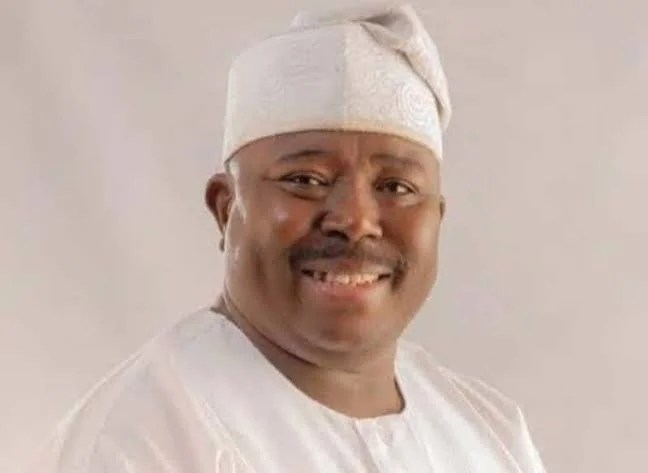

Ago-Iwoye Comes Alive as Community Celebrates Cultural Heritage

Two-Term Ex-Oyo Lawmaker Dumps APM, Accuses Makinde Govt Of Neglect

2027: Ibarapa will deliver massive votes for APC, Ayandele tells Makinde’s commissioner



-
 Politics3 weeks ago
APM Rally: APC Tackles Makinde Over Use of ‘CAF-Rejected’ ₦5.5bn Stadium
-
News4 weeks ago
Oyo South: Oseni Approves N100m for Ibadan Community Road Rehabilitation
-
Metro4 weeks ago
Ondo alcohol deaths: 29 die, 60 affected
-
Politics4 weeks ago
Ibarapa East/Ido: I’ll sustain quality representation, development, says Osuolale