Connect with us

News

Mali junta expels French ambassador in fresh bout of tension

Published

on

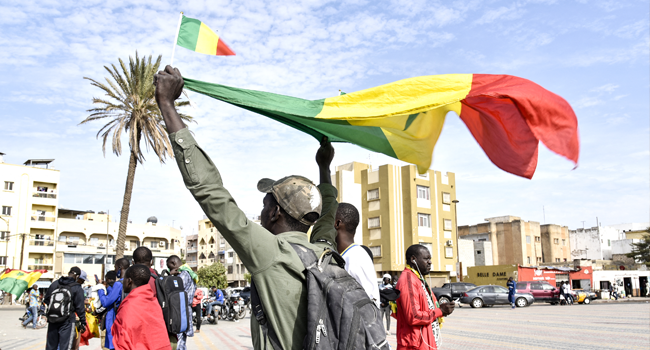
A protester holds a flag of Mali during a demonstration to support Mali on Obelisk Plazza in Dakar, on January 28, 2022. SEYLLOU / AFP

Mali on Monday said it was expelling the French ambassador in the light of “hostile” comments, a move likely to ratchet up tensions with its former colonial ruler and ally following a military coup.

A statement read on national television said, “The ambassador of France in Bamako, his excellency Joel Meyer… was notified of the decision of the government asking him to leave the national territory within 72 hours.”

The move raises further questions over France’s continued military support for Mali, a deeply poor country battling a nearly decade-long jihadist campaign.

The French foreign ministry issued a brief statement saying it “takes note” of the announcement and expressed “solidarity with its European partners” — its allies in the anti-jihadist mission.

Relations between the two countries began to fray after the army seized power in Bamako in August 2020, and worsened after the junta staged a second coup in May 2021.

Last week, French Foreign Minister Jean-Yves Le Drian told reporters that Mali’s junta was “illegitimate” and its decisions “irresponsible”.

Defence Minister Florence Parly also accused the country’s rulers of stepping up “provocations” of France.

Monday’s statement in Bamako said remarks had been made that were “hostile and outrageous”, and had been uttered “despite repeated protests” by Mali.

“The Malian government vigorously condemns and rejects these remarks, which are contrary to the development of friendly relations between nations,” it said.

However, it added, the Malian government “reiterates its readiness to maintain dialogue and pursue cooperation with all its international partners, including France, in mutual respect and on the basis of the cardinal principle of non-interference.”

Meyer, the French ambassador, was appointed to Bamako in October 2018.

Coup sparked friction

Rebel officers led a coup in August 2020 that toppled Mali’s elected leader Ibrahim Boubacar Keita, who was facing angry protests at failures to stem the jihadists.

The following May, the junta pushed out a civilian-led government appointed to oversee a transition period and named strongman Colonel Assimi Goita as interim president.

By year’s end, France and its European allies were alarmed at the junta’s reported decision to hire mercenaries from the Russian paramilitary group Wagner.

France — which stages presidential elections in April — repeatedly warned that it would be untenable for its forces to fight alongside unaccountable mercenaries.

Russian “advisors” in the Central African Republic have been accused of carrying out abuses of civilians.

Tensions have also risen since the West Africa bloc ECOWAS imposed a trade embargo and

The sanctions followed a junta proposal to stay in power for up to five years before staging

border closures with Mali on January 9, in a move backed by France, the United States and the European Union.

The sanctions followed a junta proposal to stay in power for up to five years before staging elections, despite an earlier commitment to hold a vote by the end of February 2022.

French pullback

As friction worsened last year, France started scaling back 5,100-man Barkhane Sahel operation and pulling out of some bases in northern Mali.

Its goal is to halve the contingent by the summer of 2023, but central to the plan is a French-led European force called Takuba that would shoulder some of the strain.

Under it, European allies are committing special forces to help train and fight alongside Malian units.

But Takuba has also hit problems with Mali.

Last week, the junta demanded that Denmark withdraw its newly arrived contingent of some 90 soldiers, claiming it had deployed without authorisation — a charge Copenhagen denied.

On Twitter, Danish Foreign Minister Jeppe Kofod said the ambassador’s expulsion was “unacceptable” and his country “stands in full solidarity with France.”

“Such irresponsible behaviour is not what we expect from Mali, (which will (lose) international credibility,” Kofod warned.

France’s army chief, General Pierre Schill, declined to comment on future French deployments.

“The Sahel question is overwhelmingly political,” he told reporters. “Today, on a daily basis, our units are continuing their partnership with Malian battalions.”

Comments

News

Kano Assembly Moves to Impeach Deputy Governor Gwarzo Over ₦1.6bn Alleged Fraud

Published

on

By

Deputy Governor of Kano State Aminu Gwarzo

The Kano State House of Assembly has initiated impeachment proceedings against Deputy Governor Aminu Abdussalam Gwarzo over allegations of gross misconduct, abuse of office, and breach of public trust.

The notice was presented yesterday during plenary by the Majority Leader, Lawan Hussaini Dala, who said the action follows Section 188 of the 1999 Constitution of the Federal Republic of Nigeria.

Dala said the allegations stem from Abdussalam’s tenure as Commissioner for Local Government (2023–2024) and his current role as deputy governor. He accused the deputy governor of diverting funds meant for the 44 local government councils.

According to the majority leader, Abdussalam allegedly received N1.5 million monthly from each council between June 2023 and January 2024, totaling N462 million. Between February and July 2024, he allegedly collected N3.255 million monthly from each council under the guise of special assignments, amounting to N726 million.

Dala also accused the deputy governor of abuse of office, claiming he facilitated payments of N10 million from each council to NovoMed Pharmaceuticals Limited, totaling N440 million, in violation of state procurement laws.

“The misuse of official capacity to confer undue advantage constitutes abuse of power and undermines public trust,” Dala told lawmakers, adding that the allegations amount to gross misconduct under the Constitution.

The impeachment notice was reportedly endorsed by 38 lawmakers, meeting the constitutional threshold to proceed. The Speaker has acknowledged receipt, and the House is expected to serve the allegations on the deputy governor.

If approved, a panel may be constituted by the state Chief Judge to investigate the claims.

As of filing, Abdussalam had yet to respond publicly to the allegations.

Continue Reading

News

IGP Inaugurates State Police Committee, Gives Four-Week Deadline

Published

on

By

State policing has been on the frontburner in Nigeria in recent years. Photo: X@PoliceNG

The Inspector-General of Police, Tunji Disu, on Wednesday inaugurated a seven-member committee on the establishment of state police, giving it four weeks to submit its report.

The inauguration was held during his maiden conference with senior police officers at the Peacekeeping Conference Centre, Force Headquarters, Abuja.

Charging members of the panel to discharge their duties with professionalism and objectivity, Disu described the assignment as “both significant and timely,” noting that it would shape the framework through which state policing may operate in Nigeria.

“In carrying out this assignment, your deliberations must be guided by professionalism, objectivity, and a clear appreciation of the unique complexities of policing a diverse nation such as our own,” the IGP said.

He stated that if properly designed and effectively implemented, state policing holds significant potential benefits for the country.

“By bringing law enforcement closer to communities, state police institutions can deepen local knowledge of security dynamics and enable quicker and more targeted responses to emerging threats,” he added.

The committee is expected to review existing policing models within and outside Nigeria, assess community security needs and emerging risks, and propose an operational framework for the establishment and coordination of state police structures.

It will also address issues relating to recruitment, training, standards and resource allocation, as well as develop accountability and oversight mechanisms to ensure professionalism and public trust.

The panel is chaired by Olu Ogunsakin, with Bode Ojajuni as secretary. Other members are Emmanuel Ojukwu, Okebechi Agora, Suleyman Gulma, Ikechukwu Okafor and Tolulope Ipinmisho.

Disu said the committee had about four weeks to conclude its assignment and submit a comprehensive report.
The move marks one of the first major steps taken by the new police chief since his appointment and confirmation a few days ago.

The development comes amid rising security concerns across the country, with several stakeholders advocating state policing as part of measures to tackle insecurity.

President Bola Tinubu had earlier asked the National Assembly to commence the process of amending relevant laws to pave the way for the creation of state police.

Continue Reading

News

Tinubu swears in Disu as IGP, inaugurates RMAFC, FCSC commissioners

Published

on

By

President Bola Tinubu on Wednesday swore in Olatunji Disu as the Inspector-General of Police (IGP).

Disu took the oath of office at the Council Chamber of the Presidential Villa, Abuja, shortly before the commencement of the Federal Executive Council (FEC) meeting.

The President also administered the oath of office to six commissioners of the Revenue Mobilisation Allocation and Fiscal Commission (RMAFC) and two commissioners of the Federal Civil Service Commission (FCSC).

The ceremonies were witnessed by ministers, senior government officials and family members of the appointees.
The council meeting began shortly after the swearing-in.

In attendance were Vice President Kashim Shettima; the Secretary to the Government of the Federation, Senator George Akume; the Chief of Staff to the President, Femi Gbajabiamila; the National Security Adviser (NSA), Nuhu Ribadu; and the Head of the Civil Service of the Federation, Mrs EsthMrs.Walson-Jack.

Disu was appointed acting IGP on February 25, 2026, by President Tinubu, following the resignation of former IGP Kayode Egbetokun.

His appointment was subsequently endorsed by the Nigeria Police Council (NPC).

The former Assistant Inspector-General of Police assumed office last Wednesday.

He previously served as Assistant Inspector-General in charge of the Force Criminal Investigation Department (FCID) Annex, Alagbon, Lagos, after his promotion to the rank last year.

A former head of the Lagos Rapid Response Squad (RRS), Disu has pledged to deliver accountable, modern and professional policing.

Continue Reading

Advertisement

Entertainment

Advertisement

MegaIcon Magazine Facebook Page

Advertisement

MEGAICON TV

Advertisement

Trending