Opinion
Was Bola Ige’s murder avoidable?

Published
5 years agoon
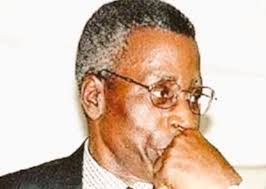
Could Chief Ajibola Ige, former governor of old Oyo State, ex-Attorney General of the Federation and foremost apostle of Yoruba’s recent ancestor, Chief Obafemi Awolowo, have escaped the gruesome death that took his life on December 23, 2001 if he had chosen the sobriquet “Demosthenes,” rather than “Cicero”? Ige’s gruesome murder and the unfortunate circumstances surrounding it have attracted mottled commentaries in the last 20 years.
This was the crux of the intellectual spat that respected professor of Political Science, my Master’s class teacher at the University of Ibadan and former Minister of Education, Tunde Adeniran and I engaged in after the death of Ige. Writing an elegy to the murdered wordsmith, orator and elder statesman, a piece I entitled Between Ige, Cicero and Demosthenes, in my Sunday Tribune column offering of March 10, 2002, I had concluded that probably, the name “Cicero” had spiritually attracted to Ige his fatal end.
Perhaps, if Ige had adopted the sobriquet “Demosthenes,” a Greek philosopher whose end was not as fatal as that of his Roman compatriot, Cicero, Ige probably would not have met such a ghastly fate in the hands of his traducers. I had strongly but passionately argued that the name, Cicero forebode a disastrous ending and Ige would have done well to avoid it. Adeniran, in a chapter he entitled “Bola Ige’s complex political philosophy,” in the book entitled, Bola Ige: The Passage of a Modern Cicero, while appreciating the arguments, he disagreed with the unscience of my postulation and sought to divorce a fatalistic connect between the sobriquet and fate of the assassinated minister.
My argument was that, granted that Marcus Tillius Cicero – Ige corrected us that the name’s pronunciation was Kikero and not Si-se-ro – and Demosthenes were both imbued with great oratorical prowess and were the greatest of their time in Rome and Greece respectively. Ige’s path with Cicero crossed in that, like him, Cicero held several political offices and became governor of Cilicia, wrote the first and second Phillipic and was equally assassinated on December 7, 43 BC, Demosthenes, whose life was wrapped up in same vocations like Ige’s, was also an orator whose life was devoted to law practice, philosophy and politics and who also wrote three Phillipics. The third Phillipic, which he entitled, On the Peace (346 BC) had as its thrust a call for a cessation of the war of Yoke and Macedon. Though attempts were made to execute Demosthenes, he fled and thereafter swallowed poison to avoid his approaching captors. Ige too was a brilliant writer who sermonized in treaties and on campaign rostrums.
Cicero, Roman statesman, lawyer and scholar, was known for upholding republican principles during the final civil war years which led to the destruction of the Roman Republic. He was a great Roman orator and writer whose writings on rhetoric, philosophy and other political treatises stood out. Like Ige, as a lawyer, Cicero’s appearances in court recorded profound legal firsts. His brilliant defence of Publius Quinctius and Sextus Roscius, the latter having been charged in a fabricated crime of parricide, stood him out. Cicero was an associate of the political trio of Julius Caesar, Crassus and Pompey who were called the First Triumvirate. He was sorely hated by the three Roman leaders, Octavian, Lepidus, and Anthony, who eventually ordered his execution. Of the three, it was Anthony who disdained him most.
Condemned to death, alongside his son, brother and nephew, Cicero fled to the Italian town of Caieta. There, Laenas pulled out Cicero’s head from a litter where he was hiding, dismembered it from his body and cut off his hand as well. While Ige was brutally gunned down at Similia Court, Bodija, Ibadan that dark December night at the age of 71, Cicero met his own gruesome death at the age of 63. Anthony was so delighted at the news of Cicero’s assassination that he gave Laenas, who brought the news to him, 250,000 denarii for the death of “the man who had been his greatest and most aggressive personal enemy.” He kept Cicero’s head and hand on a rostrum before the table where he had his meals, for a very long time.
It is not difficult to come to grips with the fatal reality that, 20 years after the death of this Nigeria’s affable Minister of Justice, the Nigerian state has literally left his coagulated blood as an advertisement of its inhumanity and an encouragement to would-be mindless murderers that Nigeria is at home with their nefarious activity. From empirical evidence of the last two decades-plus democratic “governmenting” in Nigeria, successive governments’ conspiratorial silence, lackadaisical attitude to bloodshed or even pure naivety about the destructive spiritual implication of shed blood, have become legendary.
Aside entering the pantheon of history as about the only country whose Minister of Justice was unjustly killed like a chicken and whose death is yet unraveled, the peremptory back-off of the state from finding out who actually pulled the trigger has not only raised dusts of suspicion, it has baffled the comity of civilized states. This heightened allegations that the state was actually the yet unknown gunman who pulled the trigger and that its motive was to stop an Ige who was on the verge of committing the perceived hara-kiri of tendering his letter of resignation from the federal cabinet to regroup his politically fractious South Western base.
Though Ige was labeled by his vast array of supporters as the Cicero, his humanism was the most outstanding of his philosophy. Humanism is a philosophical and ethical school that underscores the value and agency of human beings in the use of reason and their ingenuity, as against blindly deploying tradition and authority in the improvement of their individual or collective lives. Ige’s humanistic philosophy was a huge clone of the seminal thoughts of German philosopher, Martin Heidegger and that of Soren Kiekergaard. Like them, he believed that existence and humanity were more material and vital than any other consideration.
For years writing his weekly homily, Uncle Bola’s Column in the Tribune newspaper, Ige preached the invaluable essence of existence and human values. In very scurrilous pen drippings, he frowned on disorderly administration of society wherever he found one and sought to take the world through a path earlier trodden by his political leader, Chief Awolowo. He could not stand mediocrity and did not suffer fools gladly. Those who knew him spoke of his perfectionism and his finicky abidance by the dictates of truth. When he eventually became the governor of the old Oyo State, Ige struggled to match his years of political discourses with action, skirting a practical path that would serve as a showcase of what he stood for and espoused in newspaper discourses.
For this writer, an encounter with Ige that remains unforgettable was one that was readily a poster for Ige’s readiness to vacate his Olympian societal height and acknowledge that he, like every human being, was fallible after all. While his Uncle Bola’s Column starred on Page 7 of the Tribune, this writer sought refuge in aping his public sphere dissection of issues of contemporary society on Page 3 of same newspaper in a column named Festus Adedayo’s Flickers. And so, Ige and others became ministers in the Obasanjo government that would yet be his death.
Soon, a great uproar erupted on the perceived humongous furniture allowance allocated to the Obasanjo ministers. In my column, I excoriated such an inflated governmental largesse and dragged the ministers and indeed the Obasanjo government by the nape of their agbada for what I felt was an unmitigated wastage of public funds. Same week, on the political page of the Tribune, the Political Editor had also taken umbrage at such ministerial financial rascality. Minister Ige apparently read both pieces and on his Page 7 the next week, he sought to put a lie to all the vilifications of the government over the issue. What pained him most, he wrote, was that “one Festus Adedayo” of “our own newspaper” also joined the fray by “adding salt and pepper” to the issue. He then went ahead to quote what the “one Festus Adedayo” purportedly wrote, which was, and which turned out erroneously, a lift of the Political Editor’s words, verbatim.
Reading through Chief Ige’s gaffe, I was excited that I had him by his balls. To me, it was an ample opportunity to test Ige’s abidance by the same homily he preached to society. Being one assigned the task of proof-reading his column for years, I also wanted to take a pound of flesh from him for the back-of-the-tongue Ige always gave me at every misreading of his beautiful cursive handwriting which, on a few occasions, translated into errors in his column, errors that the finicky Ige couldn’t stomach. The manuscript of his column arrived Saturday afternoon. “Did that fellow go to school at all?” he would thunder whenever he spotted errors in his column.
Every attempt I made in discussions with my Tribune colleagues on the need for me to re-joind Ige’s gaffe led to cold rebuffs and sympathy for me. They all concluded that attacking Almighty Ige was tantamount to blindly walking into the unemployment market. How could a common reporter like me vilify Ige or show to the world that he was fallible, in an Awolowo newspaper? Indeed, the editor of the Sunday Tribune at the time also felt that I wanted to bite a bullet. He however acceded to my right to commit journalistic suicide; so far as my blood spillage would not splash on anyone else but myself. So the second week, I literally took the great Cicero to the cleaners in my column, condemning Ige’s condemnation of me and even almost imputing senility on the great Cicero, in a newspaper where he was held almost like a god.
But after that bravado, to parody the lingo of this generation, my liver failed me. I prepared for the worst. When I arrived office on Monday, I was told that the Minister had called to speak with me. I saw the last flame of my bravado spiral out into thin air. The stark reality of my audacity dawned on me and I almost turned jelly as the possibility of being asked to leave my job loomed. I told myself that shortly, the Minister would descend on me with his fabled and famous waspish tongue.
Same day, Ige called the central Newsroom analogue line, 02-2311675 and I was literally pulled by the trousers to pick the phone’s prong. “This is Bola Ige… Is that Festus?” he had asked. Waffling, I affirmed that I was the one speaking. And then, the bombshell, “I am really very sorry. Please, accept my apologies…”
It’s about 22 years now since that encounter and I cannot recollect plausibly my reply to this pleasantly shocking statement from Chief, the Honourable Minister (apologies to T.M. Aluko). A few days after, duty took me to Ikenne, Ogun State, Chief Awolowo’s country home, for an Awo family event and, lo and behold, the Minister arrived and went straight to the living room to discuss with Chief (Mrs.) HID Awolowo and other dignitaries. All of a sudden, Mr Folu Olamiti, the newspaper’s then Managing Editor, came looking for me. The Minister had asked if I was at the occasion and wanted to meet me. So I folded myself, prostrated before the legendary man whose name I had heard of from my primary school days. Ige held me by the shoulders and repeated his apologies. In the next installment of his column, the minister had written, “I apologise to Festus Adedayo, who I wrongly castigated.”
Bola Ige was not abashed about his Yoruba-ness and flaunted its superseding epistemology and culture above others. He constructed an idealist theory about a welfarist and humanist society that would cater for the weak against the strong, one where survival-of-the-fittest had no place. A video of Ige delivering a speech recently surfaced from God-knows-where and has suddenly gone viral. Therein, Ige’s idealism, something of the mould of the suffering animals in George Orwell’s Animal Farm, was revealed. In Orwell’s, animals sang, “Beasts of England, beasts of Ireland//Beasts of every land and clime//Hearken to my joyful tidings Of the golden future time//Soon or late the day is coming//Tyrant Man shall be o’erthrown//And the fruitful fields of England Shall be trod by beasts alone…”
“By the grace of God, by 2000AD, freedom will come the way of Yorubaland. I am sure that the God of Oduduwa, the God of Oranminyan, the God of Obafemi Awolowo and the God of Adekunle Ajasin will take us to the new land where disgrace, suffering and cheating will be a thing of the past for Yoruba people,” Ige said in impeccable Yoruba in the video. He disparaged those who thought the idea of an Eldorado for Yoruba people was a mirage and likened their resentment to the mythic grumbling of gnomes. Valiant hunters in Yorubaland who reportedly encountered these mythic beings in forests told awe-inspiring stories of their weird composition. Ige however nationalized the “disgrace, suffering and cheating” being encountered as a Nigeria-wide thing with the Yoruba wise saying of “arun to ns’ogoji ni ns’odunrun, ohun to ba s’Aboyade, gbogbo oloya lo nse.”
Though he spoke Hausa fluently, Ige was persuaded about the strength and superiority of his roots and sought to wedge together every fractious part of the Yoruba nationhood. In the video, Ige unwittingly showed the Western region what it lost by the disagreement between Chief Awolowo and SLA Akintola. Just imagine a Western Region where Awo and Akintola worked together. The rest of Nigeria might never have kept pace with their race.
In the same video, Ige regaled his audience with Akintola’s profound ribaldry. Trying to discredit the alliance between NCNC and AG called UPGA, SLA called it OBUGA (it exploded), during a campaign in Ige’s Esa-Oke hometown. In his tiny feminine voice, SLA had pointed to a house which he said belonged to “Ige-Chukwu,” a scorn at the Igbo and Yoruba alliance. Akintola, said Ige, again at a campaign forum in Akure, still trying to discredit top stalwarts of AG, had told his UNDP members that he had just returned from Owo, the home of Chief Adekunle Ajasin. “Anyone who wants his children to bury them should please raise their hands up,” he pleaded. When they did, he played on Ajasin’s name which literally meant “Dog-buried” and said that when he went to Owo, rather than see a person buried by his children, he saw one who dog buried!
Perhaps aware of how Chief Awolowo met him, underscoring his youthfulness and brilliance, Ige never forsook the assemblage of young, brilliant persons. He had an unrepentant obsession for them, with whom he surrounded himself.
Many posthumous analysts of the foot Ige took wrongly that ultimately led to his death believed that his decision to leave his Western flank for the federal, and work with Olusegun Obasanjo, perceived as the enemy of the Alliance for Democracy (AD) and Yoruba leader, Awolowo was the crucifix on which he was hoisted, preparatory for the final nail on his coffin. Same Obasanjo was the reason the Unity Party of Nigeria (UPN) sought to punish Ige and his deputy, S. M. Afolabi, at the party’s Jos convention, on allegation of illicit fraternization with him.
In a later press interview where his government was accused of failure in provision of electricity, Obasanjo called Ige a minister of power “who knew not his left from his right hand.” With this, the analysis that Obasanjo wanted to calibrate the Ige enigma by offering him ministerial appointment got a semblance of truth.
Ige was a very brilliant political strategist and a firm believer in democratic ethos. Those who knew his antecedents, especially his revolutionary consciousness, were alarmed by the grave implication of an Ige’s resignation from the Obasanjo cabinet. He had opted to leave so as to solder his disintegrating political base, in preparation for the 2003 re-election. For a sitting Nigerian president who did not win even his Otta farm ward in the 1999 elections, another landslide disclamation of Obasanjo would have upset the power apparatchik that sponsored his election and stood to lose if he was kicked out. Thus, permutations that the Nigerian government or its lackeys killed Ige to guard against this apple cart upsetting were rife. So who was the government or its sidekick that pulled the trigger? No stronger motive for his assassination has since impeached this seemingly flawless skirt.
It is in the interest of government to unravel the knot of Ige’s assassination, 20 years after. Ige’s and thousands of unjustly spilled blood are crying for vengeance. Right from the time of creation till now, the corrosive spiritual implication of unjustly shed blood has always been evident. The blood of the biblical Abel, for instance, was on its prowl and never rested until it got justice. Perhaps, the socio-political bedlam and leadership miasma that Nigeria currently finds herself are a reflection of the numerous unjustly spilled blood in the land seeking vengeance. No sane society allows such spillage of blood to pass without a wink while perpetrators of the dastardly acts strut about the landscape like some stray penguins.
Dr. Festus Adedayo, journalist, lawyer and public affairs analyst, writes from Ibadan

You may like
Opinion
Doctors’ Strike and the Price of Human Life | By Olusegun Hassan
Published
4 days agoon
October 23, 2026
The popular Yoruba saying, “Ẹni kan l’ọmọ,” meaning that only the person wearing the shoes knows where they pinch, recently took on a deeper meaning for me. Just last week, I experienced its true significance beyond its familiar place as an aphorism.
Popular sayings often remain mere expressions in our consciousness until we find ourselves at the receiving end of the experiences they describe. Similarly, systemic flaws and structural deficiencies in society may seem distant until we become victims of them. News of kidnapping is just another newspaper report until a loved one is abducted and the family is thrown into a desperate search for money to pay a ransom. In the same vein, the news that “doctors are on strike” may appear to be just another headline until someone close to us dies because urgent medical attention was unavailable as a result of the strike.
Nigeria’s story is replete with such unfortunate experiences, which have given rise to another familiar expression: “May Nigeria not happen to you.”
While the media landscape was still reeling from reports of the death of popular gospel singer Toluwanisings, who reportedly died on October 14, 2026, following an alleged lack of urgent medical attention during a doctors’ strike, I also lost a close relative two days later, on October 16, under circumstances involving the same lack of timely medical care.
She was an asthma patient who suffered an attack in the middle of the night. After receiving first aid, she was rushed to the nearest hospital, a teaching hospital, only to be turned away because doctors were on strike and none was available to attend to her. By the time the family reached the nearest private hospital, she had died. Her death left the entire family, myself included, traumatised.
These are only two cases among many similar tragedies that have occurred over the years. They raise a painful question: how many of these deaths could have been prevented if essential medical services had remained accessible?
I cannot help but wonder: what is the value of human life in this country? At what point did the sanctity of human life become secondary to demands for improved welfare by medical unions?
This is not to suggest that the grievances of doctors are illegitimate. Far from it. Medical professionals deserve fair remuneration, adequate facilities, safe working conditions and an environment that enables them to perform their duties effectively. The question, however, is whether the pursuit of these legitimate demands should come at such a devastating cost to human life, particularly when the fundamental purpose of the medical profession is to preserve life through the provision of appropriate healthcare.
It is a troubling paradox.
Doctors undoubtedly have the right to demand fair treatment and safe working conditions. However, that right must be exercised in a manner that protects patients from abandonment and avoidable harm. When patients die because essential medical services have been withdrawn without adequate safeguards, the ethical justification for the action becomes a serious matter for scrutiny.
The World Medical Association (WMA), an international body that promotes widely recognised ethical standards for physicians, upholds principles that include respect for human life and the dignity of patients. These principles underscore the responsibility of doctors to protect the health and well-being of those under their care, provide competent and timely treatment, prevent avoidable harm and act in their patients’ best interests.
These are not merely ideals about compassion. They are professional obligations that must continue to guide medical decisions, including during industrial disputes.
In Nigeria, the Medical and Dental Council of Nigeria (MDCN) addressed this issue in January 2024, reportedly directing the heads of teaching hospitals, federal medical centres and specialised hospitals to ensure that industrial action did not result in the abandonment or premature discharge of patients.
Among the safeguards outlined were the following:
- Accident and emergency departments must remain open and adequately staffed.
- Emergency paediatric services, labour wards, neonatal units and intensive care units must continue to provide emergency and critical care.
- Patients already admitted to hospital must not be discharged merely because a strike has commenced.
- Patients with scheduled appointments before the strike must be attended to in accordance with the applicable directives.
These safeguards reinforce an important principle: the right to pursue employment-related demands does not extinguish a doctor’s professional obligation to protect patients from preventable harm.
Where emergency patients are turned away, critically ill patients are abandoned, or essential services are shut down without adequate arrangements for emergency care, the circumstances warrant investigation. Where evidence establishes a breach of professional obligations or applicable regulations, appropriate disciplinary or legal action should follow.
Similarly, when a patient dies after being denied emergency treatment during an industrial action, the circumstances surrounding the death deserve a thorough and impartial investigation. Where negligence, professional misconduct or a breach of applicable directives is established, appropriate sanctions should be imposed in accordance with the law and relevant professional regulations.
The point is simple: no legitimate grievance should justify abandoning a patient whose life is in immediate danger.
At this juncture, it is equally important to acknowledge the government’s share of the blame. While this article emphasises the ethical obligation of doctors to preserve human life, the government must also recognise that poor remuneration, unpaid allowances, inadequate medical facilities, excessive workloads and unsafe working conditions undermine doctors’ morale and their ability to provide quality healthcare.
The consequences are increasingly evident in Nigeria’s continuing loss of medical professionals to other countries.
In 2025, the Coordinating Minister of Health and Social Welfare, Professor Muhammad Ali Pate, reportedly disclosed that more than 16,000 Nigerian doctors had emigrated over the preceding five to seven years, largely in search of better opportunities abroad. Furthermore, a 2025 report on Nigeria’s health statistics reportedly indicated that 4,193 doctors and dentists left the country in 2024 alone.
These departures deepen staffing shortages, increase the pressure on the doctors who remain and expose patients to longer waiting times and potentially avoidable deaths.
The government must therefore move beyond repeated negotiations and implement sustainable reforms. These should include the prompt payment of salaries and allowances, improved working conditions, adequate funding for public hospitals, transparent career progression and the effective implementation of agreements reached with medical unions.
The Federal Ministry of Health and relevant hospital authorities must also strengthen monitoring and oversight during industrial disputes to ensure that emergency and critical care services remain available in public hospitals. Patients in life-threatening conditions must not be turned away simply because doctors are on strike.
Ultimately, responsibility for Nigeria’s healthcare crisis cannot be placed entirely on one side. Doctors must uphold their professional and ethical obligations, while the government must fulfil its responsibility to create conditions in which those obligations can be discharged effectively.
Medicine is not an ordinary occupation. It carries a profound moral responsibility because, in certain circumstances, the timely intervention of a medical professional can make the difference between life and death. No employment grievance should be used to justify abandoning a patient whose life is in immediate danger.
The sanctity of human life demands responsibility from the doctors entrusted with treating patients and from the government authorities responsible for ensuring that appropriate treatment remains available.
A functional healthcare system depends on cooperation between these two critical stakeholders. When they fail to find common ground, it is the ordinary citizen who suffers the consequences. As the familiar saying goes, when two elephants fight, the grass suffers.
And trust me, I know what that suffering feels like. I have just experienced it.
Olusegun Hassan, Ph.D.
Public Policy Analyst and Social Commentator
Opinion
Oyo, Osun Petrol Price War: Why Fair Competition Should Matter
Published
6 days agoon
October 22, 2026By
Mega Icon
The decision by some filling stations in Oyo and Osun states to sell petrol at lower prices than their competitors has brought renewed attention to pricing practices in Nigeria’s downstream petroleum sector and, more importantly, to what consumers stand to gain when competition is allowed to work.
Investigations and enquiries into petrol prices in the two states revealed differences in pump prices, with some independent petroleum marketers (IPM) selling Premium Motor Spirit (PMS), popularly known as petrol, for about ₦1,375 per litre, while some competing stations charged about ₦1,385 per litre.
Although the difference is just ₦10 per litre, the savings are meaningful for motorists, commercial transport operators, artisans, traders and other residents who depend on petrol to earn a living.
For a commercial driver buying 40 litres, for instance, the price difference amounts to ₦400. For small businesses that rely on petrol-powered generators, repeated purchases at lower prices could provide some relief amid the rising cost of living. Across thousands of consumers and multiple purchases, modest savings can become a substantial reduction in household and business expenses.
However, findings from the enquiries suggest that some independent marketers who had previously sold petrol at relatively lower prices later adjusted their pump prices to match those of competing stations.
The development has prompted questions about what influences pricing decisions in the two states and whether consumers are being allowed to benefit fully from competition among petroleum marketers.
Information obtained during engagements with some marketers, who spoke on condition of anonymity, also indicated that the leadership of the Independent Petroleum Marketers Association of Nigeria (IPMAN) in the two states had expressed displeasure over the decision by some members to sell petrol below the prices charged by other filling stations.
The circumstances surrounding the reported position of the association’s leadership, however, require clarification from the relevant IPMAN officials. Their response is necessary to establish the facts, understand the basis of the reported concerns and give the association an opportunity to state its position.
THE CASE FOR FAIR COMPETITION
At the heart of the matter is a question that directly affects consumers: should a petroleum marketer who can legitimately sell petrol at a lower price be discouraged from doing so simply because competitors are charging more?
The answer should be guided by evidence, legality and consumer welfare. In a competitive market, businesses generally make pricing decisions based on their operating costs, supply arrangements, margins and commercial objectives. Where a marketer can sustainably offer a lower price while meeting all applicable regulatory, product-quality and safety requirements, consumers should be able to consider that option.
Fair competition is not merely a benefit to individual buyers. It creates pressure on businesses to control costs, improve efficiency and offer better value. A lower price from one marketer can encourage others to review their own costs and pricing decisions, potentially producing wider benefits for customers.
This does not mean that every low-priced offer is automatically sustainable or that marketers should ignore the economic realities of running their businesses. Differences in supply costs, transportation, location and other expenses may legitimately result in different pump prices.
The issue, therefore, is not whether every filling station should sell petrol at the same price. It is whether businesses can compete fairly, transparently and within the law, without undue pressure to abandon commercially viable prices that benefit consumers.
Any intervention that prevents legitimate price competition should be supported by clear evidence and a lawful, consumer-focused justification. Otherwise, the likely result is a narrower range of choices and less pressure on sellers to offer better prices.
THE BURDEN ON ORDINARY RESIDENTS
For many households and small businesses, petrol prices go beyond what appears on a filling station’s price board. Higher fuel costs can increase transportation fares, the cost of moving goods and the expense of running generators and other equipment.
Traders may have to spend more transporting their goods to markets, while commercial drivers face pressure from rising operating costs. Such expenses can eventually be passed on to consumers through higher prices for goods and services.
Against this background, any legitimate opportunity to reduce fuel expenses deserves serious attention.
Allowing genuine competition among petroleum marketers could offer some relief, particularly where consumers have access to reliable information about prices and can choose where to buy their fuel. The ability to compare prices is itself an important part of a functioning market.
At the same time, price differences should be examined in context. A lower pump price alone does not establish wrongdoing by competing stations, just as a higher price does not automatically amount to exploitation. Reliable evidence about supply costs, market conditions and the conduct of the parties concerned is needed to reach a fair conclusion.
The central point remains clear: where lower prices are lawful, sustainable and supported by quality and safety compliance, consumers should not be deprived of the benefit merely because uniformity is more convenient for sellers.
STAKEHOLDERS MUST CLARIFY THE ISSUES
The reported concerns over lower pump prices in Oyo and Osun call for open engagement among IPMAN leadership, independent marketers and other relevant stakeholders.
IPMAN officials in both states should be given the opportunity to explain whether any concerns were raised about members selling petrol below prevailing local prices and, if so, the reasons behind those concerns.
Independent marketers, on their part, should be prepared to explain how they arrive at their pump prices and demonstrate that their pricing practices are commercially sustainable and comply with relevant requirements.
The relevant regulatory authorities also have a role to play in ensuring that petroleum products meet quality and safety standards and that market participants operate within the applicable legal framework. They should also remain alert to any conduct that unlawfully restricts competition or misleads consumers.
No stakeholder should be condemned solely on the basis of an unverified allegation. Equally, concerns that could affect consumers’ access to competitively priced fuel should not be dismissed without proper examination.
A balanced approach requires both scrutiny and restraint: lower prices should be tested against evidence, while attempts to suppress legitimate competition should also face appropriate questions.
CONSUMERS SHOULD NOT BE LEFT OUT
Ultimately, the debate over petrol prices in Oyo and Osun should not become a contest between filling station owners. The interests of consumers must remain central.
Petroleum marketers need a business environment in which they can operate sustainably, recover legitimate costs and earn reasonable returns. Consumers, however, also deserve a marketplace where they can make informed choices and benefit from genuine competition.
If a filling station can lawfully and sustainably sell quality petrol at a lower price, that decision should be assessed on its merits rather than opposed simply because neighbouring stations charge more. Competition should not be treated as a problem merely because it exposes differences in pricing.
The way forward lies in transparency, fair competition and constructive engagement among stakeholders.
For residents struggling with the cost of transportation, food and other necessities, even modest savings matter. Ensuring that legitimate competition is allowed to work could help ease some of that pressure, while proper oversight can protect consumers from unsafe products and unsustainable practices.
The relevant question is whether all parties are prepared to put a fair and transparent marketplace ahead of unnecessary disputes over pricing. Consumers should not be asked to pay more simply to preserve uniformity where lawful competition can deliver better value.
Opinion
Governor Seyi Makinde’s Media Chat: A Hundred And Twenty Minutes Of Trash Talk | By Sola Abegunde
Published
2 weeks agoon
October 13, 2026By
Mega Icon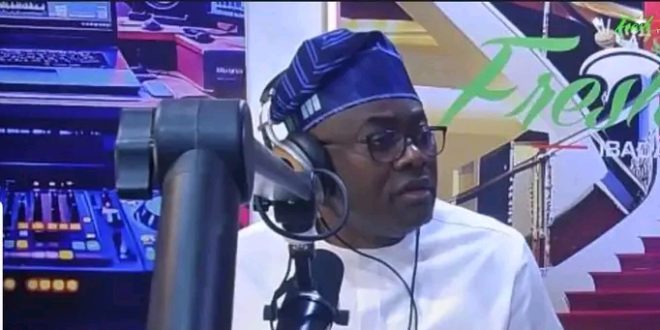
I knew that Governor Makinde would provide us with a hundred and twenty minutes of comic relief and at the same time, I knew he is bound to commit unforced errors which would further expose his shenanigans.
The outgoing Governor of Oyo state did not disappoint on both fronts.
Personally, I understand the need for him to have one final valedictory Media Chat.
The atmosphere might be too hot for him to even think of such luxury after the general election in 2027. So, if he’s got the opportunity now, why not take a shot at it?
I must however say that the Governor displayed his insensitivity right from the choice of the Studio the Chat was aired.
Shortly before the Media Chat commenced, I came across a release signed by the Chairman of the Nigeria Union of Journalist, NUJ, BCOS Chapel, Com. Ademola Balogun.
Com. Balogun was full of lamentations concerning the very terrible state of the Oyo state Broadcasting Corporations, BCOS.
He was of the very strong opinion that the BCOS should have meaningful opportunities to cover Government activities.
He also called on Governor Seyi Makinde to empower the BCOS to invest in modern studio, transmitting equipment, digital broadcasting facilities and online platforms.
Com. Ademola spoke extensively about Staff welfare and other issues.
Sadly, while Governor Seyi Makinde has been consistent in empowering a particular Radio station, the Broadcasting Corporations of Oyo state, BCOS has been dying slowly.
Unfortunately, I have no good news for Com. Ademola. His lamentations will definitely fall on stone deaf ears. It is too late for Governor Makinde to change his ways. I just pray that the Governor would not wake up one day and sold off whatever remains of the Corporation.
That is just by the way. Let me address Governor Makinde’s Media Chat for whatever it is worth. The Governor spent a whole two hours venting anger and spreading outright lies and half-truths.
I am surprised that Governor Makinde has not seen any reason for him to have a second thought about his awkward and reckless comments about the Law Profession.
I am saying this because, for the second time, his Deputy was sitting closely beside him and yet, he felt like it was humorous for him to take a dig at Senator Sarafadeen Abiodun Alli, the All Progressives Congress, APC Gubernatorial candidate, regarding his misconceived failure as a Law practitioner.
He repeated the ignorant and reckless comments about Senator Alli, not being a Senior Advocate of Nigeria and for that reason, according to Governor Seyi Makinde, the Oyo South Senator is not an accomplished Legal Practitioner.
He had made that same reckless comments a couple of weeks ago and at that time also, the Deputy Governor was beside him!
The respectable man is an accomplished Lawyer of many years of experience, who had trained a lot of successful Lawyers.
I also wonder, how people like Dr. Nureni Adeniran and Olasunkanmi Olaleye, who are also Lawyers and have been working with Governor Seyi Makinde over the years would feel about those reckless comments coming from their Boss.
If you want to follow Governor Seyi Makinde’s reasoning, if you are a teacher and you did not rise to the status of a School Principal or Head teacher, then, you’re a failure.
If you are a Military Personnel and you didn’t rise to the position of a General, you’re a failure!
Any time I saw the Governor arguing in this regard, I always asked myself if he was actually himself, because, for me, only a drunkard is capable of reasoning in that manner, or, perhaps, some young elements who had taken so much banned substances.
I have carefully analyzed the 120 minutes Media Chat and I saw that Governor Seyi Makinde spent so much time treating two issues.
The first, being his frustration about his perceived betrayal by president Bola Ahmed Tinubu and the second being his failed attempt to rewrite the Constitution of Nigeria regarding the financial autonomy for Local Governments.
The birthday boy tried to work him through the crisis at the Circular Road, but it was obvious that the main reasons behind Governor Makinde’s Media Chat were grounded on his firm beliefs that Tinubu breached certain agreements with him and others in 2023 and his warped opinion about how the Local Governments should operate within our Federation.
Let’s start with Governor Seyi Makinde’s allegations against Tinubu.
According to him, in 2023, an agreement was signed between certain individuals, including himself.
He said there was an agreement that a Government of National Unity would be formed by president Tinubu after he won the presidential election of 2023 and that he and the Governor of Lagos state, Babajide Sanwo-Olu were signatories to that agreement.
According to him, president Tinubu was not a signatory to the agreement but he was informed after the agreement was signed!
He went further to say that on the strength of that agreement, he presented Bimbo Adekambi as a Ministerial nominee because the president had earlier told him that he wanted to appoint the Minister for Budget and Planing from Oyo state.
To his chagrin and disappointment, president Tinubu settled for Bayo Adelabu and asked him to own the nomination of the former Minister for power, a request he claimed he rejected.
He therefore concluded that all the Ministers nominated from the South West are from Bourdilon.
I have carefully analyzed this confession by Governor Seyi Makinde and I have a few questions for him.
Why is it that Governor Seyi Makinde is the only one complaining about a breached agreement?
Why did it take him all these long to come out with this fact?
What was the criteria for the nomination of Bimbo Adekambi? Did he just take a random decision to choose Adekambi without a prior relationship between the two of them or what?
How does Governor Seyi Makinde want to convince any right thinking person that he believed an agreement would be binding on Tinubu on the strength of Governor Sanwo-Olu’s alleged signature?
For me, that doesn’t make any sense, most especially, for an ” accomplished Engr” like Seyi Makinde!
I am surprised that Governor Makinde leaves out what he benefited from the alignment with Tinubu in 2023.
Remove the alignment with Tinubu in 2023, Seyi Makinde was a goner and the fact that he was able to secure a second term in office ought to have been enough for him.
I am also surprised that Governor Makinde didn’t understand that he was advertising his penchant for serial betrayal and greed when he was relating the events that shaped his re-election in 2023.
It was all about him and the decisions he took, not only affected the Peoples Democratic Party, PDP alone, it also affected certain candidates of his party during the first ballot in 2023.
Now, to the issue of Local Government Autonomy.
Governor Seyi Makinde is a very funny individual. He was very clear about his position on Local Government Autonomy in 2023.
His position was that he never even believed in their existence and I was amused when the birthday boy was saying that despite his position on Local Government Autonomy in 2023, he was still able to win in 31 Local Governments, signifying the fact that the people of Oyo state believed Governor Makinde’s explanations.
I am extremely happy that Governor Seyi Makinde has not changed his opinion on how Local Governments should operate within the Federating units.
He is still stuck on the fact that the 33 Local Governments in Oyo state should be appendages to the State Government, even, in spite of the Judgment of the Supreme Court granting them full financial autonomy.
I am shocked that Governor Seyi Makinde could attempt to confuse what happened between the Lagos state Government when Tinubu was Governor of the state and the Federal Government during Obasanjo’s period, with the illegalities he has been perpetuating with the resources 33 Local Governments.
There is a clear distinction between both scenarios.
In the case of Tinubu as Governor of Lagos state, the Lagos state Government created more Local Governments and the Federal Government was of the opinion that the state Government was wrong to have done so.
As a result of this misunderstanding, the Federal Government stopped the monthly allocations for the Local Governments in Lagos state and it led to a Judicial dispute.
In the end, the Supreme Court held that the Local Governments created by the Lagos state Government were incohate, but it faulted the Federal Government for withholding the monthly allocations belonging to the Local Governments in Lagos state.
Lagos state Government thereafter recognized and administered the newly created Local Governments as Local Government Development Areas and many states have since copied the template, including Oyo state.
In the present scenario, the president, through the Attorney general of the Federation approached the Supreme Court and sought to secure full financial autonomy for the 774 Local Governments and the Supreme Court agreed to the request.
I have been asking myself, why is it that Governor Seyi Makinde is having problems with that judgement?
The monthly allocations released to the 33 Local Governments are released against their names.
Is Governor Seyi Makinde saying that it is proper for a Governor to still be the supervisor for the 33 Local Governments?
How does the judgment of the Supreme Court translate to the Federal Government trying to take control of the 774 Local Governments?
Yorubas will always say that a dog can not stand watch over two different buildings. ( Aja kii roro, ko so ojule meji po).
I was also surprised to hear Governor Seyi Makinde talking about the fact that, instead of full financial autonomy for the Local Governments, he preferred to discuss about how the Local Governments could be empowered to survive without monthly allocations from Abuja.
Haba! Governor Makinde!! Gently now.
You are depriving the Local Governments of their entitlements and you except them to thrive. How would that happen?
Why didn’t we start with the state? Can Oyo state survive without monthly allocations?
I think everyone can now see that Bimbo Adekambi as Governor, would never allow the Local Governments to breathe.
On the other hand, Senator Sarafadeen Abiodun Alli has promised to guarantee full financial autonomy for the 33 Local Governments and the implementation of the policy requires no rocket science. All it requires is the will.
There is an existing judgment of the Supreme Court which has outlined the steps to be taken by any willing state Government.
Sarafa Alli only needs to direct relevant stakeholders at the Local Governments to comply with the judgment and that is the end of the matter.
What is so difficult in that, if you are not covetous?
I might have to do this piece in series but I will like to warn the residents of the Circular Road.
You heard Governor Seyi Makinde. He is promising you nothing.
My only problem with him is his attempts to shift the blame of the chaos he orchestrated at the Circular Road on the late Governor Abiola Ajimobi.
He even said that that the Government of Ajimobi defrauded residents of the Circular Road!
Sometimes, people like Governor Seyi Makinde needs no one to enchant them. Their character is an enchantment on itself.
If you’re saying that the Governments of the late Ajimobi defrauded residents of the Circular Road, is Bimbo Adekambi not an integral part of that Government and that is before you begin to ask the Governor for proofs.
I enjoyed Governor Seyi Makinde’s valedictory Media Chat, while looking forward to the new era awaiting him next year.
My father used to tell us that the mouth of the liar does not ooze blood. ( Enu opuro kii seje).
By the way, I saw that Governor Seyi Makinde never mentioned anything about the report of the Judicial Commission of Inquiry into the abduction of Teachers and Pupils of Yawota and Esinele communities of Oriire Local Government.
How far now?
Sola Abegunde.
MEGAICON TV

2027: Makinde Hit as 200 Ex-Councillors, Thousands of Supporters Dump His Camp for APC

Cheshire Home Land: Alli warns Makinde against sale to private developers

Oseni Charges Nigerian Graduates to Prioritise Character, Excellence



Trending
-
 Politics2 weeks ago
DIPHTHERIA OUTBREAK: ALLI QUERIES ₦9.9BN IMPACT FUNDS AS OYO LAGS IN CHILD VACCINATION
-
Politics3 weeks ago
2027: Oseni condemns attack on campaign train, demands probe
-
Politics4 weeks ago
Olopoeyan: ‘I May Back APC’s Oseni Against Odidiomo for Oyo South’
-
Opinion4 weeks ago
Ladoja @82: When the ladder becomes too tall and Makinde’s sin of ingratitude | By Ayinla Joseph