Connect with us

News

Taliban supreme leader, Akhundzada makes first public appearance

Published

on

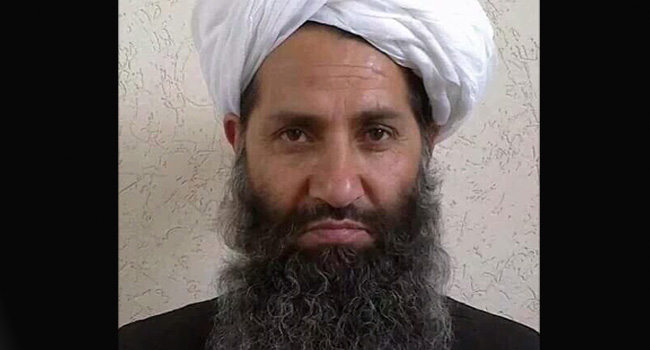
This undated file photo handout released by the Afghan Taliban undated handout photograph released by the Afghan Taliban on May 25, 2016 shows, according to the Afghan Taliban, the new Mullah Haibatullah Akhundzada posing for a photograph at an undisclosed location. STR / Afghan Taliban / AFP

Taliban supreme leader Haibatullah Akhundzada addressed supporters in the southern city of Kandahar, officials announced Sunday, his first public appearance since taking control of the group in 2016.

Akhundzada has been the spiritual chief of the Islamist movement since 2016 but has remained a reclusive figure, even after the Taliban seized power in Afghanistan.

His low profile has fed speculation about his role in the new Taliban government, formed after the group took control of Kabul in mid-August — and even rumours of his death.

On Saturday, he visited the Darul Uloom Hakimah madrassa to “speak to his brave soldiers and disciples”, according to the introduction to an audio recording circulated by Taliban social media accounts.

“May God reward the oppressed people of Afghanistan who fought the infidels and the oppressors for 20 years,” Akhundzada said, in the recording. “My intention here is to pray for you and you pray for me”.

In the 10-minute recording, he prays for the Taliban martyrs, wounded fighters and the success of officials involved in the “big test” of rebuilding what they call the Islamic Emirate of Afghanistan.

“Let’s pray that we come out of this big test successfully. May Allah help us stay strong,” he said.

There was tight security at the event and no photographs or video have emerged.

Akhundzada is referred to as “Amirul Momineen”, commander of the faithful, the rank conferred on the late Taliban founder Mullah Omar by his supporters.

Akhundzada is thought to have been selected to serve more as a spiritual figurehead than a military commander, but his unusually public statements will fuel speculation that he now plans to take a more central role in leading the new government.

Unifying Figure

Akhundzada rose from low-profile religious figure to leader of the Taliban in a swift transition of power after a 2016 US drone strike killed his predecessor, Mullah Akhtar Mansour.

After being appointed leader, he secured the backing of Al-Qaeda chief Ayman al-Zawahiri, who showered the cleric with praise — calling him “the emir of the faithful”.

This endorsement by Osama bin Laden’s heir helped seal his jihadist credentials with the Taliban’s long-time allies.

Akhundzada was tasked with unifying a Taliban movement that briefly fractured during the bitter power struggle after Akhtar’s assassination, and the revelation that the leadership had hidden the death of their founder Mullah Omar for years.

His public profile has largely been limited to the release of messages during Islamic holidays, and Akhundzada is believed to spend most of his time in Kandahar, the main city in the Taliban’s southern Afghan heartland.

His last message was on September 7, when he told the newly appointed Taliban government in Kabul to uphold sharia law as they govern Afghanistan.

Last week, Mullah Yussef Wafa, the Taliban governor of Kandahar and a close ally of Akhundzada, told AFP he was in regular contact with his mysterious chief.

“We have regular meetings with him about the control of the situation in Afghanistan and how to make a good government,” he said in an interview.

“As he is our teacher, and everyone’s teacher, we are trying to learn something from him,” he added.

“He gives advice to every leader of Islamic Emirate of Afghanistan and we are following his rules, advice, and if we have a progressive government in the future it’s because of his advice.”

Comments

News

Kano Assembly Moves to Impeach Deputy Governor Gwarzo Over ₦1.6bn Alleged Fraud

Published

on

By

Deputy Governor of Kano State Aminu Gwarzo

The Kano State House of Assembly has initiated impeachment proceedings against Deputy Governor Aminu Abdussalam Gwarzo over allegations of gross misconduct, abuse of office, and breach of public trust.

The notice was presented yesterday during plenary by the Majority Leader, Lawan Hussaini Dala, who said the action follows Section 188 of the 1999 Constitution of the Federal Republic of Nigeria.

Dala said the allegations stem from Abdussalam’s tenure as Commissioner for Local Government (2023–2024) and his current role as deputy governor. He accused the deputy governor of diverting funds meant for the 44 local government councils.

According to the majority leader, Abdussalam allegedly received N1.5 million monthly from each council between June 2023 and January 2024, totaling N462 million. Between February and July 2024, he allegedly collected N3.255 million monthly from each council under the guise of special assignments, amounting to N726 million.

Dala also accused the deputy governor of abuse of office, claiming he facilitated payments of N10 million from each council to NovoMed Pharmaceuticals Limited, totaling N440 million, in violation of state procurement laws.

“The misuse of official capacity to confer undue advantage constitutes abuse of power and undermines public trust,” Dala told lawmakers, adding that the allegations amount to gross misconduct under the Constitution.

The impeachment notice was reportedly endorsed by 38 lawmakers, meeting the constitutional threshold to proceed. The Speaker has acknowledged receipt, and the House is expected to serve the allegations on the deputy governor.

If approved, a panel may be constituted by the state Chief Judge to investigate the claims.

As of filing, Abdussalam had yet to respond publicly to the allegations.

Continue Reading

News

IGP Inaugurates State Police Committee, Gives Four-Week Deadline

Published

on

By

State policing has been on the frontburner in Nigeria in recent years. Photo: X@PoliceNG

The Inspector-General of Police, Tunji Disu, on Wednesday inaugurated a seven-member committee on the establishment of state police, giving it four weeks to submit its report.

The inauguration was held during his maiden conference with senior police officers at the Peacekeeping Conference Centre, Force Headquarters, Abuja.

Charging members of the panel to discharge their duties with professionalism and objectivity, Disu described the assignment as “both significant and timely,” noting that it would shape the framework through which state policing may operate in Nigeria.

“In carrying out this assignment, your deliberations must be guided by professionalism, objectivity, and a clear appreciation of the unique complexities of policing a diverse nation such as our own,” the IGP said.

He stated that if properly designed and effectively implemented, state policing holds significant potential benefits for the country.

“By bringing law enforcement closer to communities, state police institutions can deepen local knowledge of security dynamics and enable quicker and more targeted responses to emerging threats,” he added.

The committee is expected to review existing policing models within and outside Nigeria, assess community security needs and emerging risks, and propose an operational framework for the establishment and coordination of state police structures.

It will also address issues relating to recruitment, training, standards and resource allocation, as well as develop accountability and oversight mechanisms to ensure professionalism and public trust.

The panel is chaired by Olu Ogunsakin, with Bode Ojajuni as secretary. Other members are Emmanuel Ojukwu, Okebechi Agora, Suleyman Gulma, Ikechukwu Okafor and Tolulope Ipinmisho.

Disu said the committee had about four weeks to conclude its assignment and submit a comprehensive report.
The move marks one of the first major steps taken by the new police chief since his appointment and confirmation a few days ago.

The development comes amid rising security concerns across the country, with several stakeholders advocating state policing as part of measures to tackle insecurity.

President Bola Tinubu had earlier asked the National Assembly to commence the process of amending relevant laws to pave the way for the creation of state police.

Continue Reading

News

Tinubu swears in Disu as IGP, inaugurates RMAFC, FCSC commissioners

Published

on

By

President Bola Tinubu on Wednesday swore in Olatunji Disu as the Inspector-General of Police (IGP).

Disu took the oath of office at the Council Chamber of the Presidential Villa, Abuja, shortly before the commencement of the Federal Executive Council (FEC) meeting.

The President also administered the oath of office to six commissioners of the Revenue Mobilisation Allocation and Fiscal Commission (RMAFC) and two commissioners of the Federal Civil Service Commission (FCSC).

The ceremonies were witnessed by ministers, senior government officials and family members of the appointees.
The council meeting began shortly after the swearing-in.

In attendance were Vice President Kashim Shettima; the Secretary to the Government of the Federation, Senator George Akume; the Chief of Staff to the President, Femi Gbajabiamila; the National Security Adviser (NSA), Nuhu Ribadu; and the Head of the Civil Service of the Federation, Mrs EsthMrs.Walson-Jack.

Disu was appointed acting IGP on February 25, 2026, by President Tinubu, following the resignation of former IGP Kayode Egbetokun.

His appointment was subsequently endorsed by the Nigeria Police Council (NPC).

The former Assistant Inspector-General of Police assumed office last Wednesday.

He previously served as Assistant Inspector-General in charge of the Force Criminal Investigation Department (FCID) Annex, Alagbon, Lagos, after his promotion to the rank last year.

A former head of the Lagos Rapid Response Squad (RRS), Disu has pledged to deliver accountable, modern and professional policing.

Continue Reading

Advertisement

Entertainment

Advertisement

MegaIcon Magazine Facebook Page

Advertisement

MEGAICON TV

Advertisement

Trending