Connect with us

Crime & Court

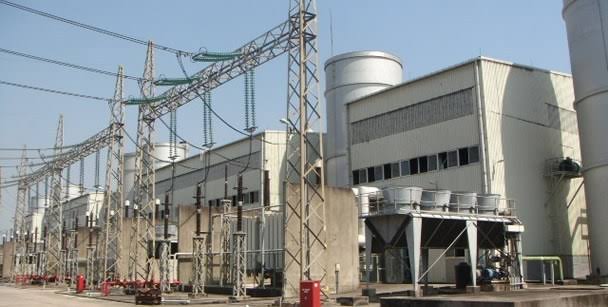
SERAP reacts to $16bn power projects, backs EFCC’s decision to probe past govts’ spending

Published

on

The Socio-Economic Rights and Accountability Project (SERAP) has agreed that  “the reported probe by the Economic and Financial Crimes Commission (EFCC) of the past governments, starting with the government of former president Olusegun Obasanjo’s $16 billion power project.

SERAP noted that it is an opportunity for the anti-graft agency to show that former heads of state and other high-ranking public officials are not immune from investigation and prosecution for allegations of grand corruption in Nigeria.

“This probe is something, which SERAP has consistently called for. Nigerians have for far too long been denied justice and the opportunity to get to the bottom of why they continue to pay the price for corruption in the electricity sector–staying in darkness, but still made to pay crazy electricity bills.”

According to reports, the EFCC has begun the probe of the $16 billion power project of the administration of former President Olusegun Obasanjo. While some put the exact cost of the project at $16 billion others say it is $13.8 billion. Key contractors and about 18 top public officers allegedly involved in the power project scam during the Obasanjo administration, and those of former Presidents Umaru Yar’Adua and Goodluck Jonathan, may also be arrested.

SERAP, in a statement signed on Sunday by its deputy director, Kolawole Oluwadare, said: “The probe is timely, especially coming at a time of citizens’ frustrations at persistent allegations of corruption and the impacts on their human rights. Investigating allegations of grand corruption and prosecuting former heads of state and other high-ranking officials where such allegations show relevant and sufficient admissible evidence would address the grave travesty that has for many years occurred in the power sector.”

The organization also added: “The EFCC should urgently invite anyone suspected to be involved for questioning. The agency should also expand the probe to cover the alleged squandering of a total of N11 trillion in the power sector between 1999 and 2015, and the unresolved case of the reported missing $12.4 billion oil windfall, allegedly spent between 1988 and 1993 by the government of former military dictator, General Ibrahim Babangida.”

“The EFCC has the full support of Nigerians in its efforts to hold high-ranking public officials to account for grand corruption, and if consistently, fairly and diligently pursued, this probe would contribute to ending impunity for corruption, and to mobilizing and encouraging youth civic engagement in the anti-graft fight in the country. SERAP stands ready to work with the EFCC in pursuing all allegations of grand corruption.

“SERAP notes that former presidents have routinely faced corruption charges in countries like Iceland, Kyrgyzstan, Brazil, Montenegro, South Korea, Pakistan, Zimbabwe, South Africa, Slovakia, Peru, and Mauritius, and the probe by the EFCC would mean this list would grow even further to include Nigeria.

“Impunity for grand corruption will continue as long as high-ranking public officials go largely unpunished for their alleged crimes. It is by pursuing these allegations and taking the evidence before the court that the truth will be revealed and justice best served. Addressing impunity in the power sector should be total. This would help to further public perception of fairness and thoroughness.

“Lack of regular electricity supply in the country had occasioned many other problems, including lack of access to potable water. The failure by successive governments to tell Nigerians the truth about allegations of corruption in the power sector amounts to a failure to ensure that electricity services are progressively made available, on the basis of equality and non-discrimination.

“In November 2016, SERAP petitioned the former Chief Justice of Nigeria, Walter Onnoghen, urging him to probe the alleged spending of the $16 billion. In April 2017, SERAP sent President Muhammadu Buhari an open letter, advising him to take allegations of corruption in the power sector to the international criminal courts to ensure that justice is served.

“SERAP has also called on Mr Buhari to refer the alleged $16 billion spending on electricity between 1999 and 2007 to the EFCC. Mr Buhari subsequently raised questions over the issues, saying that ‘one of the former Heads of State was bragging that he spent more than 15 billion American dollars, not naira, on power. Where is the power? Where is the power?

“In August 2017, SERAP published a report, ‘From Darkness to Darkness: How Nigerians are Paying the Price for Corruption in the Electricity Sector’, which revealed how over N11 trillion meant to provide regular electricity supply was allegedly squandered under the governments of former presidents Olusegun Obasanjo, Umaru Musa Yar’Adua and Goodluck Jonathan”, the statement concluded.

Meanwhile, the said report reads: “The Obasanjo’s administration spent $10 billion on NIPP with no results in terms of increase in power generation. $13.278,937,409.94 was expended on the power sector in eight years while unfunded commitments amounted to $12 billion.

“The Federal Government then budgeted a whopping N16 billion for the various reforms under Liyel Imoke (2003 to 2007) which went down the drains as it failed to generate the needed amount of electricity or meet the set goals. Imoke was alleged to have personally collected the sum of $7.8 million for the execution of the contract for the construction of the Jos-Yola Transmission Line, which was never executed. There were documented/reported allegations of corruption against Imoke that fizzled-out shortly thereafter.”

Comments

Crime & Court

NDLEA busts Oyo meth lab, arrests Mexican, four Nigerians

Published

on

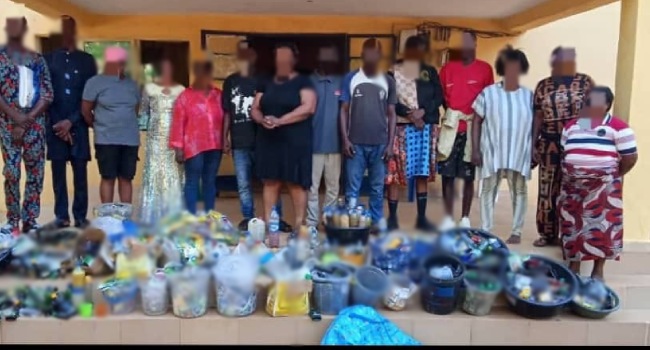
The National Drug Law Enforcement Agency has uncovered and dismantled a large methamphetamine production facility concealed inside a forest in Oyo State, arresting a suspected Mexican drug expert and four Nigerians in what officials described as a major breakthrough against an international drug trafficking syndicate.

The industrial-scale laboratory was discovered at Tapa Village in Ibarapa North Local Government Area during an operation conducted by NDLEA operatives on June 17.

Among those arrested was a 56-year-old Mexican national, Jose Villa Ochoa, who was allegedly recruited to provide technical expertise for the large-scale production of methamphetamine.
Four Nigerians identified as Maxwell Uche Nevoh, Olatunji Yusuf, Bankole Akeem Owolabi and Ganiu Monsiu were also apprehended during the raid.

The Chairman of the NDLEA, Brig. Gen. Mohamed Buba Marwa (retd.), said the clandestine facility was equipped with substantial quantities of precursor chemicals and industrial processing equipment used in the manufacture of methamphetamine.

According to the agency, forensic analyses conducted at the site confirmed the presence of methamphetamine, while all recovered substances, chemicals and equipment had been secured as exhibits for further investigation and prosecution.

The discovery came barely four weeks after NDLEA operatives dismantled another large methamphetamine laboratory hidden in a forest in neighbouring Ogun State, heightening concerns over attempts by drug cartels to turn the South-West into a hub for synthetic drug production.

Marwa said the latest operation underscored the agency’s determination to dismantle transnational drug trafficking networks operating within Nigeria.

He warned both local and foreign drug syndicates against viewing the country as a safe destination for illicit drug activities.

“Let the message go out clearly to all drug cartels, domestic and international, that Nigeria is not, and will never be, a safe haven for your illicit trade,” Marwa said.

“We will find you in the cities, we will track you into the forests, and we will dismantle your infrastructure of death.

They thought hiding in dense forests would shield them from the long arm of the law. They were wrong.”

The NDLEA described the operation as another significant blow against organised drug trafficking networks and commended the officers involved in the raid for their professionalism, resilience and courage.

Continue Reading

Crime & Court

Police recover Rivers SUV stolen five years ago in Gombe

Published

on

Operatives of the Gombe State Police Command have recovered a Toyota Highlander reported stolen in Port Harcourt, Rivers State, five years ago.

The vehicle was recovered on June 8, 2026, during a routine verification exercise conducted by detectives attached to the State Intelligence Department in collaboration with officials of the Federal Road Safety Corps at the Gombe State Internal Revenue Service vehicle licensing office.

The spokesperson for the command, DSP Buhari Abdullahi, disclosed this in a statement issued on Saturday, saying the vehicle was flagged as suspicious during the process of uploading and verifying vehicle records.

According to him, the joint team identified the Toyota Highlander bearing registration number FH823PHC and subjected it to further scrutiny, which revealed that it had been declared stolen on September 17, 2021.

Preliminary findings showed that the vehicle belonged to one Cecilia A. Duru of Akwaka Lane, Rumuodumaya, Port Harcourt, Rivers State.

Abdullahi said investigators subsequently uncovered a transnational movement of the vehicle, establishing that it was taken to the Niger Republic in 2023 before returning to Nigeria through Illela Local Government Area of Sokoto State on October 17, 2025.

He added that the sport utility vehicle was later sold in Kaduna State and eventually brought to Gombe for re-registration, where it was detected and recovered by security operatives.

“Investigation is ongoing, as efforts are being intensified to identify and apprehend those involved,” the police spokesperson stated.

He urged members of the public to exercise caution when purchasing vehicles, advising intending buyers to verify ownership documents and authenticate vehicle records through the appropriate authorities before concluding any transaction.

The command reaffirmed its commitment to combating vehicle theft and other trans-border crimes, assuring residents that efforts were underway to arrest all those linked to the theft and illegal trafficking of the recovered vehicle.

Continue Reading

Crime & Court

Court Jails Bandit Kingpin’s Mother, Sister 40 Years for Terrorism Support

Published

on

A Federal High Court sitting in Abuja has sentenced two women linked to a slain suspected terrorist kingpin, Kachallah Ibrahim Battujo, to a total of 40 years imprisonment for offences bordering on terrorism and aiding criminal activities.

The convicted women — Safiya Salihu and Halima Abdullahi — who are said to be the mother and sister of the late bandit leader, were handed the sentence on Wednesday by Justice Hauwa Yilwa after they pleaded guilty to parts of a five-count terrorism charge filed by the Office of the Attorney-General of the Federation.

Battujo, described by security operatives as a notorious bandit kingpin, was earlier eliminated by security forces on June 10, 2026, during an operation in a forest near Iluke in Kabba/Bunu Local Government Area of Kogi State.

During proceedings, the court heard that the defendants were implicated in aiding and abetting the activities of the deceased, including passing information through telephone communications and concealing aspects of his criminal operations.

According to the prosecution, both women admitted guilt to count two of the charge, which bordered on supporting and facilitating the activities of a known bandit leader in violation of Section 26 of the Terrorism (Prevention and Prohibition) Act, 2022.

Halima Abdullahi was further convicted on count four, which involved concealing information regarding illegal firearms allegedly acquired by her brother after she reportedly visited his forest hideout.

Safiya Salihu, on her part, also pleaded guilty to count five, which accused her of withholding information about terrorist activities linked to her son.

Although the charges also included allegations of receiving ₦490,300 suspected to be proceeds of terrorism and sponsorship of pilgrimage using illicit funds, the Director of Public Prosecutions, Rotimi Oyedepo, SAN, urged the court to discount those counts while proceeding with conviction on others.

Justice Yilwa, in her judgment, imposed 20 years imprisonment on each of the counts, but ordered that the sentences should run concurrently, effectively making the total jail term 40 years for each convict.

The court further directed that after serving their jail terms, the convicts should undergo rehabilitation, underscoring the judiciary’s position on balancing punishment with reintegration.

Continue Reading

Advertisement

Entertainment

Advertisement

MegaIcon Magazine Facebook Page

Advertisement

MEGAICON TV

Advertisement

Trending