
Top Stories
What will it take for 2020 to truly be the year of Gas in Nigeria? | By NJ Ayuk



“The Honorable Minister of State for Petroleum Resources, H.E. Chief Timipre Sylva has declared 2020 as the year of Gas for the Nation”, the news piece started. What amazing news! And certainly long overdue. As it seems, Nigerian officials have finally taken the cue. As I have said ever so often, more than an oil nation, Nigeria is a gas nation. It just doesn’t act like it.
Undoubtedly, natural gas has the enormous potential to diversify and grow the Nigerian economy, power its industries and homes, produce ever-so-lacking wealth, create jobs, develop associated industries in the petrochemical sector, raise people out of poverty, the list goes on.
Mr. Sylva’s demonstrated intent could perhaps become the most relevant political action anyone has taken in Nigeria in years and could change the country forever; and yet, the work ahead is so vast, we can only hope he has the strength to pull it off.
To be sure, naming 2020 the year of gas for Nigeria has a really nice ring to it, but marketing alone will not cut it. Concerted governmental action is essential if we are to see true growth in the liquefied petroleum gas (LPG) sector, and first of all, we need to see a conclusion to the long delayed Nigerian Gas Flare Commercialisation Programme. Sylva stated that this was his main priority, so let’s hope it happens soon.
Once the programme is cleared, oil producers will have a more conclusive alternative to flaring. They will be able to monetize a resource that has so far been wasted, but still that will not suffice.
The flaring issue in Nigeria is tremendous. Every year, 2 million tonnes of LPG are flared, instead of being used as a source of power or feedstock. That means millions of dollars literally going up in smoke. Nigeria’s zero-flaring programme has been on-going for years, and yet, the Nigerian National Petroleum Corporation (NNPC) has just released results that indicate that gas flaring has been consistently increasing over time. More specifically, “a total of 276.04 billion cubic feet (bcf) of natural gas was flared from Nigeria’s oil fields between September 2018 and September 2019”. Further, NNPC stated that “the volume of gas flared within this period was more than what was supplied to power generation companies for electricity production which was 275.31bcf”. This is taking place in a country where 45% of the population does not have access to electricity, besides the extremely detrimental effect that has on businesses ability to compete and the extraordinary environmental damage that represents.
Already, the federal government announced in August that it would not be able to fulfill its Zero Routine Flaring target by 2020 and is yet to provide a new deadline for this goal to be achieved.
The problem remains the same as ever. It is much, much cheaper for producers to flare up and pay the fines than do anything about it. This can not continue to be. Stronger action is needed and it falls on Mr. Sylva’s leadership to see it done.
I don’t mean by this to point the finger at oil producers. Most would probably want to monetize that resource, and would if they could. But we lack legislation, infrastructure, pricing regulations, and actors ready to receive the feedstock. They can’t just pipe the gas somewhere and hope for the best. We need to focus on deepening domestic gas penetration and promote adoption amongst the population, foster the development of gas associated industries like ammonia and urea plants, use this resource for power generation, etc. Demand doesn’t grow out of nowhere.
For this to workout, everybody needs to work together. That means the ministry and the NNPC need to partner with the international oil companies, the indigenous oil companies as well as with the country’s financial institutions to create the solutions that can make this industry flourish. That is a tall job, but an essential one.
Of course, the news that the output of liquefied natural gas (LNG) coming from the Bonny LNG-plant is going to expand by 35% once the 7th LNG train is operational is fantastic. Nigeria will strengthen its position as one of the world’s biggest LNG exporters and that will bring considerable wealth for the country, but its people continue to be in the dark.
And LNG expansion projects are something IOCs are well prepared to do, but there are other important roles in boosting the gas industry that have to be taken by others.
I speak of course of marginal field development, a topic that is of fundamental importance to me and that I have extensively covered in my most recent book Billions at Play: The Future of African Oil and Doing Deals. Both for oil and gas, Nigeria’s marginal field development programme showed incredible promise when it was first launched in 2013. It gave opportunities to local companies to explore smaller discoveries that were uninteresting for the majors, which in turn allowed them to gain experience in leading exploration and production projects on their own. Further, it opened opportunities for domestic use of natural gas for power generation. That programme is now being copied by Angola, and yet, it has stalled in Nigeria.
Further, as I have extensively debated over the years, and most extensively in Billions at Play, we need to dramatically invest in Nigeria’s ability to negotiate and manage contracts. This applies both to the need to respect the sanctity of contracts, a fundamental part of giving international investors the confidence to trust that what they sign for will be respected, but also learning to choose who to sign contracts with. The current debacle with P&ID, an unknown little company that has managed to sue the Nigerian government for breach of contract in the English courts and is seeking USD$9.6 billion in compensation, is an incomprehensible situation that should never have taken place. We need to know who our partners are and who we should be signing contracts with, and then stick by them.
Only by combining the role of the majors, the indigenous companies, the necessary infrastructure development for gas transportation, bridging with the nation’s banks to help finance projects and by giving a clear legal framework to the sector, can we hope to succeed. I do not doubt that this is possible to accomplish in 2020 and the years to come, but coming from the experience of recent years, it does not seem probable, and no one pays the price for that more than everyday Nigerians, that continue to fail to benefit from its country’s resources.
Action is necessary as a matter of urgency.
This week it was disclosed that international oil and gas companies were holding back an estimated USD$58.4 billion in investments in oil and gas projects in Nigeria because of regulatory uncertainty. Foreign Direct Investment in Nigeria was USD$1.9 billion in 2018. It’s not like we don’t need the money.
But how can we expect international oil companies to feel comfortable signing off on billions in investment if after 20-plus years of negotiations we still haven’t managed to settle on the Petroleum Industry Bill that will oversee the sector? Who can blame them for waiting to see what happens? They are waiting for us to figure out how we want to regulate the industry, and after 20 years, we still don’t seem to know. That has to change, and soon.
Nigeria has an estimated 200 trillion cubic feet of gas reserves. It is high-time to put them to use. With the right policies we could change the face of the country completely. We could give light to our people, we could power our industries, releasing them from the handicapping dependency on diesel generators that make it all but impossible for them to be competitive, we could relinquish ourselves from our dependency on imported fuel for power and heat, we could create new opportunities for job creation and industrial development, we could take millions of people out of poverty… Further, strong domestic gas and gas-based industries could help boost intra-African trade, create new synergies with our neighbours, boost integration of power generation networks, establish new partnerships, even contribute to peace.
What I am saying, I say as an African, and it applies to many countries across the continent. However, Nigeria is in a prime position to truly enact change and be a beacon to others by showing leadership and resolve. It is the continent’s biggest economy and has the continent’s biggest reserves of hydrocarbons, both oil and gas. NNPC already works with some of the best major IOCs and the country has Africa’s best and most developed indigenous exploration and production capabilities. Let’s give ourselves the opportunity to be better and to live better, by taking advantage of the resources we already possess.
Mr. Sylva is showing leadership and drive. So far, he has proven himself to be the leader that Nigeria needs to develop new LPG and LNG industries that will take the country to the next level of development, not only economically speaking, but socially, environmentally, humanly. So let’s hope he can pull through the great transformations that need to occur for 2020 to truly be Nigeria’s year of gas.
NJ Ayuk is the Executive Chairman of the African Energy Chamber and author of Amazon best-selling book, Billions at Play: The Future of African Energy and Doing Deals.




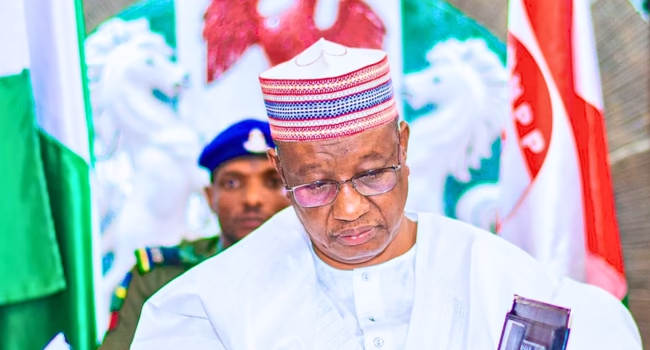
The Kano State House of Assembly has initiated impeachment proceedings against Deputy Governor Aminu Abdussalam Gwarzo over allegations of gross misconduct, abuse of office, and breach of public trust.
The notice was presented yesterday during plenary by the Majority Leader, Lawan Hussaini Dala, who said the action follows Section 188 of the 1999 Constitution of the Federal Republic of Nigeria.
Dala said the allegations stem from Abdussalam’s tenure as Commissioner for Local Government (2023–2024) and his current role as deputy governor. He accused the deputy governor of diverting funds meant for the 44 local government councils.
According to the majority leader, Abdussalam allegedly received N1.5 million monthly from each council between June 2023 and January 2024, totaling N462 million. Between February and July 2024, he allegedly collected N3.255 million monthly from each council under the guise of special assignments, amounting to N726 million.
Dala also accused the deputy governor of abuse of office, claiming he facilitated payments of N10 million from each council to NovoMed Pharmaceuticals Limited, totaling N440 million, in violation of state procurement laws.
“The misuse of official capacity to confer undue advantage constitutes abuse of power and undermines public trust,” Dala told lawmakers, adding that the allegations amount to gross misconduct under the Constitution.
The impeachment notice was reportedly endorsed by 38 lawmakers, meeting the constitutional threshold to proceed. The Speaker has acknowledged receipt, and the House is expected to serve the allegations on the deputy governor.
If approved, a panel may be constituted by the state Chief Judge to investigate the claims.
As of filing, Abdussalam had yet to respond publicly to the allegations.
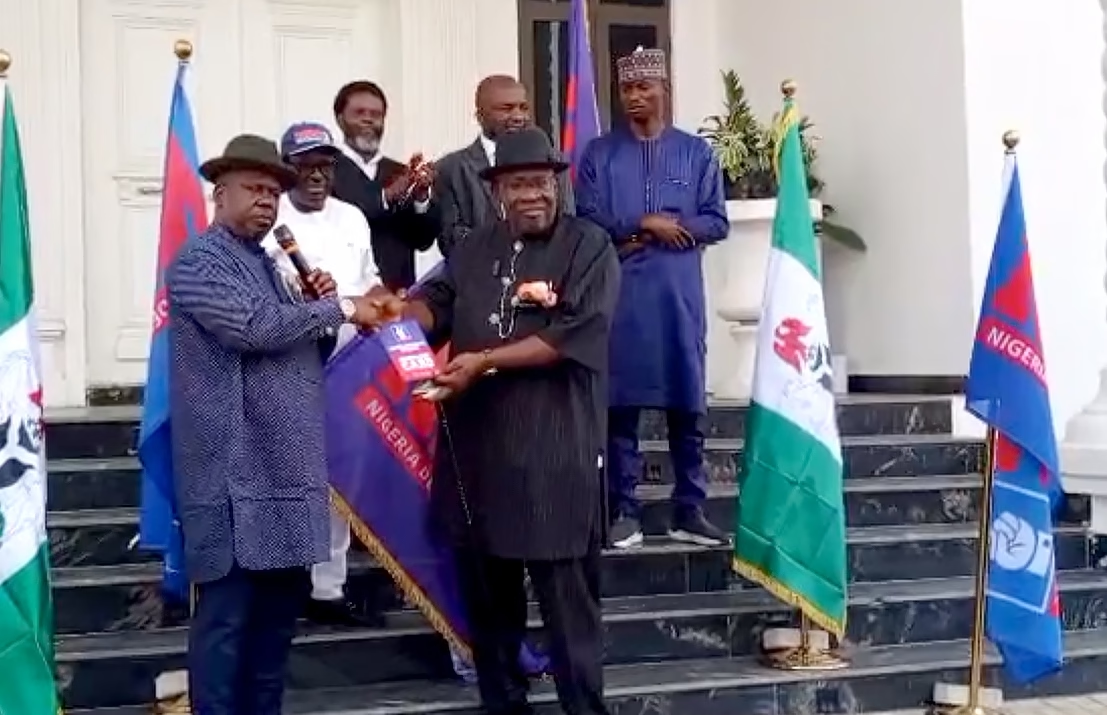
The Senator representing Bayelsa West, Seriake Dickson, on Thursday announced his resignation from the Peoples Democratic Party (PDP), declaring that he had joined the newly registered Nigeria Democratic Congress (NDC).
Dickson, a former governor of Bayelsa State, made the announcement during a media briefing in Abuja, attributing his decision to what he described as irreconcilable differences within the PDP.
The lawmaker said the emergence of the NDC would strengthen Nigeria’s democratic system by providing a credible opposition platform.
According to him, the party recently received its certificate of registration from the Independent National Electoral Commission.
He said, “Last week INEC issued a certificate of registration and we now have the newest party in Nigeria known as the Nigeria Democratic Congress and our symbol is victory, the victory sign.
“So, my dear Nigerians, you now have a credible alternative opposition party known as the Nigeria Democratic Congress.”
Dickson noted that although the party’s registration took longer than expected, its eventual approval was a welcome development for the country’s democratic landscape.
“Yes, it is coming at this time. We would have wished it started some years or months back. We don’t control INEC and their processes; they delayed. We don’t also control the judiciary, but thank God it has finally arrived,” he said.
The senator also stressed that Nigeria’s democracy must not slide into a one-party system, insisting that political diversity remained vital for national stability.
“This nation cannot be a one-party state. Nigeria cannot be a one-party state. Nigeria is not designed to be a one-party state.
“We are a very diverse nation culturally, religiously and politically and that is the beauty of our country.
“So anyone or any party promoting one-party rule in Nigeria is mistaken. We build political parties and get involved in movements to access power for the good of the people, not for our personal benefit,” he added.
Meanwhile, the Independent National Electoral Commission recently announced the registration of two new political parties.
The parties are the Democratic Leadership Alliance and the Nigeria Democratic Congress, bringing the total number of registered political parties in Nigeria to 21.
The announcement was made by the INEC Chairman, Prof. Joash Amupitan, during the commission’s first quarterly consultative meeting with political party stakeholders for 2026.
According to him, the Democratic Leadership Alliance completed the required verification process, while the Nigeria Democratic Congress was registered in compliance with a Federal High Court order.
The National Drug Law Enforcement Agency (NDLEA) has arrested a 58-year-old alleged drug lord, Uzoma Valentine Ilomuanya, who had reportedly been on the agency’s wanted list and that of British authorities for over 15 years.
Ilomuanya was apprehended in Lagos on Monday, February 23, 2026, following what the agency described as a high-level, coordinated operation by officers of its Special Operations Unit.
The development was disclosed in a statement issued on Wednesday by the Director of Media and Advocacy of the agency, Femi Babafemi.
Babafemi said the suspect’s arrest ended a prolonged manhunt linked to his alleged involvement in drug trafficking activities across Nigeria and the United Kingdom.
According to the statement, Ilomuanya was first arrested in February 2003 in the United Kingdom and convicted for drug trafficking.
He was sentenced to nine years imprisonment but was released after serving two years following a successful appeal.
Babafemi added that the suspect was again arrested in the UK in July 2011 over drug-related offences.
He said, “He was granted administrative bail but jumped jurisdiction and fled to Nigeria.
“Typical of a recidivist, Ilomuanya was in November 2018 arrested in Nigeria by NDLEA operatives following the discovery of two clandestine methamphetamine laboratories in his Obinugwu, Orlu Local Government Area country home in Imo State and at his No. 3 Barrister Declan Uzoma Close, Lagos residence where officers recovered 77.960 kilograms of methamphetamine and extensive production equipment.
“He was subsequently charged before a Federal High Court in Lagos, after which he jumped court bail and has been on the run since then.”
Reacting to the development, the Chairman and Chief Executive Officer of the NDLEA, Brig. Gen. Mohamed Buba Marwa (retd.), described the arrest as a major breakthrough in the agency’s ongoing war against drug trafficking networks.
Marwa said the operation demonstrated the agency’s resolve to track down criminal elements regardless of how long they evade the law.
He said, “This arrest serves as a stern warning to those who think they can hide behind borders to escape justice.
“Whether you jump bail in London or set up clandestine labs in your village, the long arm of the NDLEA will eventually catch up with those who choose to undermine the health, security, and future of our nation.
“We remain committed to our international collaborations to ensure that Nigeria is not used as a sanctuary for global drug lords.”
Marwa also commended officers of the Special Operations Unit for their professionalism and persistence in tracking down the suspect.
He added that the agency would continue to strengthen intelligence-driven operations and international cooperation to dismantle drug trafficking networks operating within and beyond Nigeria.



-
 Politics3 days ago
Ibarapa East Assembly Hopeful, Ramon Congratulates Ajiboye, Says Emergence Good for Oyo APC
-
 Politics7 days ago
Makinde: My Successor Must Be Loyal to Oyo, Not Me
-
 Politics3 days ago
2027: Former Oyo Deputy Governor Adeyemo Emerges APC Chairman (See Full List)
-
 Politics7 days ago
Fintiri Dumps PDP for APC, Moves with Cabinet, 14 Adamawa Lawmakers