
News
Makinde presents N294.5bn ‘budget of growth, opportunities’ to Oyo Assembly

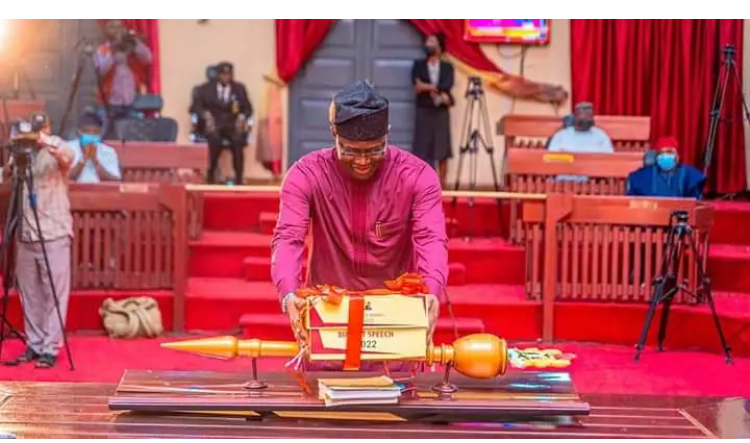

Oyo state governor, Engr. Seyi Makinde, on Wednesday, presented a budget in the sum of N294.5 billion to the State House of Assembly for the 2022 fiscal year.
The governor maintained that his administration was determined to move the state from poverty to prosperity.
Governor Makinde, in a statement by his Chief Press Secretary, Mr. Taiwo Adisa, said, “last year, we presented to you our budget on Continued Consolidation. I had a chance to present to you a report of our accomplishments over the previous budgetary cycle and our plans for 2021.
“Mr. Speaker Sir, Honourable Members of the House, this year, it gives me great pleasure to be with you again for the presentation of the 2022 Fiscal Budget which we have tagged a Budget of Growth and Opportunities.”
Giving a breakdown of the N294.5 billion proposal titled ‘Budget of Growth and Opportunities’, Makinde stated that capital expenditure stands at the sum of N156 billion, representing 52.97 per cent, while recurrent expenditure will stand at N138.5 billion, amounting to 47.03 per cent.
He said that the N294.5 billion budget represents an 18.3 per cent reduction over the amended 2021 budget.
According to him, funds for the 2022 budget shall be sourced from internally generated revenue, statutory allocations, and capital receipts.
A further breakdown of the budget indicates that infrastructure is to gulp the sum of N96.6 billion, amounting to 32.83 percent, Education sector is allocated the sum of N54.1b, amounting to 18.37 per cent; the health sector is to get the sum of N17.4b amounting to 5.9 per cent, while Agric will get N11.3b amounting to 3.84 per cent.
He told the lawmakers that his administration last year promised to continue to invest in infrastructure, adding that such investments were not only evenly distributed, they also cut across the thematic aspects of his administration spanning the four-point service agenda.
He said: “We have worked hard to ensure that infrastructural development is not restricted to just one zone of the state. In education, we have continued to make investments at all levels. At the primary level, we completed 26 model schools across all zones in Oyo State, built 57 classrooms, installed boreholes, and improved the sanitary condition of existing schools through the construction of toilets.
“We have also continued to improve the quality of education in Oyo State. We not only recruited teachers as reported, but we have also trained them on best practices. More recently we completed the recruitment of 692 education officers in the state.”
He said that his administration also ensured that the Health sector performs creditably in the 2021 fiscal year, adding that the government has continued to keep the promise of reconstructing one Primary Healthcare Centre (PHC) in each of the 351 electoral Wards of the State.
He further submitted: “In the past year, we completed the renovation, upgrade, and equipping of 40 PHCs. Secondary healthcare facilities have not been left out as we continued to upgrade and rehabilitate existing facilities to serve the good people of Oyo State.
“On Security, we have made provision to recruit more Amotekun Corps members and we will continue to make investment in technology that supports our security architecture in Oyo State.”
He stated that the state has always prioritised infrastructural development, adding that in the last year, his administration intensified efforts on building projects that can generate more income for the state.
He disclosed that the Challenge Bus Terminal in Ibadan was 70 per cent complete, while the other three terminals at Iwo Road, New Ife Road, and Ojoo areas of Ibadan were also ongoing.
He stated that the Fasola Agribusiness Industrial Hub under construction is at about 40 per cent completion, while the state has recorded significant progress in reconstructing the 21km Airport- Ajia-New Ife Express Road with a spur to Amuloko; 12km Apete-Awotan-Akufo Road and the 44.7km Saki-Ogbooro-Igboho Road.
Makinde stated that the Idi Ape-Basorun-Akobo- Odogbo Barracks Road and the 5.2km Gedu-Oroki-Sabo-Asipa Road are also nearing completion.
He further stated: “There is still so much more that needs to be done. We are aware of the complaints of our people regarding roads in Oyo State. We are determined to meet their yearnings for high-quality infrastructure in the state and that is why we continually embark on road rehabilitation and reconstruction. In the immediate, we are carrying out palliative works on these roads.”
He listed other road projects that will get direct focus in the 2020 budget as including the Iseyin-Oyo road, the Iseyin-Ogbomoso road, and the 110 km Ibadan Circular Road.
He said that the 2022 budget was put together using the inclusive budgeting model already adopted by his administration, whereby Town Hall meetings were held with indigenes and residents at different locations across the geopolitical zones of the state.
He stated: “Mr. Speaker, Honorable Members of the House, in keeping with our tradition in the last two years, we again embarked on Townhall Meetings on the 2022 budget and gave stakeholders the opportunity to contribute towards the direction of this budget.
“The people have again spoken and based on their feedback; we have prepared our budget for the 2022 Fiscal Year.”
He said that the state intends to inject the sum of N156 billion into the economy through investments in infrastructure and by ensuring that “our people have higher purchasing power.
“For the first time, our proposed capital expenditure at 52.97% is more than our recurrent expenditure. A major project we will be carrying out in 2022 is 110km Ibadan Circular Road. This tolled road will be a major economic boost as it will create an alternate entry and exit point out of Ibadan and connect the new economic corridor and business district, we are building at Moniya.
“Also, we will commence the reconstruction of the Iseyin-Ogbomoso Road to further boost economic activities in the state,” he said.
He also stated that his administration will continue to create an enabling environment for the private sector to thrive while opening doors to both local and foreign investors in agribusiness, tourism, and other sectors.
He used the opportunity to announce the Oyo Agribusiness Summit 2021, which he said would hold in Ibadan in the next few weeks.
While giving details of the performance of the 2021 budget, Makinde said that budget performance had reached 60 per cent despite the fact that there are three more months to the end of the fiscal year.
He said that the state was hopeful of raising the performance to 75 per cent.
He said that for the 2022 fiscal year, the state is projecting an Internally Generated Revenue of N79,796,513,040.00, adding that though the projection was a tall order, his administration plans to achieve it without increasing tax.
He said: “We already see this working to our advantage as the recently released figures show that our contributions to Nigeria’s Value Added Tax shot up to over N64 Billion.
“We have continued to follow the Roadmap to Accelerated Development in Oyo State 2019-2023, which highlights the four sectors that our administration has prioritised in engineering a prosperous Oyo State.”
He noted that the state has continued to exceed UNESCO standards in allocating resources to education.
In his remarks, the Speaker, Oyo State House of Assembly, Hon Adebo Ogundoyin, said that the presentation of the 2022 budget will spur lawmakers to redouble their efforts in terms of oversight functions and project monitoring.
According to him, the timely presentation of the 2022 budget will also ensure that the legislature completes work on it well before the end of the 2021 fiscal year. He added that the development would help the state keep to the January to December Budget circle.
The Speaker said: “Let me state categorically that the budget proposal is not new to us because we have been part of the process at all levels. We are equally convinced that the governor has articulated all the requests and demands of our people based on the outcome of the stakeholders’ consultative meetings on the 2022 budget, held across the State.
“Expectedly, the four cardinal pillars upon which this administration places its development agenda, viz: Education, Health, Economy (driven by Agribusiness), and Security are steadily being pursued and realised.”
He commended Governor Makinde for working to grow the Internally Generated Revenue (IGR) of the state, adding that the assembly would do everything possible to ensure the checks and balances crucial for achieving a transparent, accountable, and prudent government.
He also requested that the governor assents to the Legislative Fund Management Law which has been passed by the assembly, adding that states that have assented to the law include Adamawa, Sokoto, Zamfara, Plateau, Delta, Ekiti, and Ondo.
”Once it is assented to by you, we will be able to implement Consolidated Legislative Salary Structure (CONLESS) which is a uniform salary structure for all the State Houses of Assembly, the Speaker said, adding that some states of the federation are already implementing the consolidated legislative salary structure.
The Speaker said: “States like Rivers, Kaduna, Nasarawa, Plateau, Sokoto, Bayelsa, Delta, Adamawa, and Lagos are already paying their Legislative staff using CONLESS salary structure. In Oyo State, the Judiciary workers have also been enjoying their Consolidated Judiciary Salary Structure (CONJUSS). His Excellency, we do not want to be an exception.”



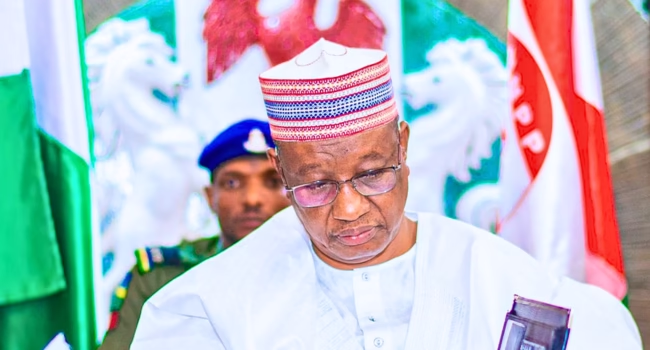
The Kano State House of Assembly has initiated impeachment proceedings against Deputy Governor Aminu Abdussalam Gwarzo over allegations of gross misconduct, abuse of office, and breach of public trust.
The notice was presented yesterday during plenary by the Majority Leader, Lawan Hussaini Dala, who said the action follows Section 188 of the 1999 Constitution of the Federal Republic of Nigeria.
Dala said the allegations stem from Abdussalam’s tenure as Commissioner for Local Government (2023–2024) and his current role as deputy governor. He accused the deputy governor of diverting funds meant for the 44 local government councils.
According to the majority leader, Abdussalam allegedly received N1.5 million monthly from each council between June 2023 and January 2024, totaling N462 million. Between February and July 2024, he allegedly collected N3.255 million monthly from each council under the guise of special assignments, amounting to N726 million.
Dala also accused the deputy governor of abuse of office, claiming he facilitated payments of N10 million from each council to NovoMed Pharmaceuticals Limited, totaling N440 million, in violation of state procurement laws.
“The misuse of official capacity to confer undue advantage constitutes abuse of power and undermines public trust,” Dala told lawmakers, adding that the allegations amount to gross misconduct under the Constitution.
The impeachment notice was reportedly endorsed by 38 lawmakers, meeting the constitutional threshold to proceed. The Speaker has acknowledged receipt, and the House is expected to serve the allegations on the deputy governor.
If approved, a panel may be constituted by the state Chief Judge to investigate the claims.
As of filing, Abdussalam had yet to respond publicly to the allegations.
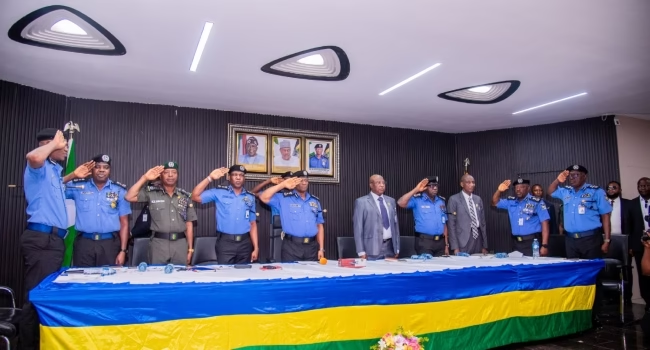
The Inspector-General of Police, Tunji Disu, on Wednesday inaugurated a seven-member committee on the establishment of state police, giving it four weeks to submit its report.
The inauguration was held during his maiden conference with senior police officers at the Peacekeeping Conference Centre, Force Headquarters, Abuja.
Charging members of the panel to discharge their duties with professionalism and objectivity, Disu described the assignment as “both significant and timely,” noting that it would shape the framework through which state policing may operate in Nigeria.
“In carrying out this assignment, your deliberations must be guided by professionalism, objectivity, and a clear appreciation of the unique complexities of policing a diverse nation such as our own,” the IGP said.
He stated that if properly designed and effectively implemented, state policing holds significant potential benefits for the country.
“By bringing law enforcement closer to communities, state police institutions can deepen local knowledge of security dynamics and enable quicker and more targeted responses to emerging threats,” he added.
The committee is expected to review existing policing models within and outside Nigeria, assess community security needs and emerging risks, and propose an operational framework for the establishment and coordination of state police structures.
It will also address issues relating to recruitment, training, standards and resource allocation, as well as develop accountability and oversight mechanisms to ensure professionalism and public trust.
The panel is chaired by Olu Ogunsakin, with Bode Ojajuni as secretary. Other members are Emmanuel Ojukwu, Okebechi Agora, Suleyman Gulma, Ikechukwu Okafor and Tolulope Ipinmisho.
Disu said the committee had about four weeks to conclude its assignment and submit a comprehensive report.
The move marks one of the first major steps taken by the new police chief since his appointment and confirmation a few days ago.
The development comes amid rising security concerns across the country, with several stakeholders advocating state policing as part of measures to tackle insecurity.
President Bola Tinubu had earlier asked the National Assembly to commence the process of amending relevant laws to pave the way for the creation of state police.
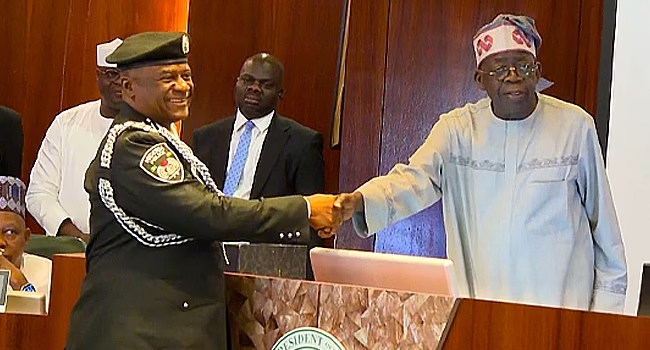
President Bola Tinubu on Wednesday swore in Olatunji Disu as the Inspector-General of Police (IGP).
Disu took the oath of office at the Council Chamber of the Presidential Villa, Abuja, shortly before the commencement of the Federal Executive Council (FEC) meeting.
The President also administered the oath of office to six commissioners of the Revenue Mobilisation Allocation and Fiscal Commission (RMAFC) and two commissioners of the Federal Civil Service Commission (FCSC).
The ceremonies were witnessed by ministers, senior government officials and family members of the appointees.
The council meeting began shortly after the swearing-in.
In attendance were Vice President Kashim Shettima; the Secretary to the Government of the Federation, Senator George Akume; the Chief of Staff to the President, Femi Gbajabiamila; the National Security Adviser (NSA), Nuhu Ribadu; and the Head of the Civil Service of the Federation, Mrs EsthMrs.Walson-Jack.
Disu was appointed acting IGP on February 25, 2026, by President Tinubu, following the resignation of former IGP Kayode Egbetokun.
His appointment was subsequently endorsed by the Nigeria Police Council (NPC).
The former Assistant Inspector-General of Police assumed office last Wednesday.
He previously served as Assistant Inspector-General in charge of the Force Criminal Investigation Department (FCID) Annex, Alagbon, Lagos, after his promotion to the rank last year.
A former head of the Lagos Rapid Response Squad (RRS), Disu has pledged to deliver accountable, modern and professional policing.



-
 Politics4 days ago
Ibarapa East Assembly Hopeful, Ramon Congratulates Ajiboye, Says Emergence Good for Oyo APC
-
 Politics1 week ago
Makinde: My Successor Must Be Loyal to Oyo, Not Me
-
 Politics4 days ago
2027: Former Oyo Deputy Governor Adeyemo Emerges APC Chairman (See Full List)
-
 News4 days ago
NERC orders DisCos to refund ₦20.33bn meter costs to customers