
News
June 12: A Defining Moment in Nigeria’s Democracy

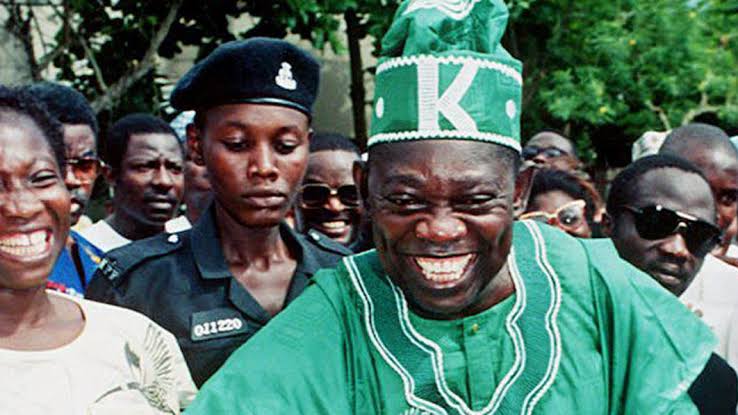

June 12 holds a significant place in Nigeria’s history, marking a pivotal moment in our journey toward democracy. This watershed day remains etched in our collective memory, symbolizing the unity, struggles, and resilience of the Nigerian people.
The Struggle for Democracy.
On June 12, 1993, Nigerians came together as never before, setting aside their differences in beliefs and worth. They united in casting their votes for Moshood Kasimawo Olawale Abiola, a beacon of hope representing the Social Democratic Party (SDP). The overwhelming support for Abiola’s candidacy overshadowed the National Republican Convention (NRC) in a decisive victory. However, little did we know that a sinister plan had been hatched by Ibrahim Babangida and his civilian co-conspirators.
Deception and Betrayal.
Despite the people’s mandate, a web of deception was spun, giving the impression that democracy had arrived. In reality, it was a ploy to rob the Nigerian people and our nation of the taste of victory and the gift of true democracy. On the eve of the election, Abiola emerged as the clear winner, yet armed men, mere puppets in the military’s game, stole his rightful triumph, igniting chaos and unrest across the country.
The Imprisonment of Hope:
Undeterred by this injustice, Abiola boldly declared himself as the President-elect, undaunted and unyielding. This act of defiance angered Sani Abacha, who emerged as a new force in the power game chess. Abiola was imprisoned, and confined to a desolate space, while the cry for justice resonated among the masses and the international community.
Years of Struggle.
For four long years, Abiola endured the harsh reality of life behind bars, deprived of human contact. Despite the immense pressure, he remained resolute, refusing to relinquish his hard-earned victory in exchange for his release. The spirit of Abiola stood firm, undeterred by the forces of oppression.
False Hopes and Tragic Loss.
As the second anniversary of his imprisonment approached, rumors circulated that Abacha had met his demise. Speculation arose that Abiola’s release was imminent, raising hopes across the nation. However, the military’s grip tightened as Abdulsalam assumed power, and Abiola’s supposed journey to freedom turned into a tragic tale. The nation was thrown into mourning when news broke that Abiola had passed away, denied the chance to reclaim his rightful position as the nation’s Commander-in-Chief.
Recognition and Reflection.
More than two decades later, Abiola was posthumously recognized for his contributions. The Grand Commander of the Federal Republic (GCFR) honor was bestowed upon him, a belated tribute to his enduring legacy. June 12 became Nigeria’s new Democracy Day, signifying not only disappointment and injustice but also the collective power of the Nigerian people in their fight against tyranny.
Lessons for the Future
On the occasion of June 12, we commemorate the advancements Nigeria has achieved despite the hurdles it confronts. However, as citizens, this commemoration binds us to acknowledge the necessity for robust establishments of strong institutions rather than powerful individuals, both men, and women. It is only when we establish institutions that will uphold the supremacy of the law and foster inclusivity can we take a backseat to saying our democracy has come of age.
As many have expressed, our democracy is still in its infancy, and like in other parts of the world, it remains an ongoing endeavor. Nevertheless, it requires our unwavering vigilance and active engagement by holding elected officials from various political affiliations answerable for their actions in fulfilling the benefits of democracy and as a means to prevent the impoverishment of the very people they have pledged to safeguard. Let us keep in mind this day and its significance in the annals of our democratic journey, ensuring that the sacrifices made on June 12 are not rendered futile. Instead, let us unite in our efforts to forge a Nigeria that is fair, just, and prosperous, where the color or creed of individuals holds no significance, and where humanity always takes precedence.
In conclusion, let us remember that our fallen heroes of June 12 serve as a poignant reminder that Nigeria’s journey toward democracy was not easily achieved. It was through the unwavering resilience and indomitable spirit of the Nigerian people that we have reached this day. This necessitates deep contemplation on how we handle this delicate gift, which has been entrusted to us by the struggles of the past. Today, many families struggle to secure even a single nourishing meal, let alone two. This compels us to reflect soberly on how we have missed opportunities in the past and how we are on the brink of missing them today. Unless we unite as a people, setting aside our collective greed and eradicating corruption from our nation, we will continue to face these challenges.
While our leaders have called for sacrifices from the citizens they lead, it is crucial to ask whether they are prepared to sacrifice their comforts and address the issue of wasteful spending that hinders progress and nation-building. They must be willing to make decisions that will shape our collective destiny and alter the course of governance at all levels, fulfilling the aspirations of all citizens.
Allow me to leave you with this profound quote by Obafemi Awolowo: “The government owes as much duty to the individual citizens as the latter does to them.”


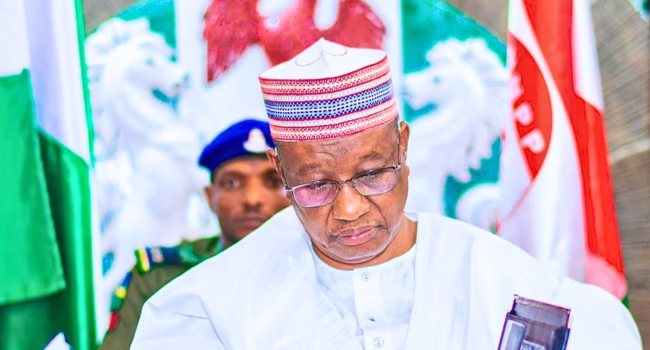
The Kano State House of Assembly has initiated impeachment proceedings against Deputy Governor Aminu Abdussalam Gwarzo over allegations of gross misconduct, abuse of office, and breach of public trust.
The notice was presented yesterday during plenary by the Majority Leader, Lawan Hussaini Dala, who said the action follows Section 188 of the 1999 Constitution of the Federal Republic of Nigeria.
Dala said the allegations stem from Abdussalam’s tenure as Commissioner for Local Government (2023–2024) and his current role as deputy governor. He accused the deputy governor of diverting funds meant for the 44 local government councils.
According to the majority leader, Abdussalam allegedly received N1.5 million monthly from each council between June 2023 and January 2024, totaling N462 million. Between February and July 2024, he allegedly collected N3.255 million monthly from each council under the guise of special assignments, amounting to N726 million.
Dala also accused the deputy governor of abuse of office, claiming he facilitated payments of N10 million from each council to NovoMed Pharmaceuticals Limited, totaling N440 million, in violation of state procurement laws.
“The misuse of official capacity to confer undue advantage constitutes abuse of power and undermines public trust,” Dala told lawmakers, adding that the allegations amount to gross misconduct under the Constitution.
The impeachment notice was reportedly endorsed by 38 lawmakers, meeting the constitutional threshold to proceed. The Speaker has acknowledged receipt, and the House is expected to serve the allegations on the deputy governor.
If approved, a panel may be constituted by the state Chief Judge to investigate the claims.
As of filing, Abdussalam had yet to respond publicly to the allegations.
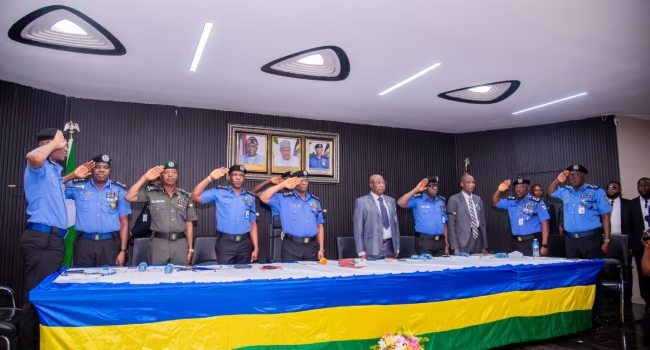
The Inspector-General of Police, Tunji Disu, on Wednesday inaugurated a seven-member committee on the establishment of state police, giving it four weeks to submit its report.
The inauguration was held during his maiden conference with senior police officers at the Peacekeeping Conference Centre, Force Headquarters, Abuja.
Charging members of the panel to discharge their duties with professionalism and objectivity, Disu described the assignment as “both significant and timely,” noting that it would shape the framework through which state policing may operate in Nigeria.
“In carrying out this assignment, your deliberations must be guided by professionalism, objectivity, and a clear appreciation of the unique complexities of policing a diverse nation such as our own,” the IGP said.
He stated that if properly designed and effectively implemented, state policing holds significant potential benefits for the country.
“By bringing law enforcement closer to communities, state police institutions can deepen local knowledge of security dynamics and enable quicker and more targeted responses to emerging threats,” he added.
The committee is expected to review existing policing models within and outside Nigeria, assess community security needs and emerging risks, and propose an operational framework for the establishment and coordination of state police structures.
It will also address issues relating to recruitment, training, standards and resource allocation, as well as develop accountability and oversight mechanisms to ensure professionalism and public trust.
The panel is chaired by Olu Ogunsakin, with Bode Ojajuni as secretary. Other members are Emmanuel Ojukwu, Okebechi Agora, Suleyman Gulma, Ikechukwu Okafor and Tolulope Ipinmisho.
Disu said the committee had about four weeks to conclude its assignment and submit a comprehensive report.
The move marks one of the first major steps taken by the new police chief since his appointment and confirmation a few days ago.
The development comes amid rising security concerns across the country, with several stakeholders advocating state policing as part of measures to tackle insecurity.
President Bola Tinubu had earlier asked the National Assembly to commence the process of amending relevant laws to pave the way for the creation of state police.
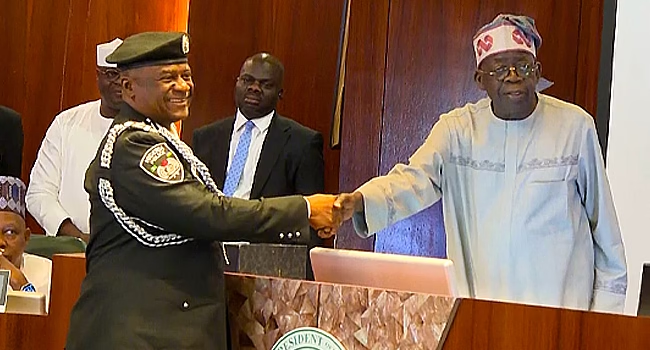
President Bola Tinubu on Wednesday swore in Olatunji Disu as the Inspector-General of Police (IGP).
Disu took the oath of office at the Council Chamber of the Presidential Villa, Abuja, shortly before the commencement of the Federal Executive Council (FEC) meeting.
The President also administered the oath of office to six commissioners of the Revenue Mobilisation Allocation and Fiscal Commission (RMAFC) and two commissioners of the Federal Civil Service Commission (FCSC).
The ceremonies were witnessed by ministers, senior government officials and family members of the appointees.
The council meeting began shortly after the swearing-in.
In attendance were Vice President Kashim Shettima; the Secretary to the Government of the Federation, Senator George Akume; the Chief of Staff to the President, Femi Gbajabiamila; the National Security Adviser (NSA), Nuhu Ribadu; and the Head of the Civil Service of the Federation, Mrs EsthMrs.Walson-Jack.
Disu was appointed acting IGP on February 25, 2026, by President Tinubu, following the resignation of former IGP Kayode Egbetokun.
His appointment was subsequently endorsed by the Nigeria Police Council (NPC).
The former Assistant Inspector-General of Police assumed office last Wednesday.
He previously served as Assistant Inspector-General in charge of the Force Criminal Investigation Department (FCID) Annex, Alagbon, Lagos, after his promotion to the rank last year.
A former head of the Lagos Rapid Response Squad (RRS), Disu has pledged to deliver accountable, modern and professional policing.





-
 Politics2 days ago
Ibarapa East Assembly Hopeful, Ramon Congratulates Ajiboye, Says Emergence Good for Oyo APC
-
 Politics7 days ago
Makinde: My Successor Must Be Loyal to Oyo, Not Me
-
 Politics3 days ago
2027: Former Oyo Deputy Governor Adeyemo Emerges APC Chairman (See Full List)
-
 Politics7 days ago
Fintiri Dumps PDP for APC, Moves with Cabinet, 14 Adamawa Lawmakers