Business
Dangote, the Congo plant and the imperative of African industrialization
Published
8 years agoon
By
adminBy Ehiedu Iweriebor
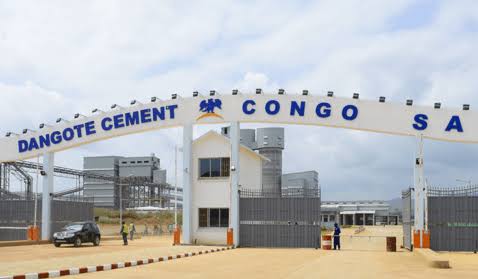
THE Dangote Group of Nigeria, one of the pre-eminent industrial conglomerates in Africa, in pursuit of its pan-African development and emancipation strategy, on November 23, 2017 formally launched its newest economic development industrial project, the Dangote Cement plant in Mfila, in Congo-Brazzaville. With this $300 million dollars, 1.5 million metric tonne per annum plant, the Group now has a presence in ten of the 17 countries in which it plans to construct and expand cement plans. While it had to re-calibrate the pace and timing of its earlier ambitious plans to complete its various planned plants at an earlier date, because of the economic down turn in Nigeria from 2014, the completion of the Congo plant indicates that the Group’s Pan-African cement plant’s expansion and new plants’ construction programme is still very much on course even though the pace of completion is now staggered over a longer time frame.
This new plant, as an industrial project will have direct and indirect benefits in Congo-Brazzaville that domestic resource-based industrial projects plants usually generate. It is expected to provide at least 1,000 direct jobs and numerous other employment opportunities that will be stimulated by its presence. For example other sectors that will be stimulated include the following: expansion of local civil and housing construction projects by state and private builders; expansion of cement block makers; the establishment of a transportation fleet for the distribution of the cement and the employment of drivers, conductors and mechanics for the trucks; the expanded use of fuel; the emergence of small and medium scale cement distributors and even big distribution companies and workers and new sale stores; banks, food suppliers and sellers of small dry goods and items. In short, the impact of this plant will be the progressive creation of new economic activities and employment opportunities. From these new economic activities the Congolese state, the local government and community authorities will derive Internally Generated Revenues (IGR) that did not previously exist.
The various speeches at the launching of the Congo-Brazzaville plant highlighted the economic development significance and prospective impact of this this massive industrial project. President Denis Sassou Nguesso of Congo-Brazzaville, noted that the plant was the biggest industrial plant in the country and the investment represented an industrial revolution within the regional group – Economic Community of Central African States. He noted that from their assessment of the impact of Dangote cement plants in other countries, they had always stimulated multiplier effects through the promotion of complementary and cognate industries and hoped that similar multiple direct and indirect effects will happen in the country. He also noted the timeliness of the take-off of the plant as a contributor to state revenues at a time when his government’s revenues had precipitously declined by 31.3 percent and oil sector revenues had also declined by 65.1 due to the fall in oil prices.
Clearly the Congo-Brazzaville government appreciates the investment, presence and impact of the Dangote cement plant.
In his own address, the Nigerian President Muhammadu Buhari, affirmed that Aliko Dangote and the Dangote Group by their pan-African investments had emerged as “worthy Ambassadors” of the country. He highlighted the various areas in which the Dangote Group had through its massive investments in the cement sector changed the course of Nigeria’s economic history. These include the provision of a key material for infrastructure development, the introduction of road construction with cement, the pursuit of expansion through backward integration and import substitution and the achievement of national self-sufficiency in cement availability and the contributions to savings of over $2 billion dollars annually from the termination of dependency through importation.
Aliko Dangote, President of the Dangote Group, in his address articulated the significance of the plant in terms of timely completion, its contribution of widespread availability of affordable cement, the plant’s contribution to the country’s expanded cement production capacity in excess of current demand and the consequence of reducing dependency on cement importation. He also noted that the plant will contribute to the country’s economic renaissance through foreign exchange conservation, employment generation, infrastructure expansion and multiple economic activities.
Dangote graciously and gratefully highlighted the strong and dedicated support provided by the government and people of Congo-Brazzaville from project’s conception to completion. Partly in pursuit of the Group’s philosophy and strategy of Corporate Social Responsibility, the Group was implementing several social projects including school construction, provision of scholarships, renovation of a hospital, road construction and bridge renovation. It also affirmed its company’s policy and commitment to give priority in employment to indigenes of the area of the plant’s location.
The various addresses highlighted the great economic impact of the Dangote’s chosen investments in cement production. But they did not often directly and fully underscore the actual primary sources of its revolutionary impact as a specific type of non-dependent industrial project with its inherent catalytic consequences. That is that they are resource-based industrial plants whose production are based on the exploitation and processing of a local resource. In short, the reasons for the great impact of these projects is that unlike the more common, attractive and lucrative arenas of foreign direct investment (FDI) such as extractive, wasting and non-development sectors like mineral and mining sectors and enclave assembly plant industries that are unconnected to the local economic environment, Dangote chose a different trajectory.
The Dangote Group’s choice of resource-based industrialization based on a comprehensive backward integration strategy as the primary pathway and its contribution to African self-actuated and self-directed economic development, prosperity generation, transformation and emancipation is developmentally apt, strategic and fecund.
This can best be understood within the perspective of Africa’s greatest failure in the post-independence era: economic development. This has been due to the failure to create and apply an autonomous economic philosophy and strategy of self-actuated development based on the well-established principles of endogenous technology capacitation and industrialization. On the contrary, African states and leaders at independence chose the maintenance of the inherited colonial economy, and in the neo-colonial framework of the times, the focus became the expansion of the production and export of raw materials: agricultural and mineral; the mass importation of consumer goods, intermediate goods and capital goods. This entailed the corresponding non-domestication of the historically established levers of development levers: the productive forces – technology and industrialization and equally importantly the ideological premise of development: the psychologically disposition, political will and activated self-agency for self-actuated and self-reliant development that is imperative to any successful development.
The result of this failure of the inherited and non-development neo-colonial economic system and strategy has been the condition of growth without development characterized by the persistence of underdevelopment, expanded dependency and poverty generation. The fact is that no African state since independence from the 1950s has been able to establish and sustain a philosophy, policy and strategy of self-actuated development and secure domestic prosperity generation.
This economic development failure was aggravated by the largely successful recolonization of African economic development objectives, policies, strategies and programmes in the 1980s through the acceptance, imposition and implementation of the Multilateral imperialist agencies – World Bank and International Monetary Fund(IMF) – non-development dogmas embodied in their Structural Adjustment Programmes (SAP) by the African leadership and states. Based on the unproven and unvarying dogmas called conditionalities: currency devaluation, trade liberalization, removal of subsidies, deregulation and privatization, they were not intended in any way to address the core causes of the balance of payments crisis of African economies of the late 1970s and early 1980s, that is African countries development incapacitation, raw material exports, dependency, mass importation, non-industrialization, under-production and poverty generation. It was the African leaders inability or unwillingness to identify and address these fundamental issues and their preference for pre-packaged supposedly neutral external “expert technical” solutions that led them as supplicants to these neo-imperialist agencies.
The substantive objective of these imperialist agencies was to forcefully return the incrementally economically self-directed African states back into the conditions economic colonialism with its exclusive focus on primary commodities (raw materials) production and export and dependency on importation of all manufactured goods. Furthermore, the World Bank and IMF also wanted to effect the removal of African states’ as promoters and activators of economic and social development especially freedom conferring industrialization through the cession of development responsibility by privatization to the undeveloped and dependent local capitalist groups; but more consequentially to foreigners through the fetish of foreign Direct Investments (FDI) as the new promoters of African “economic development”. But the FDI fetish is a dangerously misleading dogma of non-development: it misdirects, misrepresents and disarms societies and leaderships from ownership and responsibility for the philosophy, objectives, strategies for their own societies’ development.
The ability of external forces to inflict these damaging, disruptive and painful consequences of neo-colonial economic failure and their expression in persistent underdevelopment, dependency, underproduction, poverty, beggarliness, humiliation and indignity on Africans, has been possible due to active and direct complicity of much of African leaderships’ and elite who were successfully programmed to marginalize African agency and responsibility for its own development. These African elite enthroned and accepted foreign diktat, policies and programmes as inescapable for African development.
Yet this situation of the subservience and servility of the psychologically programmed African leadership, elite, intelligentsia has not been uniformly one-dimensional. Not all African leaderships, elite, intelligentsia, business people, bureaucrats and technocrats have supinely conceded to Africa’s surrender, submission and acquiescence to conditions permanent underdevelopment and cession of self-responsibility for development to others. Some among these were patriotic elite and leaderships who came to the ineluctable and correct conclusion that Africa can only enter into the state of freedom, dignified existence and a prosperous world by the pro-active choice and creation of its own philosophy and strategy of self-actuated development. This new development strategy will comprise the assumption of responsibility; the centrality of African agency; technological capacitation; modernization of all productive forces including agriculture and mineral production but above all the relentless pursuit of mass industrialization and mass production as the indisputable pathway and proven expressions of societal self-modernization in the contemporary world.
In the African business world today, it can be said without equivocation that Dangote and the Dangote Group has been and is in the vanguard of the promotion African self-development through resource based development capacitation; backward integration and genuine import substitution; radical reduction of import dependency for consumer goods and industrial inputs; mass industrialization, mass production and in-country and incontinent prosperity generation.
The expansive range of the industrial products of the Dangote Group beyond cement; and including food and agro industry: sugar, salt, tomato, rice, pasta, milk, flour; poly products and heavy industry like motor vehicles, coal mining and processing, refined petroleum, fertilizer and petrochemicals all attest to the promoter and Group’s understanding of the centrality of industrialization to genuine economic diversification and successful societal development and advancement.
The opening of the Congo cement plant within the Dangote Group’s pan-African industrial development strategy and its multiplier effects, creation of diverse employment opportunities and in-country prosperity generation, all attests to the Group’s contribution economic development and empowerment, and re-dignifying of Africans through the single-minded commitment to economic advancement through industrialization.
What is now required of African states, leaderships, technocratic and bureaucratic elite and business leaders and intelligentsia is following Dangote’s example, to prioritize technological capacitation and industrialization as the indisputable foundations and pathways for the project of Africa’s self-conceived, self-directed, self-funded and self-actuated and non-dependent programme of radical economic transformation and renaissance in the modern era. Only liberated African peoples, states and leaders can create this made in Africa – Africa by Africans for Africans and the world.
Ehiedu Iweriebor is a Professor, Department of Africana and Puerto Rican/Latino Studies, Hunter College, City University of New York, USA.
Related
Business
Sedabuk Oil and Gas Ranks Among Africa’s 100 Safest Companies
Published
2 months agoon
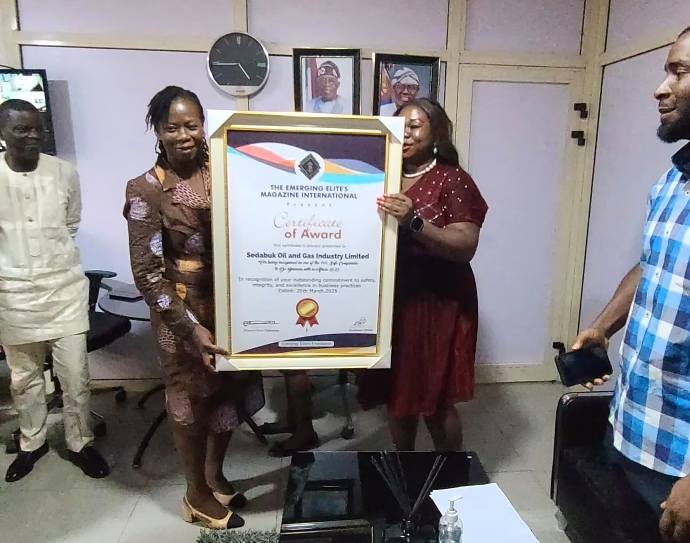
January 13, 2026Sedabuk Oil and Gas Industry Limited has been listed among the 100 Safe Companies to Do Business With in Africa for 2025 by Emerging Elites Magazine International, in recognition of the firm’s integrity-driven operations, strict compliance culture, and employee-focused policies.
The award was presented to the Managing Director of the company, Engr. Adunola Oseni, at a ceremony attended by members of Sedabuk’s management and staff, alongside the editorial board and team of Emerging Elites Magazine in Lagos.
Presenting the award, the Editor-in-Chief of Emerging Elites Magazine International, Princess Olivia Chukwuma, said Sedabuk emerged after a “thorough, transparent and merit-based selection process” designed to identify African businesses that exemplify excellence and ethical conduct.
According to her, the 100 Safe Companies to Do Business With in Africa Award is an international initiative created to recognise indigenous African companies with proven records of integrity, safety, and best business practices, noting that awardees are continuously monitored and recertified every three years if standards are sustained.
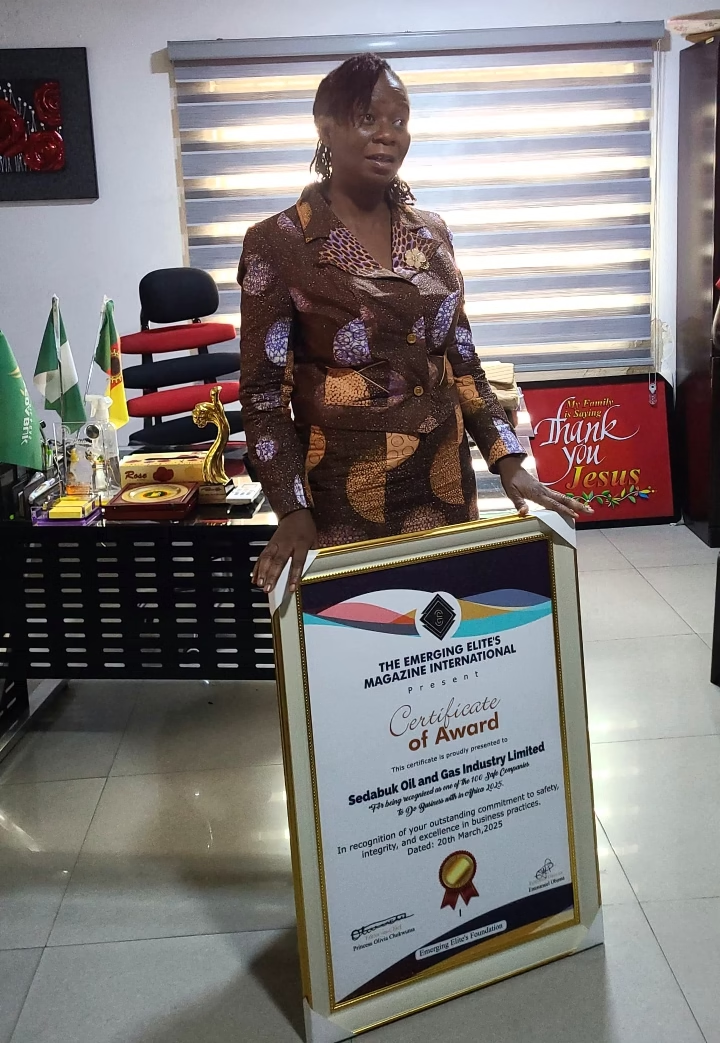
The MD of Sedabuk Oil and Gas Industry Limited, Engr. Adunola Oseni, poses with the Certificate of Award shortly after the company was recognised among Africa’s 100 safest companies to do business with.
Chukwuma said Sedabuk was selected for its employee-centric culture, stressing that the company has no record of unpaid salaries since inception, maintains fair wages, and prioritises staff welfare through initiatives such as its “One Nutritional Meal a Day” programme, which she described as “rare and commendable” in Nigeria’s oil and gas sector.
She also cited the firm’s zero-tolerance policy for fraud, recalling a June 2022 incident in which a pump attendant was sanctioned for under-dispensing fuel while affected customers were compensated, an action she said “clearly reflects Sedabuk’s philosophy of integrity in service delivery.”
Other factors that earned the company the award, she said, include its reputation for honouring contracts, absence of contract-related court cases, strict adherence to safety standards, and voluntary compliance with regulatory obligations, taxes, and statutory dues without coercion.
“With these attributes and more, Sedabuk Oil and Gas has become a beacon of hope—a new breed of Nigerian company that is trustworthy, valuable, and safe to do business with,” Chukwuma said, as she inducted the firm into the Hall of Fame of the 100 Businesses Safe to Do Business With in Africa 2025.
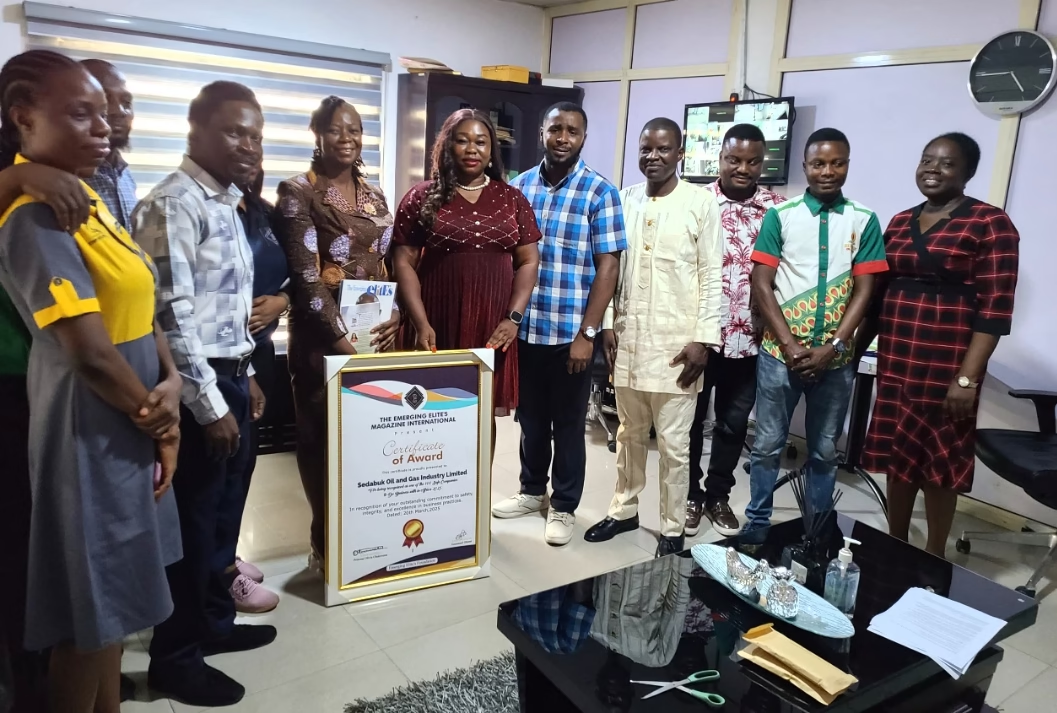
MD, Engr.Adunola Oseni and staff of Sedabuk Oil and Gas Industry Limited during the presentation of a Certificate of Award by The Emerging Elites Magazine International, honouring the company’s adherence to safety standards and best business practices.
Responding, the Managing Director, Engr. Adunola Oseni described the recognition as “a validation of our core values and a strong motivation to do more,” adding that the award belonged to the entire workforce of the company.
“We will continue to uphold integrity, safety, and transparency in all our operations, remain committed to staff welfare and regulatory compliance, and set standards that others in the industry can emulate,” the Sedabuk boss said.
Related
Business
Sedabuk Oil & Gas Rewards Staff with Over ₦10m, Deepens Welfare Culture
Published
2 months agoon
January 7, 2026
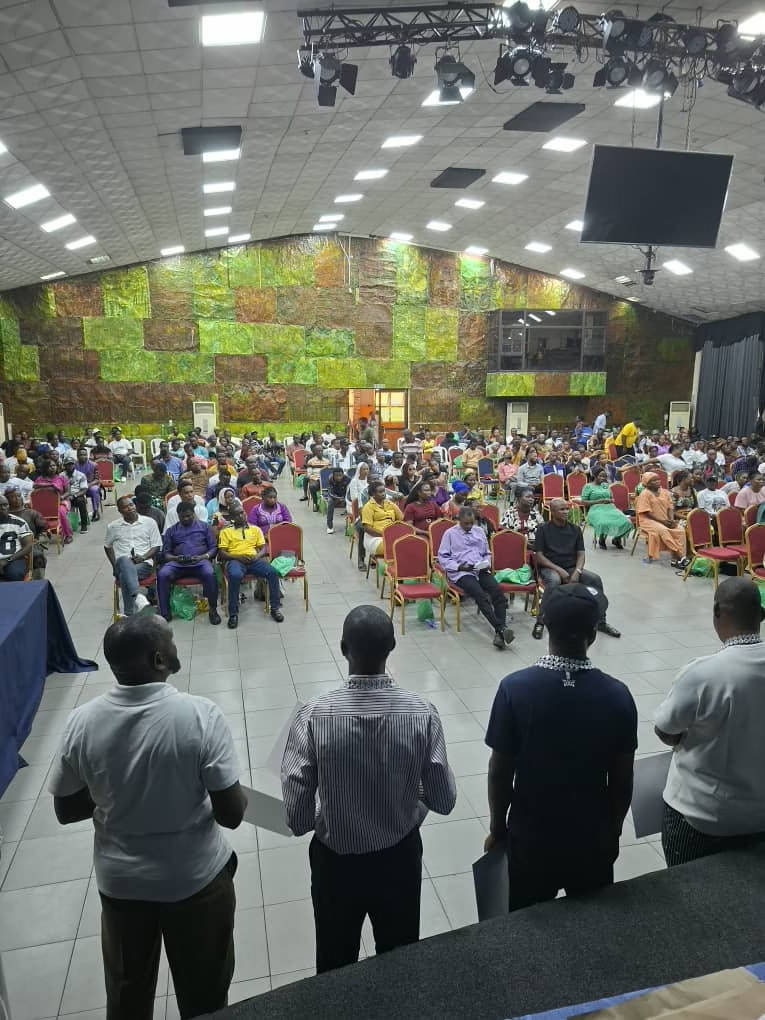
Sedabuk Oil and Gas Industry on Tuesday reinforced its reputation as a people-centred organisation as it rewarded outstanding employees with cash prizes totalling over ₦10 million at its 2025 Employee Recognition and Awards ceremony held in Lagos.
The event, which attracted over 300 staff members alongside top management officials from across the company’s divisions and subsidiaries, was organised to celebrate excellence, dedication, and loyalty within the Sedabuk workforce.
Speaking at the ceremony, the Managing Director, Engr. Adunola Oseni, described the occasion as one of the proudest moments in the company’s journey, noting that Sedabuk’s steady growth has been deliberately anchored on staff welfare and well-being. She said the company, from inception, made a firm commitment to put its people first, stressing that no organisation can truly thrive if its workforce is neglected.
![]()
Oseni disclosed that Sedabuk has never owed or delayed salaries since it commenced operations, describing prompt payment as a mark of respect and responsibility. She added that the company reviewed and increased salaries twice in 2025, improved wages across the board, and sustained its seven-year-old One-Day-Meal Programme to ensure employees do not work hungry.
The managing director announced cash awards spanning retail operations, station-based roles, marts, laundromats, and group-wide excellence categories, explaining that the initiative was not just about financial rewards but about recognising hard work and reinforcing a culture of appreciation. According to her, a loyal and motivated workforce remains the company’s most valuable asset.
She assured staff that management is entering 2026 with stronger welfare policies, better incentives, and more opportunities, with the aim of positioning Sedabuk as one of the best organisations to work in Nigeria. Oseni further urged employees to raise the bar in the coming year by working harder, smarter, and together.
Several employees emerged winners across key categories, including Pump Attendant of the Year, Station Captain of the Year, Mart and Laundromat Excellence Awards, and Special Recognition honours.
The highlight of the ceremony was the Group Chairman’s Spirit of Excellence Award, where Adediran Segun Aderonke emerged Sedabuk Star of the Year with a ₦2 million prize, while Ibiloye Olayinka won the Most Outstanding Employee of the Year award with ₦1 million.
In his remarks, the Group Head, Human Resources and Administration, Mr. Adeleye Olusanjo, lauded the managing director for her consistent leadership and unwavering commitment to staff welfare, assuring employees that more incentives and improved support structures are already being planned for 2026.
The event was attended by senior executives, including the General Manager, Finance and Strategy, Mr. Aderoju Sola; the Group Head, Operations and Logistics, Mr. Rufus Enioshunwa; and the Group Head, Corporate Audit, Risks and Ethics, Mrs. Tolulope Omotola, among others.
Established in 2018, Sedabuk Oil & Gas Industry Ltd operates over 12 petrol stations across Lagos, Ogun, and Oyo states.
Related
Business
SEC Flags Zugacoin, Samzuga GPT as Fraud Risks, Warns Nigerians
Published
9 months agoon
June 20, 2025By
adminThe Securities and Exchange Commission (SEC) has raised a red flag over two cryptocurrency products — Zugacoin and Samzuga GPT — warning the Nigerian public to steer clear of them.
In a strongly worded statement issued on Wednesday, the apex capital market regulator described the digital assets as unauthorised crypto schemes with no legal backing or regulatory approval in Nigeria.
According to the Commission, neither the promoters nor issuers of Zugacoin and Samzuga GPT are registered to operate in any capacity within the Nigerian capital market.
“Preliminary investigations revealed that Zugacoin and Samzuga GPT are meme coins,” the SEC said. “Meme coins generally have no use case, intrinsic value, or tangible projects backing them.”
The regulator added that the only perceived value of such coins often stems from aggressive promotion by their creators or community hype, making them prime candidates for “pump-and-dump” fraud — a deceptive scheme where promoters artificially inflate the price of a coin through misleading information before dumping it at peak value, leaving unsuspecting investors with massive losses.
“Once the promoters dump their coins and stop hyping the coin, the coin price typically falls and investors lose money,” the SEC warned.
The Commission urged members of the public to avoid engaging in the purchase or promotion of Zugacoin, Samzuga GPT, or any similar crypto assets, noting that anyone who chooses to invest in such schemes does so entirely at their own risk.
To further safeguard investors, the SEC advised the public to always verify the legitimacy of any virtual, crypto, or digital assets and their promoters through its official platforms:
https://home.sec.gov.ng/fintech-and-innovation-hub-finport/registered-fintech-operators/
www.sec.gov.ng/cmos
This warning is the latest in the SEC’s ongoing crackdown on fraudulent digital asset operations targeting unsuspecting Nigerians amid a rise in crypto-related scams.
Related
Advertisement
Entertainment
Adekunle Gold, Simi welcome twins
Ayefele drops new album, Reflections
Reggae Legend, Jimmy Cliff, Dies At 81
Photos: Davido blows $3.7m on lavish Miami white wedding for Chioma
FAAN probes K1 for spilling alcohol on airport officer during boarding
Odunlade Adekola loses father
MegaIcon Magazine Facebook Page
MEGAICON TV
Advertisement
Trending
-
Politics3 days agoIbarapa East Assembly Hopeful, Ramon Congratulates Ajiboye, Says Emergence Good for Oyo APC
-
Politics7 days agoMakinde: My Successor Must Be Loyal to Oyo, Not Me
-
Politics3 days ago2027: Former Oyo Deputy Governor Adeyemo Emerges APC Chairman (See Full List)
-
Politics7 days agoFintiri Dumps PDP for APC, Moves with Cabinet, 14 Adamawa Lawmakers